

Here’s what caught our attention over the last week:
Can beauty solve the housing crisis? - Alex Armlovich
Can cheaper inputs solve the housing crisis? - Alex Armlovich
How much of the housing crisis can we blame on endangered species? — Dylan Matthews
A new kind of problematic regulation — Willow Latham-Proenca
Cutting the Future STEM Workforce — Matt Clancy
It doesn’t take two trials — Saloni Dattani
What we talk about when we talk about institutional design — Jordan Dworkin
Can beauty solve the housing crisis? - Alex Armlovich
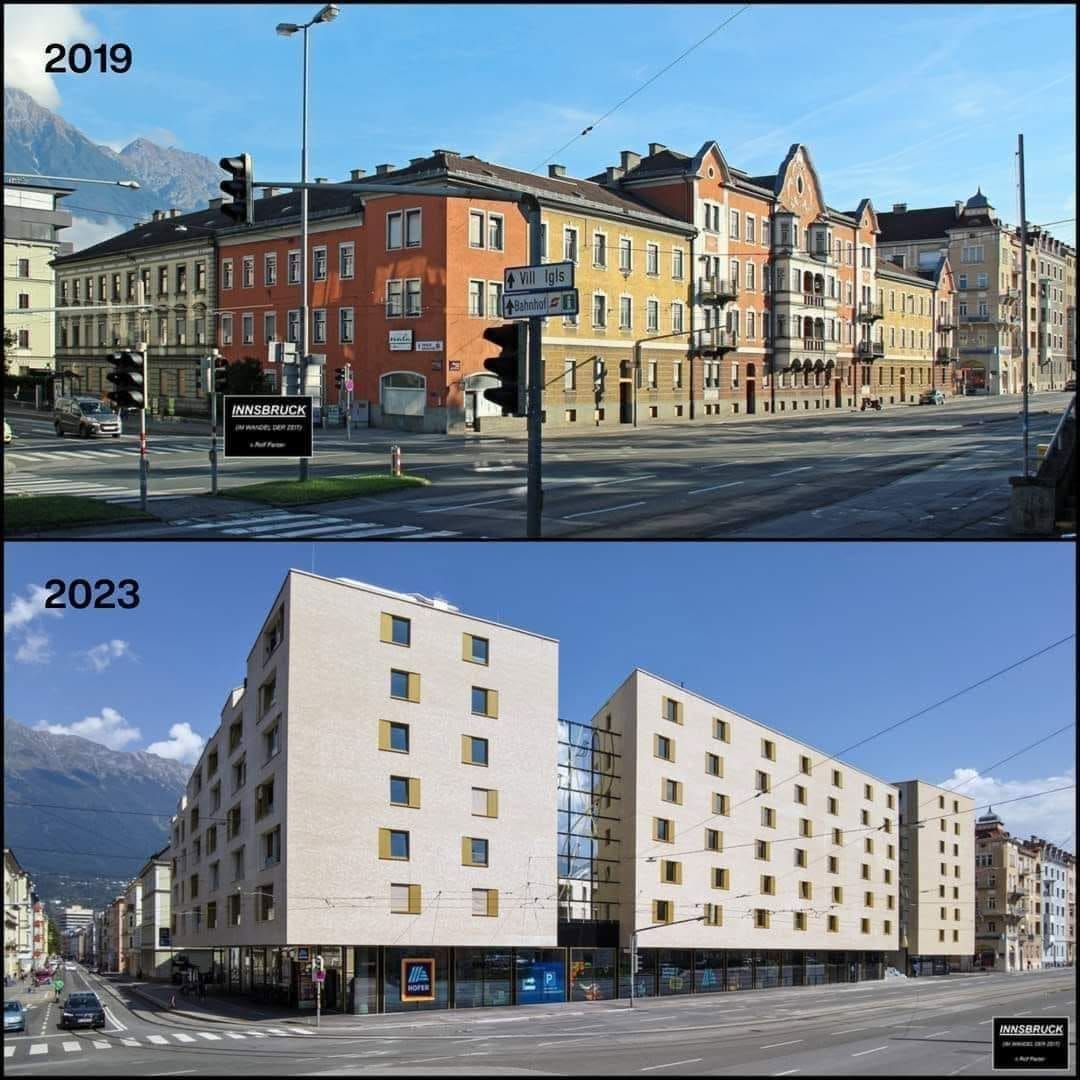
Samuel Hughes has a new Works in Progress essay asking again whether beauty can solve the housing crisis. He distinguishes NIMBYs (locals who oppose development of all kinds nearby) from NITBYs (”Not In That Backyard”): people who live nowhere near a project but casually oppose it because it looks ugly to them. Hughes argues that NIMBYism predates modernist architecture by a generation (first-wave restrictive zoning swept Europe and the US while new buildings were still classically ornamented), so beauty alone won’t dissolve local opposition. But the historical conservation movement, which froze European city centers and large swaths of American downtowns starting in the 1960s, could plausibly be a NITBY response to modernism: thousands of years of demolition-and-rebuild stopped almost overnight once the replacements got “ugly”. For infill development, it appears true that sometime after WWII, American city residents lost faith in the future of what their cities would look and feel like.
But competing stylized facts remain: cinderblock strip malls and vinyl-sided “mcmansion” sprawl continues to be the central feature of the most rapidly-building metros in the US (a sharp difference from the UK’s strict century-old ban on “ribbon development” sprawl). Beautiful projects like I’On in Charleston and the Duchy of Cornwall’s Faversham still get NIMBY’d to a standstill, and Robert AM Stern’s traditionalist neoclassical limestone revivals brought favorable reviews but few permitting wins. Finally: beyond the uncontroversial option of preapproved “pattern books”, nobody has an obvious policy lever to make new buildings beautiful at scale.
Can cheaper inputs solve the housing crisis? - Alex Armlovich

One of Brian Potter’s latest Construction Physics installments asks whether cheaper labor or materials can meaningfully cut housing costs: Looking at national average data in the US, he mostly answers no. Construction can’t chase cheap labor the way garment manufacturing did because most work happens on-site; modular builders that ship from low-cost locations (Idaho, even China) typically claim schedule certainty, not hard-cost savings.
From AGF’s perspective, however, it remains a puzzle how HUD Code manufactured homes have achieved huge hard cost savings over site-built homes, while modular construction has not done so. (Potter, too, has cited >50% lower costs per square foot for HUD Code manufactured homes). Some of the cost advantage for traditional HUD Code homes is related to entry-level finishing and materials: more upscale HUD Code CrossMods, built to middle class tastes and finishes, are “only” 20% to 30% cheaper per square foot than site-built homes. If multifamily modular could match the 20% savings of CrossMods, that would be a meaningful improvement. It may be unwise to expect miracles from multifamily modular policy or innovation, particularly in the national average data that covers wide swathes of the US where construction costs are already low, regardless of any code reform or innovation. But I also don’t think it’s crazy to explore whether some mix of code reform and innovation could help bring, say, NYC’s current Type I high-rise hard costs down closer to Chicago’s current Type I high-rise hard costs.
How much of the housing crisis can we blame on endangered species? — Dylan Matthews


You may have heard about the effects of the Endangered Species Act on big construction projects — like the famous case of the tiny “snail darter” fish and its role in delaying the Tellico Dam in Tennessee. But what about the effects on more everyday construction?
Harvard econ grad student Maxwell Tabarrok has a nice Journal of Public Economics article (official, free PDF, blog summary) estimating how housing permits change in areas that see a nearby species listed as endangered under the law. Listing of animal species leads to a large drop in permitting rates (0.5 permits per thousand residents, or 10 percent of an average area’s permitting rate); de-listing a previously endangered species leads to a similar-scale increase in permitting.
Tabarrok’s methodology is to treat each listing/delisting as a policy change and then do a “difference in differences” comparison of permitting rates in places that have the species nearby (the treatment group) and those that don’t (control group). This is about the best you can do in the absence of an actual experiment or some source of truly random variation in species listing, though it leaves some room to question whether the Endangered Species Act is causing this slowdown in permitting.
Tabarrok’s accompanying blog post suggests that the Trump administration’s new interpretation of the ESA could greatly weaken its effects on housing construction. Specifically, the Trump team is junking the current interpretation that includes damage to habitats as a form of harm to endangered species, and embracing a new interpretation where the law only applies to literally, directly killing or injuring animals. Under the now-final rule, set to take effect in September unless courts block it, the ESA would go from a law that bans construction that might harm endangered species to one that bans hunting and poaching endangered species. (The exception is projects on federal land or with a “federal nexus,” like the famous Tellico Dam.)
I like housing construction, but conserving endangered species is also valuable. Tabarrok has nicely illustrated the costs of the law, and I’d love to hear more about the benefits and how to balance the two optimally.
A new kind of problematic regulation — Willow Latham-Proenca
A forthcoming paper lends some structure to the intuition around regulated utilities (these are the vertically-integrated kind, with a local monopoly and their own generation facilities – they’re “regulated” because a state Public Utility Commissions, rather than the market, sets their rates). Gowrisankaran, Langer, and Reguant look to explain why coal has hung on so much longer in regulated markets than deregulated ones during the start of the natural gas boom – 26% of coal capacity in deregulated states was retired between 2006-2018, versus 17% in regulated areas.
They find that the standards Public Utility Commissions use to set rates are likely part of the explanation – to be included in a utility’s rate base (the pool of capital investments on which a utility can earn a rate of return), generation facilities must be “used and useful.” This creates a perverse incentive for utilities to keep expensive legacy facilities operating even if a cheaper option (in this case, natural gas) becomes available.
Interestingly, emissions don’t really factor into the decision over the long term; the authors find the cost advantage alone would be enough for a cost-minimizing utility to retire practically all coal generation over a 30-year horizon. However, the authors make an important caveat on reliability – reducing the rate base too far, without other compensation, could hamstring utilities’ ability to invest enough in the infrastructure that keeps the lights on.
Cutting the Future STEM Workforce — Matt Clancy
Last week, the Wall Street Journal reported that the Trump administration is considering implementing a $100,000 fee on international students who want to work in the United States after graduation via the optional practical training visa, one of the most common pathways to immigration to the United States. This policy, if implemented, would be the second recent blow to US legal high skilled immigration: earlier this month, the administration changed visa duration rules to add new burdens and uncertainty for international students. Previously, common student visas lasted for the duration of a course of study. Now the visas last up to a maximum of 4 years, with extensions possibly but uncertain and requiring application.
(The trouble is that four years is too short for a PhD. I did mine in five years, which put me on the fast end of my Economics PhD cohort, and the typical STEM PhD takes between 5 and 6 years.)
Collectively, these policies (along with the heightened uncertainty around funding for research) are likely to reduce high skilled immigration from international students. A new report from Amy Nice, Michael Clemons, and Jeremy Neufeld tries to quantify the size of the impact, looking at survey evidence and the historical share of the STEM workforce that follows affected pathways. They estimate that, if these policies had been in place for the twenty years between 2003 and 2023, the US STEM PhD workforce would be 11.5% smaller than it is today. That would mean lower US economic growth (and probably no significant benefits to native-born STEM workers; more here).
It doesn’t take two trials — Saloni Dattani
In June, the FDA issued new draft guidance stating that drug makers no longer needed to run two trials to demonstrate the efficacy of a new drug before it could be approved; rather, “one adequate and well-controlled clinical investigation with confirmatory evidence” could satisfy the evidentiary standard. It was a controversial move, although others pushed back saying the two trial guidance isn’t commonly followed in the first place and was an unnecessary burden.
In a recent post, the biostatistician Kaspar Rufibach shared a characteristically thoughtful take. When drug developers want to maximize their chances of succeeding in the second trial, they often try to design it identically. But, for a drug that “just” showed significance in the first trial, its chance of succeeding in a second, identical trial is just a coin toss: 50%. Better, he suggests, would be to run a single, larger trial, or run a second trial that’s different and gathers evidence for the drug’s effect on another disease, in another region, or a different route of administration, for example.
What we talk about when we talk about institutional design — Jordan Dworkin
If you’ve been following the conversation around the design of scientific institutions and funding strategies, you may have come across a table breaking down how different characteristics map onto different mechanisms.
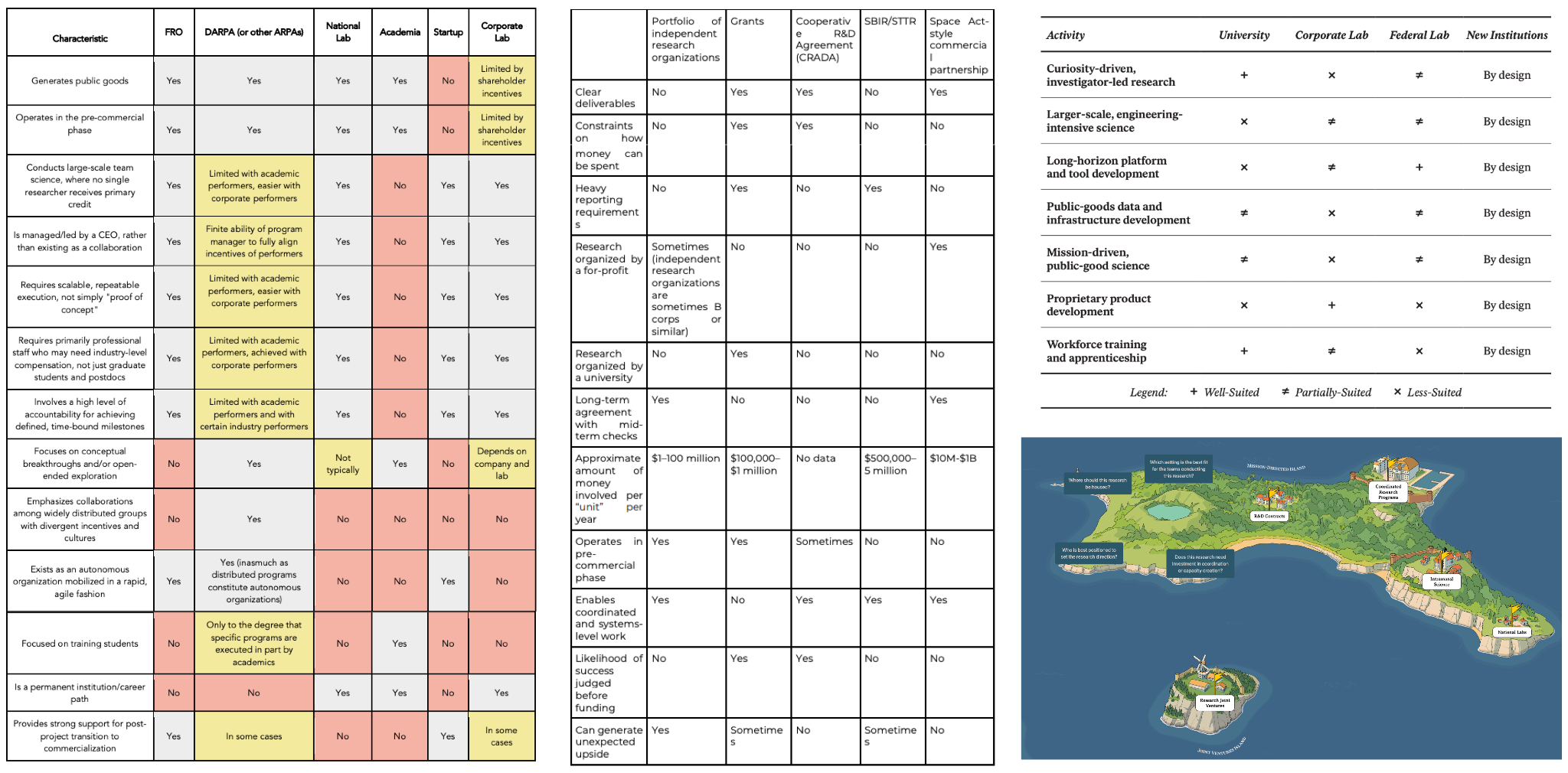
Last week Hiya Jain, Stuart Buck, and Aishwarya Khanduja published “A Taxonomy of R&D Orgs”, an excellent longform contribution to this tradition that distills the multidimensional differences between research organizations into nine key parameters: (1) optimal project timeline, (2) level of user input, (3) size of discretionary research budgets, (4) career incentives, attracting talent, and personnel models, (5) revenue strategy, (6) degree of focus on a single mission, (7) size of organization and/or research teams, (8) governance and project selection mechanisms, and (9) openness and IP strategy.
They go deep on each, exploring the range of possibilities and laying out case studies of institutions that sit at different points on the spectrum. It serves as both taxonomy and history (e.g. I did not know that staff scientist/engineer roles in part emerged as a result of early ARPA block grants to CMU, MIT, and Stanford), and will be a useful resource as the scientific ecosystem tests out a wide range of new (and old) models.
Here are a couple of highlights from our grantees and team:
1Day Sooner is still looking for a clinical trial abundance policy director
Saloni and Jacob Trefethen released a new episode of Hard Drugs on drug repurposing: Are miracle drugs hiding in plain sight?
Dylan Matthews wrote about our chance to fix the Jones Act
A paper about the Atlas of Innovation was published as an NBER Working Paper
I love these posts because I self-identify as someone tracking the hell out of this space - and yet I always manage to learn something new. Had never heard of the “used and useful” construction before, and it totally makes sense as a substantial inertia-vector of legacy electrons. Has the rationale underpinning that kind of guidance (not “guidance” but etc) been explicated anywhere? It’s kind of a fascinating provision.