

There are a lot of different ways you can use money to speed up innovation on a given problem. As a partial list, you could:
Ask researchers to propose research projects and fund the best ones
Hold a competition, and award a prize to the best submission
Hire a contract researcher to deliver the innovation you seek
Form a new research organization to work on the problem
Make an advance commitment to subsidize the purchase of the innovation
Make loans to organizations that work on the problem
How do you decide which way to commit funding?
There’s no simple heuristic for this problem. Economists have written a lot of papers that evaluate the empirical and theoretical case for different policies, but these are usually considered in isolation, as in, “how well does peer review predict the eventual scientific impact of a grant program” or “does an advance commitment to subsidize purchase of a new product lead to faster invention and uptake?” When papers do compare policies, they cover only a subset of the options. Over time, a literature has built up that covers a huge range of considerations and tradeoffs, but there is no overarching map of this territory to help decision-makers decide which policy to use. Yet, decisions need to be made, and in the absence of a decision framework, policymakers will use other considerations: familiarity, novelty, or idiosyncratic taste.
Over the past few years, I have been part of a team of economists and policy wonks developing a guide to this decision problem. This team was mostly drawn from the Institute for Progress (IFP) and the Market Shaping Accelerator. The result, which launched last week, is the Atlas of Innovation, an interactive web tool we made for policymakers to help them make sense of funding mechanisms for innovation.
Our most important goal was to come up with a decision framework that pointed policymakers towards the right policy tool. But given the complexity of the problem and the literature that has grown up around it, that meant the framework would end up convoluted and complicated. For example, the image below is an early iteration of our decision framework. But we wanted something a policymaker could use without deep economic expertise.
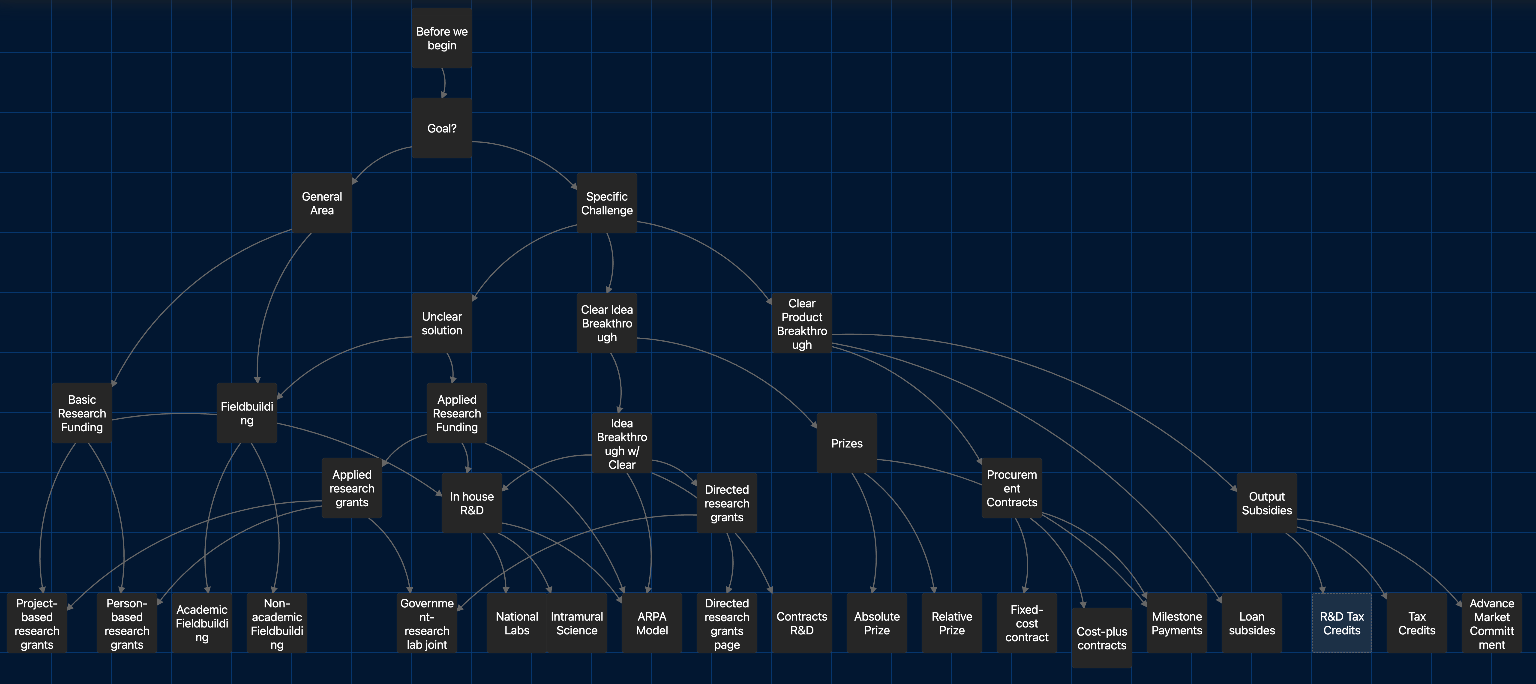
IFP co-founder Caleb Watney’s vision for an answer to this dilemma was an online tool, where policymakers could answer a series of questions about their innovation-related challenge and get pointed to a recommended policy. The (potentially) complex decision tree could live behind the scenes where it wasn’t necessary for anyone to engage with it.
For example: suppose you want to spur progress on a pan-coronavirus vaccine, which would protect against Covid-19 variants, but also MERS, SARS, and other coronaviruses. If you take this problem to the Atlas of Innovation, the first question you’ll be asked is “how precisely defined is your goal?”, with two options: “narrowly defined” or “broadly defined”, with some explanatory text to help decide which is a better fit.
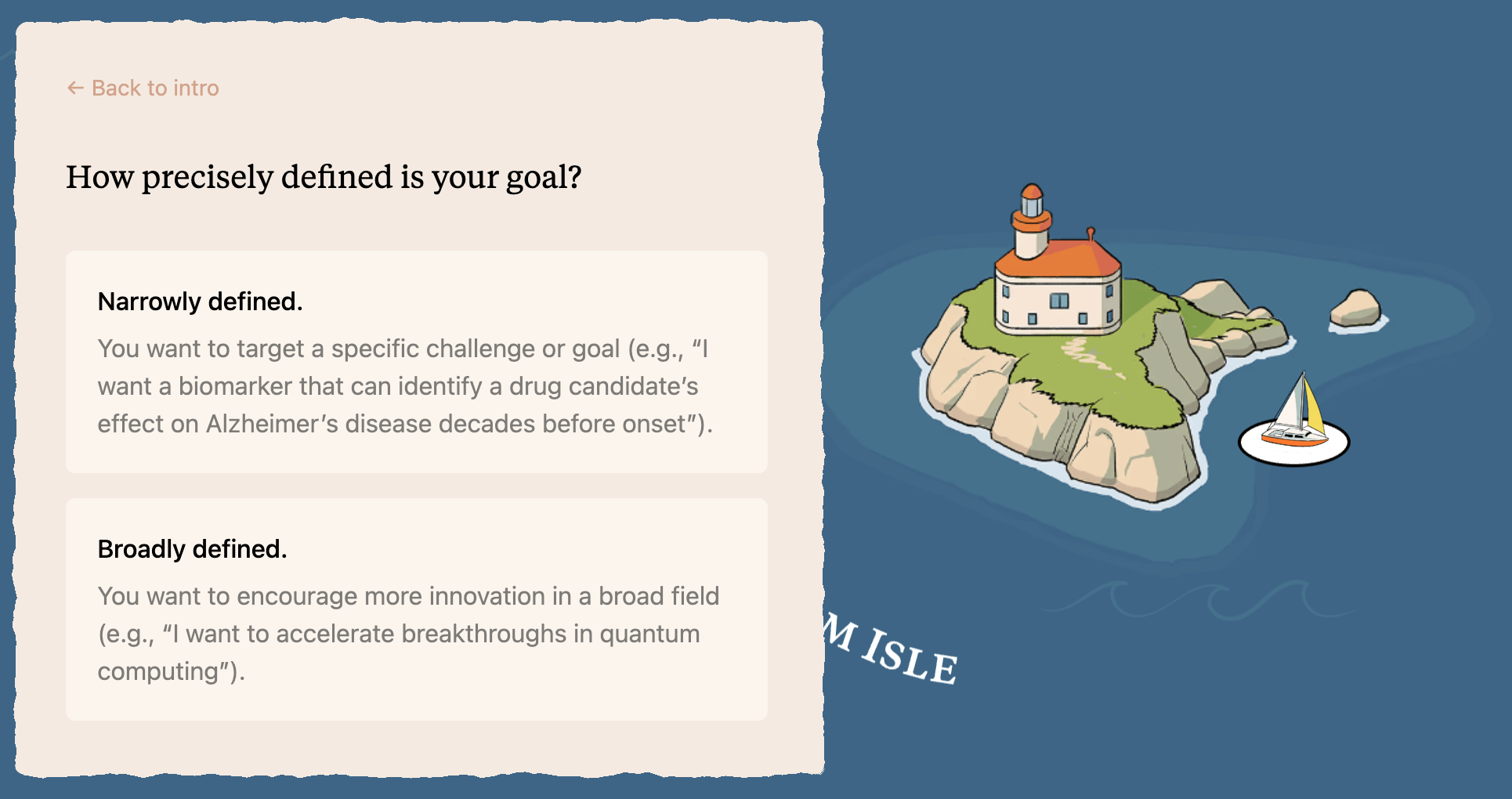
“Narrowly defined” is a better answer for a specific innovation target like a vaccine. If you can specify the goal you are trying to achieve, then that opens up a set of financing mechanisms that make payouts conditional on achieving some target, like advance market commitments, procurement contracts, or certain kinds of prizes. If not, you’ll be better served by financing mechanisms that defer goal setting to the research performers. Depending on the answer you give, the Atlas takes you to a new set of questions that help zero in on a good policy option.
After a series of questions, the Atlas recommends a specific policy. For example, for a pan-coronavirus vaccine, a plausible recommendation is an Advance Market Commitment. The landing page for each recommended policy explains the reasons we recommended this policy as a solution to the answers given. These landing pages also play a few other roles for us: they let us describe more of the evidence base related to a policy, to describe subvariants of the policy, point to other related policies (in case our recommendation didn’t quite hit the mark), and give examples and a bibliography.
You may have noticed the screenshots of the Atlas have a lot of imagery. To encourage people to actually use the thing, we wanted the experience of using the Atlas to be better than the experience of reading a White Paper. So, in addition to the metaphor of navigating through an archipelago, each landing page also has an illustration from R. Kikuo Johnson, which tries to capture the spirit of the policy tool in metaphor.
For example, R&D tax credits are relatively untargeted, and can incentivize lots of different kinds of firms to engage in lots of different kinds of R&D. That’s represented here as a wind that speeds lots of different kinds of sailboats. Meanwhile advance market commitment creates a market for a new product to serve, if it can be invented. That’s represented here as building a town, to entice the railroad to extend a line out to that area.

The result lives at AtlasOfInnovation.org. Check it out, or check out the accompanying paper which describes our decision framework (presented at the 2026 NBER Entrepreneurship and Innovation Policy and the Economy Conference and forthcoming in the accompanying volume).
But I hope this isn’t the end of the story.
To start, one thing I came away from this experience with was a sense of just how uneven the scholarship is across these different policy tools, at least, as applied to the problem of fostering innovation. One hope is that the Atlas can help illuminate these gaps, fostering new research. Second, while we put a lot of work into this decision framework, it is still only a first attempt. We hope now that there is one attempt out there, researchers and policymakers can critique it, study its implications, and help come up with something better. Third and finally, for this version of the Atlas, we opted to focus on ways the government (or other funders) can spend money to pursue an innovation target. But there are a range of other policy options governments have to accelerate innovation: immigration, education, intellectual property rights, regulation, standards, and so on. I hope there will be future versions of the Atlas that can draw on richer evidence, reflect improved understanding of the decision framework, and incorporate policies beyond funding mechanisms.
But for now, I’m happy that Version 1.0 is out there.
To close, I want to thank all the people involved in the project, and for letting me contribute to it. Special thanks to IFP’s Matthew Esche and Caleb Watney who led the overall project. Less special thanks to my collaborators Sarrin Chethik, Claire McMahon, Siddhartha Haria, Christopher Snyder, and Heidi Williams. Thanks to Beez Africa for creative direction, Emma Steinhobel for design, joodaloop for web development and design, and Ben Murphy for web technical direction. Thanks also to Eamonn Ives, Hewson Duffy, Joseph Fridman, and Santi Ruiz for all their work editing this into something that non-economists would want to read. And finally, thanks to the large number of policy and economics experts who gave us detailed feedback on this project (see the full list here).
This is incredibly cool, love the use of illustrations and story telling (more policy papers should follow suit!).
The option to double click on questions (eg with follow up questions, or examples / case studies) to guide users when unsure would be helpful. For example: “Who is best positioned to set the research direction?” - a tricky question when your goal is broadly defined.