



Here in the US, at least one 2026 policy change has been a clear winner for economic growth. Starting on March 17, 2026, the Trump administration has waived the Jones Act, America’s cabotage law barring non-US built vessels from conducting trade between US ports, for certain oil, gas, and fertilizer shipments. The waiver was extended in April; it’s currently set to expire on August 16.
This move shouldn’t have been overly surprising. Kevin Hassett, Trump’s Council of Economic Advisers director in his first term and National Economic Council head today, is a vocal Jones Act detractor, and wrote in a 2021 book that Trump hates the law too (“This Jones Act, it doesn’t make any sense,” he quotes the president saying). Casey Mulligan, another economist who served during Trump I and is now chief economist at the Department of Health and Human Services, reported the same in his memoir You’re Hired!: “President Trump hates the Jones Act. It is the type of harmful regulation that he has succeeded in ending in health insurance, telecommunications, farming, and many other industries.”
Of course, Trump World contains multitudes and other advisers (notably Peter Navarro, Trump’s “senior counselor for trade and manufacturing”) are vocal Jones Act defenders. Mulligan and Hassett, in their books, recall being defeated by Navarro and allies in Congress in term one when they fought for a Jones Act waiver for liquid natural gas. But that a waiver actually went through this year, and has continued to be renewed, suggests the law’s critics are winning the intra-administration fight this time around.
This makes 2026 perhaps the single most promising moment for meaningful Jones Act reform in decades. Durable reform, though, has to go through Congress, and will have to be bipartisan. It will also have to grapple seriously with what transitioning to a new regime looks like.
The case against cabotage
Defenders of the Jones Act like to call it “America’s oldest law,” noting that rules limiting which ships could use US ports are as old as the first Congress. But the “Jones Act” generally refers to section 27 of the Merchant Marine Act of 1920, a provision authored by a Seattle shipping lobbyist and added to the law by Washington Senator Wesley Jones. This is still the most important single statute regulating shipments between US ports.
As it exists today, the law requires that ships be…
Captained by a US citizen, with all US citizen officers, and US citizens making up at least 75 percent of the rest of the crew
If owned by a corporation, owned by a corporation with at least 75 percent US citizen ownership
Assembled in the US, with the “major components” of their hull, main deck, and other “superstructure” all built in the US
Cabotage laws like this are common internationally, but they often only restrict trade to vessels flagged in the country in question, or owned by nationals of that country, or crewed by staff in that country. The Jones Act is unusual in requiring that ships moving between US ports be built in the US. Most other countries with large cabotage trade, like China, Japan, and India, don’t require domestically-built vessels, despite the former two having massive shipbuilding industries much more successful than that of the US. As a result, only the 92 Jones Act-compliant US-built ships currently in operation can move between US ports when the Act is in effect.
The economic case against the Jones Act is simple: there are many useful trips to be taken by ships within the United States; the Jones Act, plus the tiny size of the Jones-compliant fleet, means many trips are not taken when the Act is in operation; allowing those trips to take place represents new, beneficial economic activity that we’re currently blocking.
Perhaps the best examples of these Jones-prevented trips are the ones happening right now, under the waiver. The Cato Institute has been tracking waiver-enabled voyages, and there have been 195 to date as of this writing, on 161 different vessels, shipping some 50 million barrels of various fuels and fertilizers (most of the volume is gasoline and crude oil). Those 161 vessels represent a more-than-doubling of the US cabotage fleet, relative to the Jones Act’s 93:
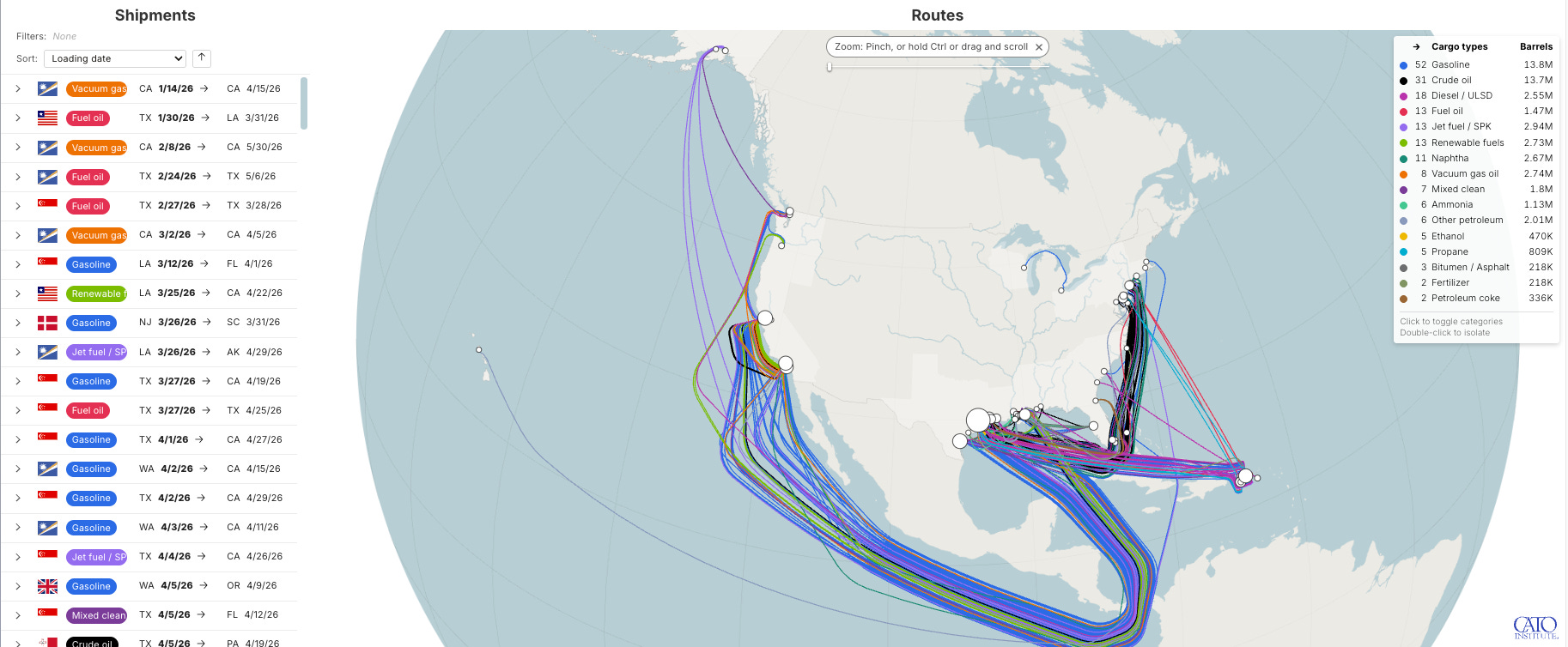
As you can see from their maps, these journeys typically originate in the Gulf Coast, the center of US oil refining and export, and then make their way either to the northeast US, to Puerto Rico, or to the West Coast via the Panama Canal.
If you’re not especially interested in boosting oil shipments for climate reasons, don’t worry: the Jones Act is harming your priorities as well. A major effect of the Jones Act is to transfer goods from freight ships to freight trucks, which produce vastly more carbon emissions per ton-mile traveled than ships.
The Jones Act is also a major factor behind the stagnation of the US offshore wind industry. Installing a wind turbine in the ocean requires specialized ships called wind turbine installation vessels (WTIVs). Until March of this year, there were literally zero WTIVs built in the US. That meant that installation required sailing WTIVs from ports in Canada to as far as Virginia with turbine components, because foreign-built ships couldn’t be based in the US and do US port-to-port hops. As of March, there’s exactly one Jones Act-compliant WTIV, first installing turbines years behind schedule and far over budget, and we need at least four WTIVs to meet the Biden administration’s old offshore wind targets.
More formal modeling gives us some sense of the magnitude of the economic harms from the Jones Act. A 2019 paper from the OECD’s Karin Gourdon and Joaquim J. M. Guilhoto conducted a simulation estimating the economic costs of the Jones Act and an analogous domestic-content rule in Brazil. They suggest that total US economic output will grow by between 0.1 and 0.4 percent annually. That’s between $31.8 billion and $127.4 billion a year, per the most recent GDP numbers.
Here at Coefficient Giving, we often evaluate grant opportunities by estimating their impact in “Coefficient Giving dollars,” which we define as “the amount of welfare generated by a $1 gift to someone with an annual income of $50k,” roughly the US GDP per-capita when we started this framework. More precisely:
CG $v = $50k * w * ln(1+z%) * y.
Where v is the value of an intervention, w is the number of people affected, z is the percentage change in the income of the people affected, and y is the number of years they’re affected. The math is less important than the overall idea: we place a great deal of value on increasing people’s incomes, with longer-lasting changes affecting more people being worth more.
Jones Act repeal looks very, very good under this framework. Suppose we take the low-end figure from the OECD researchers (0.1 percent added to annual output); that’s z. Imagine for the sake of argument that we have a grant opportunity that has a 1 percent chance of leading to the US repealing the Jones Act ten years earlier (y = 10) than would otherwise happen. The US has 340 million people or so (w = 340 million). Do the math and you get about CG$170 billion in impact. Right now, our Global Health and Wellbeing teams have a 1000x bar for grants: they have to produce CG$1000 for every US$1 we spend. That implies we’d spend $1.7 million to generate a 1 percent chance that the Jones Act gets repealed ten years early, before even considering other factors like environmental benefits.
Obviously, no one can guarantee an advocacy campaign will even be that effective, and the nature of advocacy is that most people you fund have a low, sometimes under a percentage point odds of success. But when the value is this high, it’s still worth funding longshots. And with a Jones Act waiver currently in effect, serious reform looks like less of a longshot.
We need bipartisanship and creative thinking
The battle lines around the Jones Act are very familiar at this point. On one side are the US ship-building companies and allied unions, organized as the American Maritime Partnership, which push very hard against any weakening of the law. On the other side are anti-protectionist groups like Americans for Prosperity and the Cato Institute, the latter of which has done yeoman’s work documenting the law’s harms.
My sympathies are more with the latter, but the current ecosystem could use shaking up. For one thing, there are strong reasons for Democrats, both moderate and left-wing, to oppose the Jones Act. Behind its huge environmental costs, it particularly raises costs for consumers in Hawaii and Puerto Rico, which are entirely dependent on shipping for most goods but are forced to use the small Jones Act fleet for shipments from the US mainland.
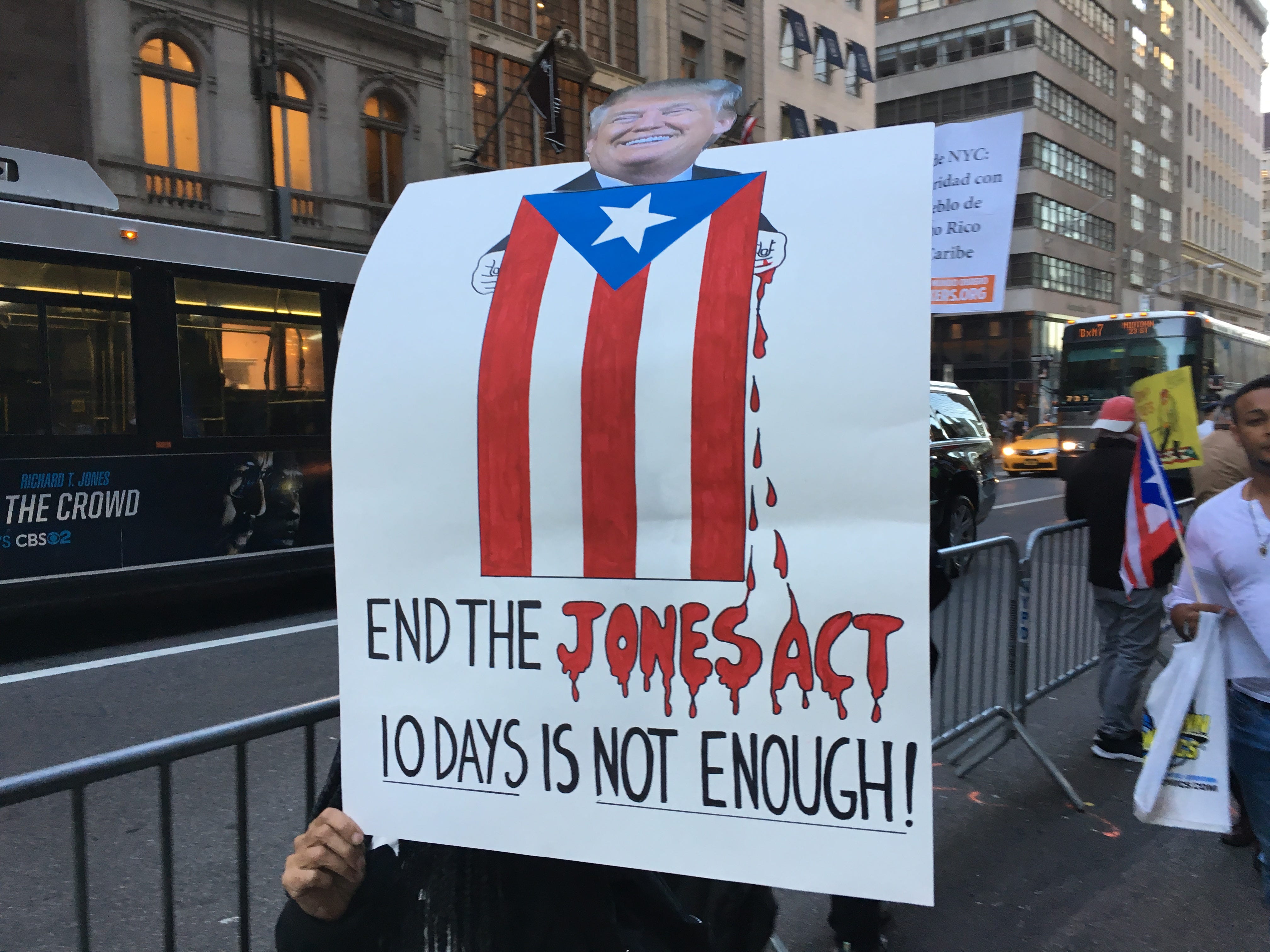

As a result, there’s a reasonably large group of Democratic Jones Act critics in Congress, largely consisting of members with Puerto Rican ancestry. Alexandria Ocasio-Cortez (D-NY) is a vocal critic, having tweeted even before she entered Congress, “Congress must repeal the law that cements PR’s status as 2nd class citizens.” Nellie Pou (D-NJ) repeatedly urged repeal during her time in New Jersey’s state legislature. Ritchie Torres (D-NY) has proposed legislation exempting Hawaii, Alaska, Puerto Rico, and Guam from Jones Act requirements, just as the US Virgin Islands is currently exempt. While most of Hawaii’s Congressional delegation has sided with the shipbuilders over consumers and backed the Jones Act, Ed Case (D-HI) has been a welcome exception in supporting the waiver this year and urging permanent reform.
Conversely, there are Republicans like current House Speaker Mike Johnson who are vocal fans of the act. The Jones Act isn’t an obviously partisan issue, which is good: it means there could be bipartisan support for reforms, which is helpful even under unified government — but will be essential if, as expected, Democrats take the House this fall.
Realistically, any progress will involve real compromise. There aren’t the votes for an outright repeal of the Jones Act, and there are not likely to be the votes any time soon. There might be votes, though, for smaller measures:
An exemption for Puerto Rico, Hawaii, Alaska, Guam, and Northeast states reliant on heating oil, or perhaps just one of that set
Repealing the build requirement of the act but not the crewing requirements, so that labor unions representing US seafarers continue to benefit, and perhaps even gain as the new foreign-built ships hire their members
Pairing adjustments to the act with buyout offers to current US-based shipbuilders, so those affected have resources to choose a new career path and the transition is truly win-win
Pairing changes to the act with subsidies to US-based shipbuilders akin to those in the SHIPS for America Act, so US firms face more competition but also have more resources with which to face it
None of these are my first choice of policy regime, and I don’t suspect any of them are the first choice for any player in this debate. But the current Jones Act waiver makes compromises like these uniquely possible. Will pro-Jones Act members of Congress choose any of these over an in-effect Jones Act? Of course not. Might they be willing to budge if it means an indefinite Jones Act waiver comes to an end and they get at least some of the law back? Potentially.
Right now there simply aren’t many groups trying to work through what a good compromise could look like. If you are a think tank, advocacy group, or independent policy researcher interested in this area and crafting a compromise that reduces the Jones Act’s harms while providing some kind of win to its promoters, please get in touch. The waiver means the time for action is now.
Where does “securing another deferral of the Jones Act” rank in proportion to overall repeal? It feels like there are multiple >>1% scenarios in which this happens, each of which eventual repeal gets much more likely. Might that be the lever to focus on?
I’ve talked with a few people inside and outside the administration about this topic, it seems like an issue that clashes heavily with military ambitions to revitalize the American shipbuilding industry in anticipation of conflicts in the pacific. Matching China’s pacing threat may outweigh the economic and environmental benefits of Jones Act repeal. On its face, one could easily see a bi-partisan coalition coming together to support these reforms and running headfirst into the demands the military industrial base is trying to meet.