

This post is a report on the steps forward and backward for Abundance and Growth that happened between July and September 2026. It’s meant to be a report on the overall abundance and progress movement, not just the activities of our grantees, though many of our grantees did work on the following. This post focuses on updates in the five policy verticals the Abundance and Growth Fund works on: energy, housing, innovation, clinical trials, and state capacity. Our previous quarterly progress report is available here.
This update is a team effort: special thanks to folks at Welcoming Neighbors Network, the Institute for Progress, CleanEcon, Recoding America, 1DaySooner, the Abundance Network, Roots of Progress, and the Abundance and Growth Fund team for their useful input.
Energy
The big news is BAAJA, the Bipartisan American Affordability and Jobs Act (not to be confused with the beverage). Over much of 2026, Senators Capito, Lee, Whitehouse, and Heinrich have been hammering out the details of a major federal permitting reform proposal, whose text was released on the last day of the quarter. BAAJA contains many of the elements abundance organizations have been advocating for, for the better part of a year: reforms that tilt judicial review towards substance and away from procedure; shorter deadlines for review; clarity around how new transmission infrastructure will be paid for; and much more. See Willow’s roundup of commentary on the bill’s many different provisions (it comes in at 417 pages). If passed, it would be the most substantive energy legislation in decades and would mark a dramatic step forward for the US ability to quickly build new energy infrastructure. Passage, alas, is far from guaranteed, but we’ll very likely know the ultimate fate of the bill in the next quarterly progress report.
Beyond BAAJA, there have been a cluster of policy wins related to advancing new kinds of energy. With respect to fusion technology, House Democrat Zoe Lofgren and Republican Jay Obernolte proposed the $10bn American Leadership in Fusion Act in September. For geothermal, in September, DOE selected 21 geothermal projects for up to $99 million in funding. And California passed a bill that legalizes plug-in solar panels, with no permit required. Meanwhile, across technologies, DOE signed a memorandum with the Small Business Administration to direct its Small Business Investment Company program towards DOE priority technologies, and also announced an agreement with the Foundation for Energy Security and Innovation to provide support for SBIR and STTR awardees after their awards.
Finally, in September, Emerald AI, Google, and NVIDIA, with major utilities as launch partners, founded the AI Energy Management Alliance, a coalition focused on unlocking grid capacity through faster policy and regulatory change.
Housing
The big news in Q2 was the passage of the ROAD to Housing act in the House. The bill subsequently went into law in Q3. Attention is now shifting to implementation, and the National Association of Affordable Housing Lenders and the Institute for Progress both released guides for implementation.
Meanwhile there has been plenty of action in the states. Perhaps most significantly, California’s SB79, which passed last September began to be enforced on July 1. Concretely that means developers can begin submitting proposals under the law’s provision, which California YIMBY estimates has already led to proposals for several hundred new homes across Palo Alto, San Mateo, Atherton, South Pasadena, and Santa Monica. At the same time, several major cities (San Diego, Los Angeles, and San Francisco) are complying in ways that reduce and delay its impact (more from California YIMBY here), though we think the effects of passage are still positive for supply.
Other notable local policy changes:
North Carolina passed S.445, a large, end-of-session omnibus that contains several major pro-housing policies that facilitate more accessory dwelling units, homes near jobs, and manufactured housing.
Michigan passed single-stair reform, making it easier to build apartment buildings.
Asheville, North Carolina passed zoning changes to expand options for duplexes and accessory dwelling units.
The City of Columbus released a draft of the next phase of its “Zone In” project, poised to unlock tens of thousands of new homes.
Innovation
This quarter on innovation, there was a lot to be worried about, as well as some reason for excitement.
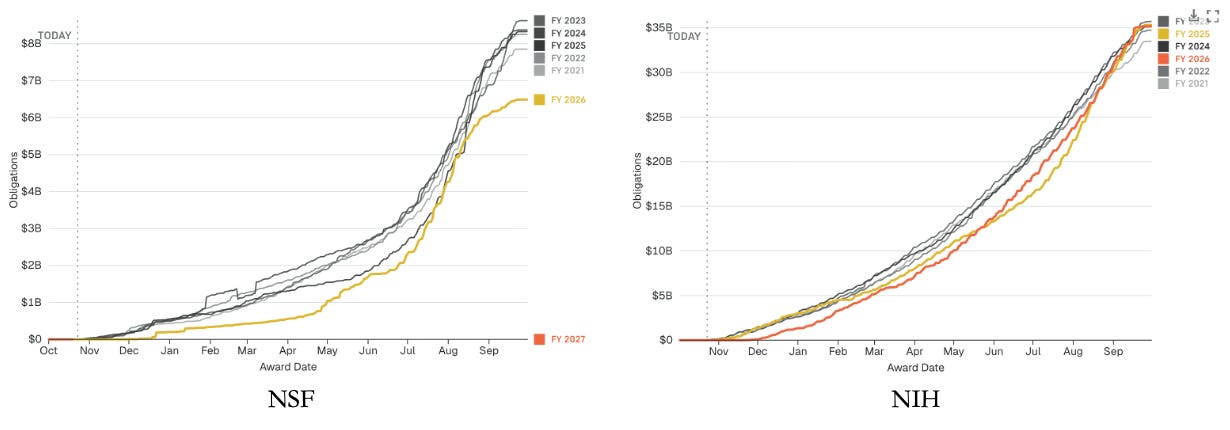
With Q3 marking the end of the fiscal year, let’s start with a look at how federal funding for R&D went in FY2026. According to GrantWitness, the National Science Foundation obligated only $6.5bn in FY2026, down substantially from $8.3bn in FY2025 and $8.4bn in FY2024, and far less than what congress appropriated. NSF generally has two years to spend appropriated money, so there is still an opportunity for NSF to catch up next year, but the trend is worrying. Things look better at the NIH, where the agency obligated $35.2bn, the same level disbursed in the last two years. However, NIH achieved this goal with substantially fewer awards - 61,044, more than 10% down from two years ago. That reflects, in part, an increased use of forward funding, wherein current year funds are obligated towards funding a grant in future years. This can lead to a de-facto decline in funded research for the current year.
There were also signs of experimentation in how R&D funding is spent. In July, NSF and Astera announced roughly $400 million for a national network of programmable cloud laboratories. In August, NSF released 12 funding opportunities covering over $1.5 billion, incorporating longer awards and rapid grants. In September, it opened an X-Labs funding opportunity for AI for physical systems.
Turning to federal policy affecting the supply of innovation talent, it’s been a worrying quarter for high skilled immigration. US Citizenship and Immigration Services proposed (but has not yet implemented) a new $100,000 fee on H-1B visas (actually, $103,265). Unlike last year’s $100,000 fee, this one would apply to applicants based in the United States, such as graduating students looking to transfer to employment. The Department of Homeland Security also proposed eliminating the 60-day grace period that H-1B holders currently enjoy to find new qualifying employment upon job loss. While neither policy has been implemented, they would collectively reduce the attractiveness of working in the United States and a big question is whether the decline in demand among cap-eligible orgs would fall below the 85,000 cap (the fee does not apply to cap-exempt organizations). IFP has an FAQ on the policy, and argues that most analyses say this would in fact be the case. Meanwhile, EIG has written a letter to US Citizenship and Immigration Services arguing the proposed fee would tilt the population of visa-holders towards workers who are underpaid.
The Department of Homeland Security also finalized a new duration of status rule in July, which would require international students on F-1 and J-1 visas to complete their studies in 4 years (too short for the median PhD student), or else apply for an extension. This rule was blocked by an injunction in September, but is under appeal.
On a more positive note, in July, the White House released Science: A New Golden Age, endorsing metascience units, new research institutions, and experimentation with science-funding mechanisms. On September 10, NSF announced it would be launching a metascience unit, to be housed in the office of the director. As the announcement states:
The [Office of Metascience] will develop and rigorously evaluate new approaches to funding, merit review, program management, and the adoption of emerging tools. It will identify what practices produce better outcomes, scale what works, and discontinue what does not. The OMS will be staffed by metascience experts and data scientists who will build the data infrastructure needed to evaluate outcomes and will work closely with the wider leadership team to ensure its recommendations are rapidly and thoughtfully implemented throughout the agency.
Lastly, on September 14 Senators Hickenlooper and McCormick launched the Bipartisan Senate Science and Innovation Caucus, which will provide a venue for discourse about new legislation to boost American scientific research and our STEM workforce.
Clinical Trials
As Saloni detailed on our blog, there is some exciting momentum on clinical trials abundance. In September, ARPA-H announced four related efforts to develop tools and infrastructure to speed up trials. ARPA-H Director Alicia Jackson described them as “probably the largest suite of investments that we’ve made in a singular area”. They include the programs:
SURPASS, which aims to build ‘phaseless designs’ to run trials faster. It involves funding for innovative trials that use shared infrastructure and adaptive designs, in three areas: computer simulations, statistical methods, and AI tools.
STACK, which would help more clinics in the US become trial sites, including those that lack research experience.
COMMONS, to build the data plumbing for trials: nationwide consent infrastructure and access to regulatory-grade patient data, so trials can find eligible participants faster and feed predictive models.
CINCH, focused on adults with cancer, to help them understand their options and potentially contribute their data or find clinical trials to participate in.
Also in September, the OpenAI Foundation announced support for CTD Commons, which aims to publish regulatory records from failed or shelved drug programs. This is related to an idea Ruxandra Teslo wrote about last year for IFP’s launch sequence. Ruxandra Teslo’s New York Times essay this quarter also brought national attention to barriers keeping promising drugs out of trials.
Meanwhile, something we missed in the Q226 update: in the 2027 appropriations, the Agriculture, Rural Development, Food and Drug Administration, and Related Agencies committee provided a variety of guidance language to the FDA that would also accelerate trials if implemented. To start, it encouraged the FDA to develop guidance to facilitate greater use of “real world data” and “real world evidence”, both of which involve making approval decisions more on the basis of data on use of the drug, rather than clinical trials. More pointedly, it also directed FDA to revise its process of approving phase I clinical trials to make them more in line with the speedy Australian system (see this IFP primer from Ruxandra Teslo and Adam Kroetsch for more information). Relatedly, on September 15, FDA launched its Expedited IND Pilot Program to help sponsors start first-in-human trials faster through research-institution partnerships and rolling review. The committee also encouraged FDA to assess how to use AI to accelerate its own processes. Finally, the Operation TrialBlazer roadmap, which Saloni also wrote about here, reported that they’re considering rule-making so one ethics board would review a study for all participating clinical trial sites rather than each site conducting its own separate review.
State Capacity
While the federal government is the focus of debate, a large share of government functions are actually performed by the states (a discrepancy noted by Daniel Stid late last year). So it’s quite encouraging to see a number of states implement state capacity reforms.
In July of this year, North Carolina passed the Public Workforce Modernization Act. Prior to the new bill, finding new public sector job opportunities in North Carolina was byzantine, giving calibrated feedback to workers wasn’t happening, retaining high performers with pay increases was challenging, and letting go of poor performers was extremely protracted and difficult. The Act streamlines much of this process, and introduces a lot of new innovations to help recruit, retain, and effectively manage civil service talent: a track to more easily make temporary workers permanent, a pilot testing upward feedback (where reports rate the performance of their managers), and setting in motion a review of the underlying classification and compensation system. Jen Pahlka discussed the bill in more detail here.
In August, California Assembly Speaker Robert Rivas released the results of an interesting new process called Outcomes Reviews; an update on a similar program in Oregon happened in September. Outcome Reviews is a structured program where legislators can nominate a bill they championed for an outcomes review, which sets into motion an investigation to assess how well the law achieved its outcomes. In California, the reviews found that some laws basically worked as intended, while others needed followup legislation to clean up gaps in the legislation that led to an implementation failure. The important point is that the Outcomes Review process creates a standardized mechanism for iteratively refining and improving laws based on real world performance outcomes, and for recognizing lawmakers for their efforts to make existing bills deliver, instead of merely recognizing them for passing legislation (and then merely hoping that implementation goes well). The California process is being scaled up next year. Again, see Jen Pahlka for more details.
Finally, we also saw some attempts to use AI to improve state capacity. In July, New York Governor Kathy Hochul signed an executive order launching the state’s Regulatory Reset, using AI tools to review all 61,000 of the state’s regulations and surface outdated or duplicative requirements. And returning to the federal level, the end of September marked the launch of America.gov, a chat interface for interacting with the US government. The initial implementation is mostly a layer for accessing publicly available information, but we’re hoping this is only a first step, and that the interface will gradually expand to help people with applications and other government requests, or with access to private information tied to the user’s identity.