

Text for the long-awaited Senate permitting bill dropped last week, and it’s more ambitious, bipartisan, and cleverly drafted than even my hopeful expectations. While we’ll probably continue to see analysis of the bill’s more than 70 provisions and 417 pages in the month leading up to the November 9 Senate vote, here’s a roundup on some of the best writing I’ve seen on the bill so far, organized by some of the bill’s most important provisions.
First off, it’s a very good bill.
I’m not alone in being positively surprised about the scope and quality of the provisions that the Senators1 were able to negotiate here.
It’s ambitious:
“On both the grid and conventional permitting reform provisions, the bill is much more aggressive than I expected – in almost entirely good ways.” - Thomas Hochman in Green Tape
It’s likely to be effective:
“In short, my view is that the bill would do an extraordinary amount of good if enacted. And it does so in a way that has broad, bipartisan appeal.” - Alex Mechanick in Artificial Weights
And it’s extremely timely:
“Congress has its best shot in years to build new sources of electricity [...] a sweeping permitting reform deal that would end the self-imposed scarcity driving up electricity bills” - Baillee Brown of Inclusive Abundance
It’s a generational change on transmission
BAAJA’s transmission section doesn’t just meet the standard of the 2024 EPRA bill, it exceeds it:
“The transmission and grid provisions in BAAJA are ambitious, going beyond the provisions of 2024’s EPRA bill…If passed, the bill would constitute the most significant improvement to transmission and grid governance in decades.” - Chirag Lala, Center for Public Enterprise
“The transmission section is even bigger and better than Manchin’s deal: it makes utilities adopt technologies that get more out of the grid we already have and lets virtual power plants compete in electricity markets.” - Baillee Brown of Inclusive Abundance
It does this in several ways; I’ll highlight just a few of them here.
First, BAAJA’s federal “backstop” siting authority empowers FERC to step in to permit high-voltage transmission lines after a year of inaction by state or local approvers:
“BAAJA would give FERC enhanced federal “backstop siting” authority for lines over 230 kV, through which developers could simultaneously apply to FERC and state regulators. This new authority would accelerate the review process [...] while preserving states’ authority over intrastate and low-voltage lines. This is much closer to how FERC approves natural gas pipelines” - Rachel Levine and Liza Reed at Niskanen
Cost allocation provisions would set rules for how transmission costs are divided, preempting prolonged squabbles over who pays:
“Under the bill, FERC can also approve who should pay for the new lines. The bill sets out a new national formula that lays out how utilities and customers should divvy up the cost of a new line; only customers who benefit from a project, such as by seeing their energy costs go down, are supposed to pay for it.” - Robinson Meyer et al. at Heatmap
And it allows developers to compensate communities that transmission lines pass through:
“Customers receiving no or trivial benefits are protected from having the costs of line development involuntarily allocated onto them. Jurisdictions hosting lines, meanwhile, can receive host-community payments from developers” - Chirag Lala, Center for Public Enterprise
Interregional planning requirements would force reluctant neighboring regions to work together in customers’ best interests:
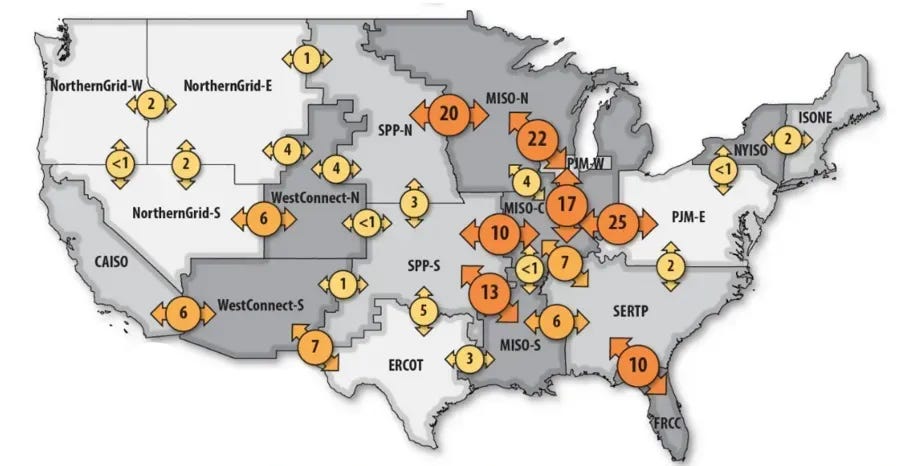
“Under the bill, the country’s regional grid authorities are required to study whether they could improve their system or reduce customer costs by knitting their own grids more closely together or connecting them to their neighbors. The grids have to use the same forecasts and formulas when studying these interregional connections — something that has never happened before.” - Robinson Meyer et al. at Heatmap
Grid planners would need to streamline and consolidate their interconnection queue processes:
“BAAJA … mandates that FERC require each transmission planning region … to consolidate their interconnection and regional planning processes [to] jointly evaluate transmission and generation needed for forecasted demand over a 20-year time horizon… It also streamlines generator cluster studies by requiring developers to submit nonrefundable security deposits and imposing withdrawal penalties. This consolidated planning process … substantially reduc[es] the uncertainty over the size and potential instability of potential grid upgrade costs” - Chirag Lala, Center for Public Enterprise
And grid operators would be required to allow virtual power plants (VPPs) to get more out of their existing systems:
“[BAAJA] forces regional grid operators to allow virtual power plants into their markets, for instance. Virtual power plants let households work together to get paid to use solar panels, batteries, flexible EV charging, or other smart technology to flex their energy use up or down as the grid requires.” - Robinson Meyer et al. at Heatmap
It has real teeth in regulation and oversight of electric utilities
BAAJA bans federal ROFRs (right of first refusal) that let electric utilities shut out competing transmission builders (functionally slowing down new lines):
“The legislation eliminates the federal right of first refusal for incumbent utilities, stripping their automatic right to build new regional lines, and requires FERC to issue a rule requiring “each transmission planning region to file a consolidated interconnection and regional transmission planning process” - Diana DiGangi at UtilityDive
Requires utilities to get more out of their existing infrastructure:
“Utilities would study how to fortify existing power lines and be incentivized to deploy grid-enhancing technologies (GETs) and Advanced Transmission Technologies (ATTs), improvements that can be added quickly without new infrastructure” - Maya Gibbs, Hannah Griggs, & Gabriel Sandler at Third Way
And beefs up state (and federal!) regulation of utility overspend:
“The bill also tries to keep utilities from building the wrong kind of transmission… In 2023, 90% of transmission spending nationwide went to lower-voltage reliability upgrades… It’s been unclear who is allowed to decide whether these projects are worth it. Because the lines are transmission projects, the federal government is in charge, because it has oversight of utility-scale transmission projects. However, because these projects are often built entirely within state lines … the federal government can’t make sure a given project is prudent or needed. The new permitting proposal clarifies that states are allowed to regulate these low-voltage, medium-scale projects. It also says that states can call in the feds, so to speak, and ask FERC for oversight or an investigation if local regulators believe a given utility project is out of line.” - Robinson Meyer et al. at Heatmap
It makes requirements that large loads pay their own way binding
By explicitly barring utilities from socializing the costs of upgrades among other consumers:
“The bill states that transmission costs should be fully assigned to the owners and operators of computational loads, or data centers, “so as to minimize or avoid the cost burden on other customers.” Specifically for loads equal to or exceeding 20 MW, the legislation mandates exit charges and bars the load’s incremental costs from being recovered from any other customer.” - Diana DiGangi at UtilityDive
And creating new transparency and tracking requirements:
“Additionally, the federal government would begin tracking how much energy data centers actually use, ensuring that policymakers and the public can see exactly how these facilities affect their communities. - Maya Gibbs, Hannah Griggs, & Gabriel Sandler at Third Way
It re-focuses environmental litigation on environmental harms
By limiting the use of injunctions to real harms or serious errors, not procedural issues:
“Injunctions and vacatur are eliminated outright for NEPA-specific claims. These remedies are, of course, preserved when the violation involves an underlying statute such as the Clean Air Act and the Clean Water Act, including when those violations are challenged through the APA. The logic for Republicans and Democrats alike is that purely procedural statutes such as NEPA do not create substantive environmental protections, and thus ought not result in project-stopping litigation.” - Thomas Hochman in Green Tape
Which de-fangs the “litigation-proofing” arms-race that produces thousands of pages in NEPA documentation over years of analysis:
“Without the threat of a project-killing injunction or vacatur, NEPA lawsuits lose most of their value as a delay tactic – and agencies will likely limit the “litigation-proofing” of NEPA documents that has driven much of the ballooning page lengths and review timelines over the years.” - Thomas Hochman in Green Tape
While preserving the core function of environmental litigation – stopping environmental harm:
“The APA still allows anyone wronged by an unreasonable (arbitrary or capricious) action to stop that action, or to force the agency to act if the problem is a delay in agency action. So if an action harms the environment for little benefit, or for easily avoidable benefit, an APA suit would stop it regardless of NEPA. The bizarre aspect of the hostile turn procedures is that even when there is little to indicate that the agency’s action was wrong on the merits, litigants can generally block actions anyway. BAAJA ends that.” - Alex Mechanick in Artificial Weights
It reduces judge-shopping, and gets serious environmental problems in front of a judge faster
BAAJA requires NEPA, NHPA, ESA, and some CWA cases to go straight to higher-level courts:
“The new bill says that cases will skip the district court system and go straight to the relevant court of appeals.” - Robinson Meyer et al. at Heatmap
“Moving cases to circuit courts (or ideally, the expert D.C. Circuit) has another benefit: it reduces judge and forum shopping that empowers the most extreme judges in the country.” - Alex Mechanick in Artificial Weights
It democratizes access to federal infrastructure funding by narrowing the scope of federal reviews
So fewer projects require NEPA analysis:
“NEPA applies only to a “major federal action,” so that definition determines which projects enter the process … the result of [BAAJA’s] changes is that fewer projects enter review at all, allowing limited agency resources to focus on the complex projects that need multiple federal permits or are on federal lands.” - David Zeger et al., Bipartisan Policy Center
Or NHPA analysis (particularly relevant for long transmission lines that cross a small federal footprint):
“On scope, BAAJA uses the Seven County framework to establish that analyzed effects must be “reasonably foreseeable” and directly alter the characteristics of the historic property in a way that diminishes its integrity. There is also a new “small federal handle” clarification – that is, if a 100-mile transmission line crosses just 1 mile of federal land, the review must be cabined to effects attributable to that mile, rather than cover the whole project.” - Thomas Hochman in Green Tape
As a result, we’ll likely see more state and local transit or housing projects accessing federal funds, especially in districts where local capacity to take on expensive and complicated environmental review is limited.
It shortens consultation clocks
For both NHPA:
“BAAJA… also limits the duration of the NHPA consultation to the time it takes to complete a NEPA review.” - Robinson Meyer et al. at Heatmap
And ESA:
“My overall take is that the bill’s ESA amendments are quite modest. The changes that will probably have the biggest effects … are 1) provisions that speed up the timelines on consultation, 2) changes to bring digital transformation to how permits and ESA workflow are managed, and 3) consolidation of much ESA litigation into one federal court.” - Timothy Male, Environmental Policy Innovation Center
It narrows the scope and raises the stakes for reversing existing permits
By limiting how much the federal government can interfere with existing federal authorizations:
“The bill says that the federal government is no longer allowed “to take any new action that would revoke, rescind, withdraw, terminate, suspend, amend, or alter a federal authorization or permit in effect on or after” September 16 of this year. It also says that agencies may not “take any other action to interfere with or prevent the construction or operation at full capacity of a project that has secured all necessary Federal authorizations and permits.” Crucially, there is a carveout for these steps “if such action is necessary to prevent specific, urgent, substantial, and proximate harm or damage to life, property, national security, or defense that is based on new information.” That justification would be subject to legal challenge.” - Robinson Meyer et al. at Heatmap
Which will hopefully constrain abuses of executive power, at least on the margin:
“These efforts may be limited in their efficacy. But to the extent that they are effective, they will help reduce the scope of, and temptation to engage in, abuses of power. In that way, they illustrate how more constraints on government (here: special procedural constraints on certain types of agency action) can speed up government, improve the quality of its actions, and reduce abuses of power.” - Alex Mechanick in Artificial Weights
It’s genuinely bipartisan and tech-neutral
Making it more politically durable across Congresses and administrations:
“Crucially, none of these reforms pick one type of energy over the other; the same rules apply to a solar or wind farm, a power line, and a gas pipeline. Climate advocates traditionally don’t like that, but that neutrality allows such a good deal to come together – and it’s also what most Americans want.” - Baillee Brown of Inclusive Abundance
And it’s the best deal that will be politically possible for a long time
BAAJA’s reforms will make it cheaper to build both public and private infrastructure. It will get energy supply online faster, and address some of the worst perverse incentives that plague our energy system. Even if the bill requires compromise from both sides of the aisle, we should remember that waiting on modern energy system carries significant costs of its own. How quickly we get started matters enormously from a growth and a climate perspective, both because the costs of energy constraints get very big, very fast and because reaping the benefits of transmission takes years.
I’ll close out this roundup with one final quote from Baillee Brown, because I couldn’t say it better:
“If there ever was a perfect moment, this is as close as it gets.”