

This post is a report on the steps forward and backwards that happened between April and June 2026 related to some of the areas we work on. Kudos and thanks to the many, many people working on all of the below - it’s a huge effort spread across many people and organizations, which we are proud to be part of.
This report is also a team effort - we can’t list everyone as an author on substack, but this is the work of the entire Abundance and Growth Fund team.
Housing Policy
After quite a rollercoaster, the Senate passed the 21st Century ROAD to Housing Act 85–5 on June 22, 2026, and the House passed it 358–32 shortly after. Speaker Johnson sent it to the White House on June 29 and while President Trump declined to sign the bill, it will become law by default if he neither signs nor vetoes it within 10 days (Sundays excepted) while Congress remains in session — likely today. The bill’s 45-plus housing provisions cover a wide array of reforms: cutting red tape, overhauling funding and financing, and providing technical assistance plus carrots and sticks for state and local reform. Beyond incentives, the supply-oriented regulatory fixes and financing measures trim federal permitting friction, expand the definition of manufactured housing by relieving the HUD code chassis mandate, raise and index FHA multifamily loan limits, lift the bank public-welfare-investment cap from 15% to 20%, and stand up grant programs to convert vacant buildings and rehab aging homes.
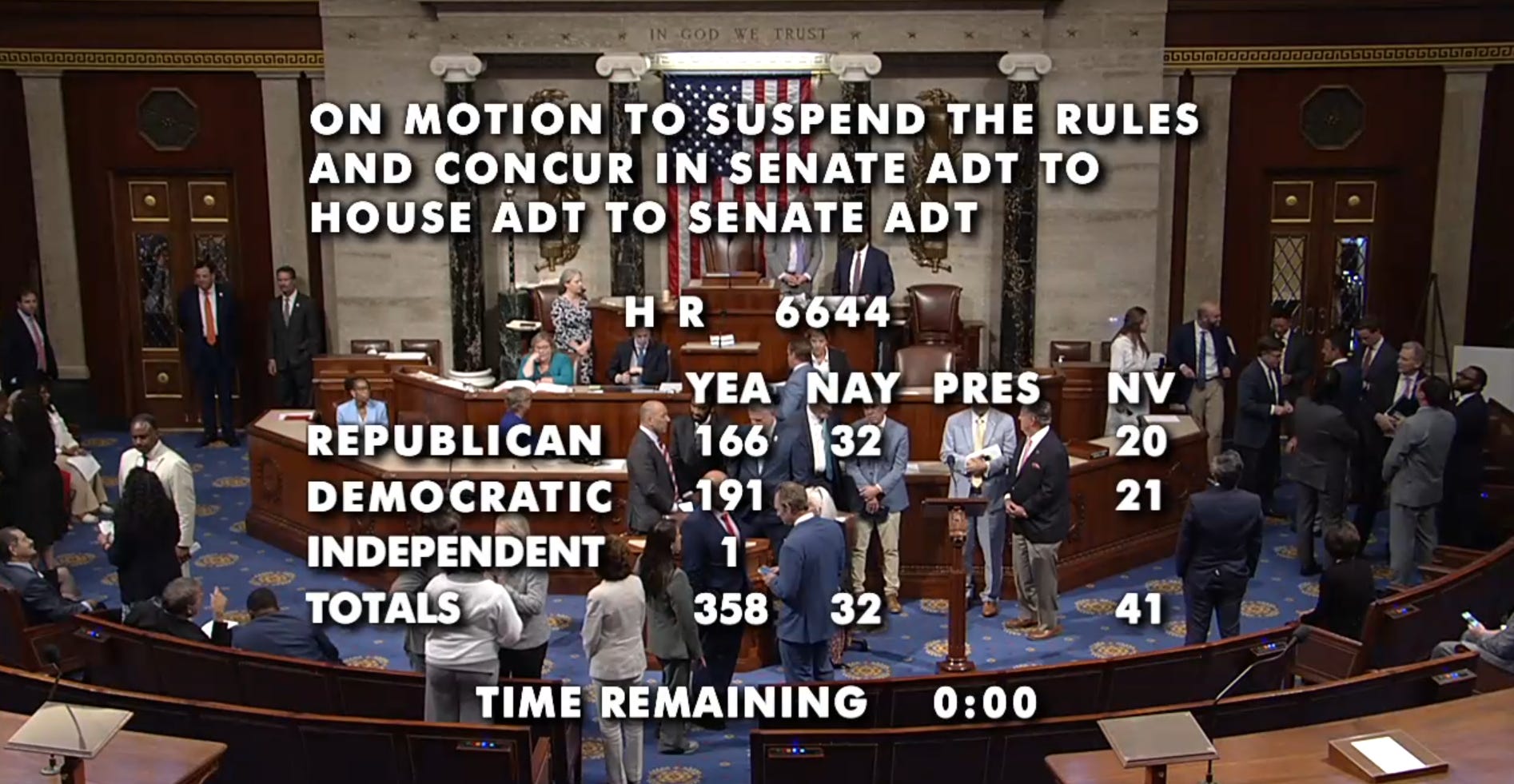
While the ROAD to Housing Act provides direct cleanup of key paperwork and bad rules that exist at the federal level, most of the binding constraints on housing still live at the state and local level.
Idaho — In April, Governor Little signed SB 1352, SB 1354, and HB 706, requiring cities over 10,000 to allow small-lot starter-home subdivisions and ADUs and permitting cities to authorize single-stair apartment buildings.
Virginia — In April, Governor Spanberger signed a housing package including SB 531 (by-right ADUs in single-family zones, signed April 13) and SB 388 (by-right affordable housing on faith and nonprofit land).
New York — This May, Governor Hochul signed FY2027 budget legislation exempting qualifying infill housing projects — up to 500 units in New York City — from SEQRA environmental review.
Maryland — On May 26, Governor Moore signed HB 894, preempting local zoning near high-frequency rail stations, and HB 548/SB 325, vesting development rights at application and deferring impact fees to occupancy.
Florida — Governor DeSantis signed HB 803 (permitting reform, including a permit exemption for residential work under $7,500) in May and HB 1389 (extending Live Local Act by-right approval to government- and faith-owned land) in June.
North Carolina — H162, eliminating local minimum parking requirements statewide, passed the Senate 44–1 in June and the House by concurrence that week and became law this month.
Washington, DC — The DC Council unanimously passed the One Front Door Act (B26-0227) in May, directing code amendments to permit single-stair apartment buildings up to six stories; the Mayor signed it in June, and it becomes law later this summer, after the 30-day congressional review.
Finally, Center for Building’s proposal to raise America’s “International” Building Code single-stair apartment height limit from three stories to four passed its final membership vote and will officially make the 2027 International Building Code.
Innovation Policy
In May, the National Science Foundation announced its new X-Labs program, a $1.5 billion, decade-long initiative to fund independent, milestone-driven research teams working outside of traditional university and corporate structures. The program aims to address a long-held concern that existing grant mechanisms and institutional models aren’t well suited for team-oriented, engineering heavy, long-term research efforts. The initiative draws on ideas from across the science policy community, including the Institute for Progress, whose X-Labs proposal last August laid out a framework for this kind of funding model.
While we’re excited about this program, it is currently proposed to be under 2% of NSF’s annual budget; though we hope that will grow after the model proves itself. It’s also worth noting it could end up a higher share in the short run, if the NSF fails to disburse conventional grants on time, which it is at risk of doing (see below).
Related to the X-Labs announcement, the Abundance and Growth Fund supported US-based cohorts of the Big if True Science (BiTS) accelerator and Brains research accelerator, both of which graduated and pitched their ideas for ambitious science projects this quarter. These are the kinds of ideas that (we hope!) will one day become X-Labs, or Focused Research Organizations, or ARPA programs. Speaking of FROs and ARPA programs, in April Convergent Research and ARIA continued the expansion of the FRO model across the pond, partnering to launch two new UK FROs: Meridial and Echo Labs.
Turning to the majority of the NSF budget that funds traditional research grants and training programs, we were encouraged to see the NSF’s 2027 budget request propose an NSF metascience unit to “champion agency-wide efforts to explore non-traditional R&D funding mechanisms and drive evidence-based optimizations to the R&D portfolio.” We’ll be closely watching to see if this is followed through on.
One challenge facing traditional grant systems is excess conservatism, or risk aversion. A first step in fixing this could be measuring it. The Metascience Novelty Indicators Challenge organized by UKRI (for which we funded the prize) is one recent attempt to build such a measure. The challenge was a global competition to develop scalable methods for assessing the novelty of research papers (see coverage in Science here). The winning team from Forschungszentrum Jülich was announced in June; they built an AI-based approach that compares the knowledge contribution of a paper to the state of knowledge, as represented by the text of the papers it cites.
Sometimes a prize like that one is the best way to make progress on an innovation challenge, sometimes a grant program would be, but other times a different policy is a better fit. Maybe an advanced market commitment, maybe a focused research organization, maybe something else to help policymakers decide which is which. The Institute for Progress and the Market Shaping Accelerator joined forces to create the Atlas of Innovation: An interactive guide for policymakers to identify the right funding mechanism for innovation challenges.
The above projects aim to improve how research funding translates into scientific and technological progress. But that presupposes funding is happening in the first place. And while we’re excited to see new innovative initiatives at the NSF, this administration has also been hostile to federal support for science (which we think has very high returns - see this, and this project we are supporting). After Congress rejected the administration’s proposals for deep cuts to science last year, spending on new awards (see figure below) has largely not kept up with historical averages, though there was improvement at NIH, DOE, and NSF over the last quarter.
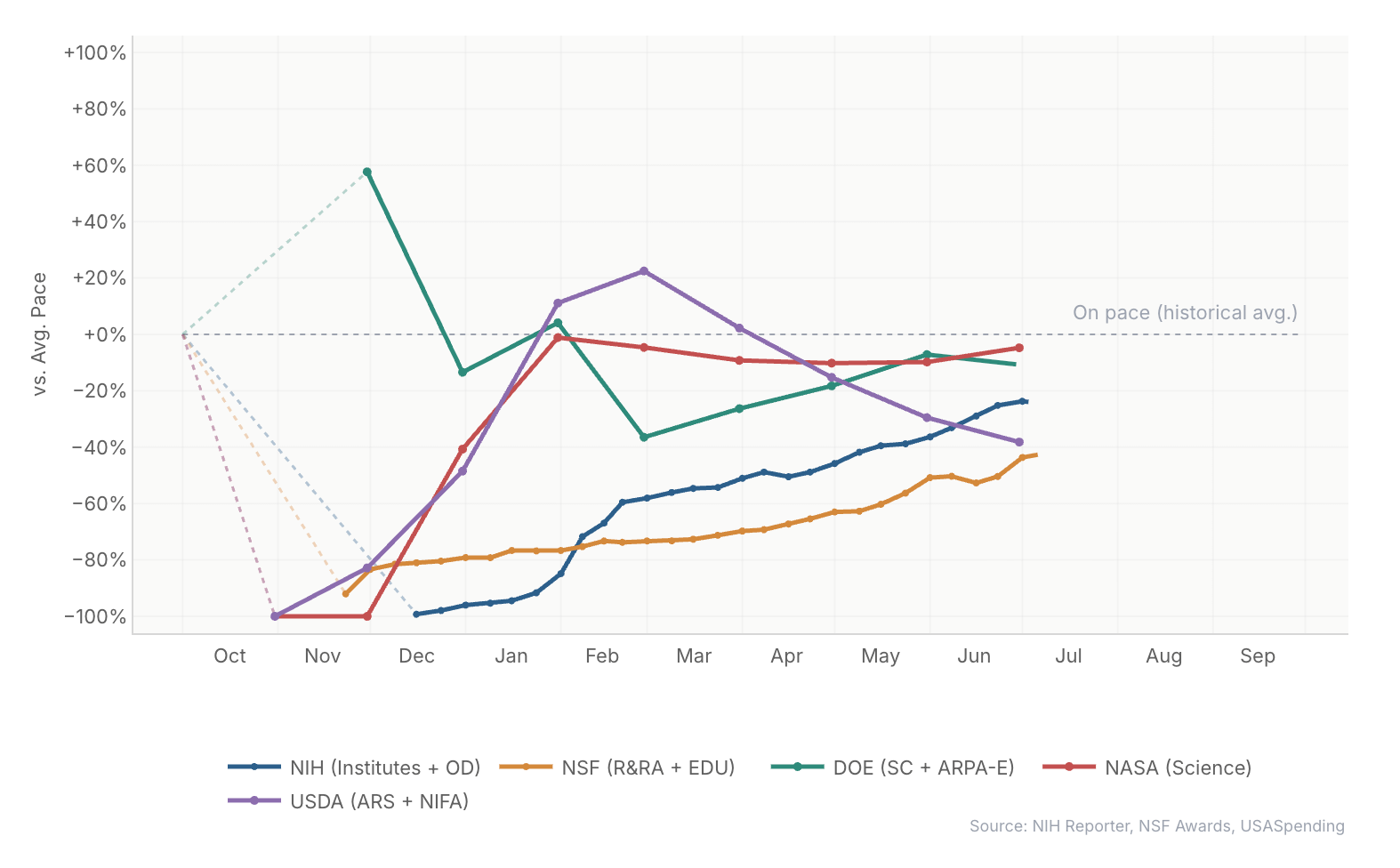
Caption: FY2026 New Award-Making Pace vs. Historical Average. Source: sciencespending.org
Last year, spending accelerated in the back half of the year for many agencies, and there is still time for the same thing to happen this year. Even so, the delays in funding are causing real long-run damage. A combination of rising uncertainty, the awarding of fewer (but larger) grants, and tighter immigration and visa policies are jointly contributing to significant declines in graduate student enrollment.
Clinical Trials
The FDA announced a flurry of new policies aimed at making the US clinical trials system work more effectively. One reason that clinical trials are expensive and inefficient is that the data they generate are locked in siloed systems and manually transcribed. In April, the FDA announced a pilot project to fix this, which would create ‘Real Time Clinical Trials’. The idea is to let regulators see trial data in real time, as it’s collected, potentially compressing the dead time between study phases.
Additionally, in June, the US Department of Health and Human Services (HHS) announced a new initiative called ‘Operation Trial Blazer’ that aims to bring back early-stage clinical research, which has increasingly been outsourced to countries like China and Australia, by reducing how long it takes to get approval to start phase 1 trials as well as how long it takes the FDA to review data from phase 1 trials.
Operation Trial Blazer includes several parts. One is an FDA pilot program to set up a network of qualified research institutions that help researchers prepare the protocol and supporting components before they submit it, though the FDA still decides whether a trial can proceed. It also provides more guidance on what manufacturing data is needed for phase 1 and clarifies this is lower than for later-stage trials, since companies have so far tended to submit more data than necessary to secure approval. And it includes guidance on choosing the first doses given to humans, recommending these are based on statistical modeling of the drug’s pharmacology rather than animal toxicology studies, which were often poor predictors of side effects in humans. Finally, there’s a platform for the FDA to review components of the package as they arrive, as a ‘rolling review’, rather than all at the end.
Most of this sounds positive, but there’s a caveat, at least in the short term. The FDA’s main bottleneck right now is staffing capacity, given the cuts over the last few years (roughly a fifth of the agency’s workforce, around 3,500 FDA staff, were cut last year). Whether these reforms ease that problem or worsen it further is an open question. Rolling reviews especially require more staffing time, because reviewing at the end typically means some attrition from researchers who don’t make it to that stage; similarly, the requirement that the FDA still sign off on whether phase 1 trials can proceed adds to that load too, especially while the initiative is new and leaning on staff input. Still, there’s good stuff here: the guidance on manufacturing data and dose selection doesn’t depend on FDA capacity the way the pilot does, so some of these changes could result in improvements soon.
Energy
On federal energy permitting, a bill has remained elusive, but we’re holding out hope for a bipartisan package before the August recess. In the meantime, there are two bipartisan moves worth keeping an eye on. In June Senators Cotton and Cortez Masto introduced a Senate version of the FREEDOM Act, which would help prevent agencies from revoking permits or halting construction on fully permitted energy projects, and is a direct response to the administration’s stop-work orders on offshore wind. The Senate version rolls in much of the House’s geothermal package from earlier that month and is notably cleaner than the House’s: it strips the most stringent agency penalties and moves fees into a freestanding “Permitting Performance Fund,” which should quiet concerns that the original structure would create a cost spiral for agencies. Meanwhile, in mid-June Senator King added an amendment to the NDAA targeting the DOD’s increasingly creative use of flight path certification to block onshore wind projects. Neither energy bill is a sure thing, but both signal that permitting certainty has bipartisan legs even in this environment.
On the electricity market side, FERC issued its long-awaited response to DOE’s October 2025 rulemaking request. This took the form of six “show cause” orders directing each of its jurisdictional regional operators – nonprofit regional bodies that run most of the grid outside of Texas - to justify or modify its current tariff structure, as well as submit detailed information on whether its portion of the grid will have enough power to serve new demand. The tight deadlines (60 and 90 days, respectively) for these actions will mean we may see important changes in how large loads connect to the grid and pay for energy over the coming months.
I try to follow these spaces closely, but I appreciate recaps like this because they re-up things like ‘real-time clinical trials’, which I had no idea were happening and are clearly a huge deal. I think many regulatory overhaul efforts wind up trying to push a boulder up a big hill by requiring a certain kind of comprehensiveness to begin gaining traction. But this is exactly the kind of ‘tip of the spear’ effort that can operate by and large an existing context and lubricate the way for more substantial subsequent adjustments by creating a more actionable default set of existing conditions.