


Hope you’ve had a great week! Here’s what we’ve been reading:
Our scientific ecosystem often prizes outputs that, themselves, don’t necessarily drive scientific progress, but instead are useful proxies for the more intangible processes that do. Three reads this week have me thinking about what happens if AI gets good at creating these outputs before (or instead of) getting good at the things they’ve been proxying for. First is David Bessis’s fascinating essay on AI in math. He discusses, among many other things, the idea that theorem-proving has historically served as a legible demonstration of underlying conceptual innovation, because solving major open problems typically required first building a new framework that made the solution tractable and expressible; AI may break that coupling, producing correct but unintelligible proofs and capturing social rewards without the accompanying distillation and canonization that allow the field to build on the new knowledge. Second is Engzell and Wilmers’ recent preprint, “The Paper Factory,” which, though different in goal and tone, describes a related dynamic in social science. The authors develop a multi-agent LLM workflow that automates most of the steps of creating a publishable empirical paper, but struggles with the intangibles that form the foundation of meaningful outputs, like problem selection and judgment. For a more speculative take on the topic, read Ted Chiang’s prescient short story “Catching crumbs from the table,” published in 2000 in Nature, which imagines human scientists reduced to interpreting the incomprehensible discoveries of superintelligent successors. — Jordan Dworkin
The US is richer than Europe. This is not especially controversial: residents of just about every European country, save for tax havens like Luxembourg and the petro-state of Norway, lag the US in median income. But is Europe falling further behind the US, or keeping up? Paul Krugman says “keeping up”; Luis and Pieter Garicano say “falling behind.” Some of their debate is technical and about what the proper purchasing power parity (PPP) metric to use when comparing living standards between the US and Europe. But the biggest question in the debate is how to think about US dominance in tech. The five most valuable companies on Earth (NVIDIA, Google, Apple, Microsoft, and Amazon) are all American tech firms, and the smallest of them is nearly five times more valuable than the most valuable European tech firm (ASML). To Krugman, this is basically irrelevant to living standards; Europeans can still use those American firms’ products, often (as with Google) for free, so the physical location of the firms isn’t so important. To the Garicanos, this pattern is evidence of a fundamental lack of dynamism in Europe that is already hurting residents and will hurt them more as AI scales up. — Dylan Matthews
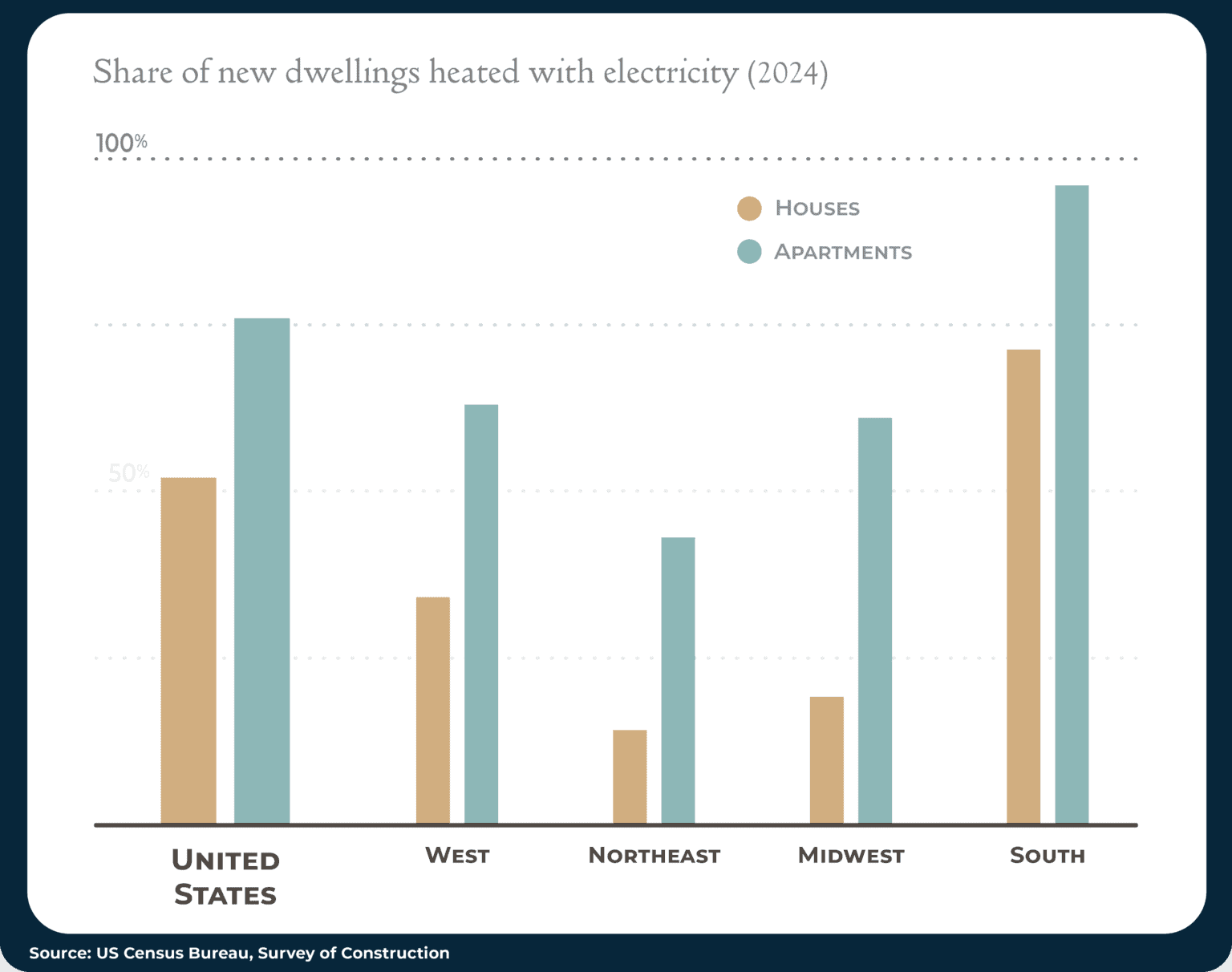
Alan Durning at Sightline has a new report arguing that the climate movement is underrating one strategy for reducing climate change: apartment buildings. Apartment buildings have lower carbon emissions than single-family homes for several reasons. They are more energy efficient; more likely to be heated by electricity; and when sited near offices, shops, and public transit, let people get around more on foot, by bike, and by public transit instead of driving. But perhaps just as important is the fact that housing policy is tractable. Building more apartments doesn’t require new government spending, nor asking people to make hard tradeoffs. Private developers want to build apartment buildings, and people want to live in them, if only they are allowed. We’ve made a lot of progress in the last year to enable building more apartment buildings, but there is a long way to go. — Matt Clancy
Matt Yglesias dropped an avowedly contentious take on energy abundance, arguing that “conventional environmentalism” is overly focused on efficiency and missing the upside of truly abundant energy generation. Yglesias argues that “too cheap to meter” energy would not only make efficiency arguments irrelevant, but unlock vast new frontiers in energy-constrained areas like synthetic fuels, vertical farming, and lab-grown animal proteins. Leaving aside the political positioning of energy efficiency for the moment, I found this a helpful provocation on what we should and shouldn’t expect from more generation capacity. While more cheap energy is clearly a good idea, and we're sympathetic to many of the conclusions here (permitting reform and interregional transmission would be important wins), my read is that we still risk missing a step by focusing too closely on energy prices alone as a driver of innovation. For some sectors, the cost of energy probably is a binding constraint (synfuels, desalination, potentially some green industrial materials), so it follows that cheaper energy would lead to growth there. For others — including cultured meat and potentially vertical farms, but also next-gen aviation — there are still major materials science/biotech bottlenecks (or physical constraints) to be addressed. It’s not clear to what degree even too-cheap-to-meter energy would actually induce the innovations to make those technologies commercially viable; at least some of the literature on directed technical change implies that energy prices can shift R&D budgets within the energy sector, but we’re (to my knowledge!) missing an empirical through-line from energy prices to R&D in complementary fields. If we don’t know how strong the link between energy price and complementary innovations is, it’s worth asking whether driving energy prices as close to zero as possible is the most cost-effective way to induce those innovations. That said, there are plenty of good reasons to build more cheap energy — not least that growing demand has made ever tighter supply-side constraints an increasingly real possibility even for “conventional” growth. — Willow Latham-Proenca
New York took two big steps on housing permitting this week. After weeks of late-budget deadlock, Governor Hochul’s SEQRA modernization is reportedly final with bill text coming next week. The deal reportedly exempts NYC housing projects up to 500 units in medium/high-density districts and 250 in low-density areas, with smaller carveouts upstate. On the city side, the mayor launched the SPEED Task Force report. Originally scheduled to arrive after a final Albany budget, the report is explicit that its headline pre-certification cut — slashing ULURP rezoning pre-cert from two years to six months — is contingent on the state SEQRA carveout actually landing. Beyond SEQRA-enabled reform, SPEED promises: five months trimmed from new-construction permitting, five months from office-to-residential conversion permitting and lease-up, and a ground-up rewrite of the affordable housing lottery that takes median time-to-move-in from 210 days to under 100. All told, the report projects two years off the timeline for projects requiring rezoning and eight months off all affordable housing — backed by $14M in the executive budget and ~96 new agency hires where capacity actually binds the expected flood of streamlined housing permit applications. With Evan Soltas’s LA permitting work implying each year saved is likely worth ~8% in construction costs, that’s the stacked feasibility shift needed to help turn theoretical zoned capacity into actual homes. — Alex Armlovich
FDA Commissioner Marty Makary resigned this week, just over a year in the role. It seemed sudden from the outside, but was reportedly a long time coming internally, with months of friction with RFK Jr. Apparently, the final straw was his reluctance to approve flavored vapes. I find the chaos worrying, and although Makary announced some promising ideas, like streamlining clinical trials, Bayesian analysis, and reducing animal testing, as STAT news describes, he also oversaw the departure of experienced career scientists, more politicized approval decisions, and eroding evidentiary standards. — Saloni Dattani
One reason that clinical trials are slow, expensive, and wasteful is that the data they generate are locked in siloed systems and manually transcribed. Recently, the FDA announced a pilot project to fix this, which would create “Real Time Clinical Trials”. The idea is to let regulators see trial data in real time, as it’s collected, potentially compressing the dead time between study phases. But as Adam Kroetsch writes in a new post, the announcement was muddled; speakers discussed topics like rural access and site burden, which made it unclear what was actually being proposed. His take is that the idea is genuinely promising, but will be difficult to deliver at scale, and requires the FDA to go much further. He recommends they define how they actually use live data, build interoperability standards, and give sponsors explicit regulatory cover to abandon unnecessary verification practices. — Saloni Dattani
Here are a few other highlights and announcements from our team and grantees:
Alex Armlovich published “Tokyo land is still >$85 million an acre” looking at what happens to land values when a megacity actually achieves housing abundance. The short answer: rents fall, but land values don’t, which matters for the political economy of getting zoning reform passed.
NSF officially launched the $1.5 billion X-Labs initiative, funding independent research teams with large, flexible block grants to tackle scientific challenges outside traditional university structures. The initiative draws on ideas from across the science policy community, including the Institute for Progress, whose X-Labs proposal last August laid out a framework for this kind of funding model.
The Foundation for American Innovation is hosting the Energy Imperatives Summit on June 9-10 in Washington, DC, a two-day forum on energy policy featuring speakers from government, industry, and finance.