

American economic growth is slowing. Consider the figure below, which plots the increase in GDP per capita experienced by a 35-year-old American. Before the year 2000, the norm was to experience per capita income doubling (and then some) by your 35th birthday. But in the 21st century, per capita income gains have steadily fallen. Today, the typical person sees GDP per capita increase by roughly 70% in their first 35 years. We think these declines represent large losses to material prosperity and health, relative to our potential.
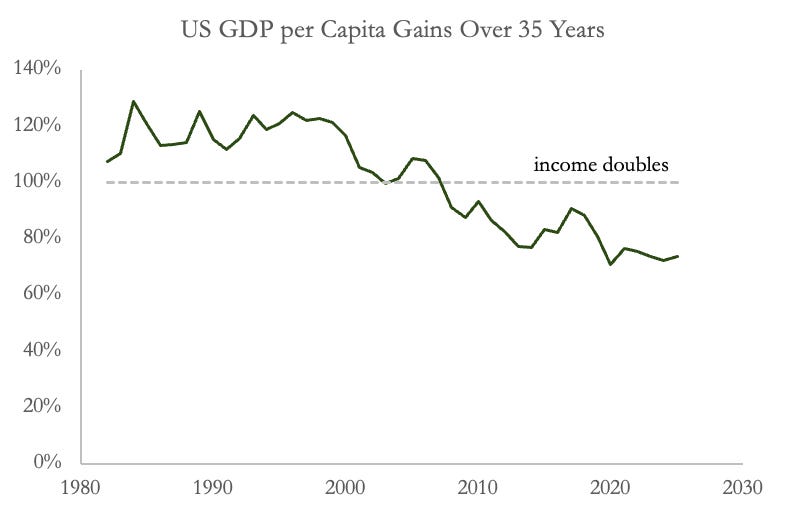
What happened to growth? Part of the answer is policy. When there is insufficient weight put on the long-run growth effects of a policy, we make bad tradeoffs and pursue better policies with insufficient urgency. We think better policies are possible and there is an opportunity for philanthropy to help get us there.
Our primary goal at the Abundance and Growth Fund is promoting broadly shared economic growth—reducing the cost of living by increasing the supply of goods and services—via better policy. We’re a three-year fund with a $120 million commitment. In this post I want to give a bird’s eye view of the kind of work we’re supporting in 2026.
Policy areas
There are a lot of different policy areas that bear on growth and the cost of living, but we’re starting with five areas that we think are important and tractable: innovation, energy, clinical trials, housing, and state capacity.
Our first area is innovation. Technological progress, drawing on scientific research, is the foundation of economic growth. But government funding for science has not significantly evolved for decades. Spending has been fixed at 0.4% of GDP since the 1970s, despite a large academic literature documenting that federal funding for research has a large impact on productivity growth (it probably pays for itself via increased tax revenue, over a long enough time horizon). Meanwhile, even though the returns to science are high, we think they can be even higher: the science funding ecosystem has not evolved significantly for decades and is starting to show its age. Across a variety of different indicators (Nobel prizes, citations, patents), the impact per dollar of recent science seems to have fallen. In our grantmaking to support increasing innovation, we break it down into three pieces: talent, resources, and productivity. Talent refers to the people doing the innovation, resources to the funding and other support they have, and productivity is how well our talent is able to use resources (including AI) to drive innovation.
Our second area is energy. For the average person to benefit from innovation, new technologies need to actually be deployed at scale. But building new energy infrastructure - whether solar, wind, geothermal, or nuclear power - requires navigating a government approval process that has become dramatically more onerous over time. For example, in the 1970s, environmental reviews were a few dozen pages on average; the average is now above 1700 pages, and they take years to complete (more here). This constraint on the supply of energy is likely to worsen over time as demand for electricity from electric vehicles and data centers grows. Our energy program focuses on policy reforms to make it easier to get new energy technologies built in the real world. Specifically, we’re supporting efforts to bring about federal policy reforms to streamline energy permitting, both in the near term and over the longer run, and to support similar reforms in the states.
Next comes clinical trials. New drugs face a similar dynamic as energy; breakthroughs in biomedical science can lead to better health, but only if people can access them. The cost of getting a drug to market has been doubling roughly every nine years. Much of this cost is associated with the costs of running clinical trials, which have slowed over time from roughly six years in the 1970s to 8-9 years in the 2010s. As with energy, we’re again interested in supporting national policies that reform the clinical trials system to make it faster and less expensive, without compromising safety. But we’re also interested in increasing transparency around the data used in clinical trials, as a way to speed up research on drug efficacy and new applications (especially as AI potentially lowers the cost of analyzing that data).
Our fourth area is housing. Most people spend roughly a third of their income on housing - the single largest expenditure category - so if we want to create broadly shared economic growth, creating abundant housing is a prerequisite. Alas, since the 1960s, many local governments have increasingly restricted the ability to build more housing in the places people most want to live, whether via zoning, excessively restrictive building codes, parking requirements, or any number of other policies developed by the 20th century “growth control” movement. The result is a growing gap between construction costs and home prices in high-income metros, with real consequences for broadly shared growth: migration to high-wage cities has reversed since the 1980s, and lower-wage workers are now worse off if they move to expensive metros once housing costs are factored in. We support work to change these policies to increase the supply of housing. While we have historically focused on the most supply-constrained big cities, this year we want to look at state and regional reforms in jurisdictions that might be more tractable to work in before the wedge between prices and costs gets too large.
Finally, cutting across all of the above is the capacity of the government itself to perform its functions well, which we call state capacity. Just as government policies can impede the supply of energy, medicine, and housing, so too can it impede its own function. For example, policies designed to prevent biases in hiring decisions can mean subject matter experts who best understand what is needed for a role are excluded from key parts of the hiring process. In other cases, policies designed to reduce paperwork increase it. More broadly, Americans are not happy with how well the government works: for decades, between half and two-thirds of Americans have believed the government is generally ‘wasteful and inefficient.’ This matters for growth in two ways: government policy affects the economy and the government is itself a major economic player (US federal government spending is 14% of GDP, even after setting aside social security and paying interest on the debt). To increase the ability of the government to execute, we support reform policies that cut across all of government. Two areas we are especially interested in are rules around civil service hiring and government procurement, which jointly determine whether government objectives are carried out by government employees or contractors who are positioned to do the work well.
Most of our focus is on the United States, but we are also interested in these policy areas in other high income countries,1 and have made some grants to support work abroad (mostly in Europe).
Strategy areas
Within those domains, we support a lot of different kinds of work - anything we think will improve the prospects of a sufficiently good outcome. It can be a bit hard to describe all the kinds of work we do concisely, but one way to organize it is on a continuum from research to fieldbuilding to practice.
On one end of the spectrum is research. Sometimes, it’s not clear what the best policy even is, or the evidence base for a policy is too weak for us (or policymakers) to be sure it’s a good idea. In that case, we may fund academic research to try and build a better evidence base about the tradeoffs of different policies. We’ve made several grants like this related to improving our understanding of what kinds of policy changes can improve science (for example, we are co-funding a series of grants with the UK Department for Science, Innovation and Technology on this topic), and are looking at opportunities to support research on what kinds of permitting reform would have the biggest impact on building energy infrastructure. But as a group focused mostly on policy change, we usually think about supporting research with the objective of shedding light on a specific policy question, rather than open-ended exploratory research.2
Once we have some clarity around what policies will be most effective, we often support fieldbuilding; work that spreads ideas and grows the network of people who care about them. For example, we were founding investors in The Argument, in part because we didn’t see a publication looking at contemporary policies and politics with an abundance frame. We also have a program to support experts part-time to write accessible living literature reviews. Other work focuses on the people who are excited by ideas. For example, we support some of the major conferences in these policy areas (YIMBYTown, Metascience, the Roots of Progress, the Abundance conference) as well as some membership organizations that help people interested in these topics learn more and actively participate. This process can take time; for example, while our housing policy work has recently racked up major wins, we have been supporting YIMBYTown since 2016.
Finally, when there is an ecosystem of people and a solid evidence base on policy design, it’s time to support practice. That can take a lot of different shapes as well. In some cases, we help launch organizations that directly do important work, such as the International Student Resource Center, which provides authoritative immigration information to international students in the USA; Pilot City, which organizes workshops where city agencies pitch research projects that will help them achieve local government goals to academics, and vice versa; and research accelerators like Brains and BiTS. In other cases, our grantees generate and provide information that is directly useful to policymakers. For example, we have supported modeling work on the budget impacts of high skilled immigration reform, or the climate impacts of permitting reform. And, of course, other organizations we have supported directly advocate for specific policies. These might include DC-based think tanks (such as the Institute for Progress), or regional groups that focus on their state or local government (such as California YIMBY, Open New York, or the Sightline Institute).
What’s next
We think innovation, energy, clinical trials, housing, and state capacity cover some of the most important and tractable policy areas for promoting broadly shared growth, but there is a lot more we could do. Part of that will come down to how our budget changes over time; it isn’t fixed and we are seeking additional funding.3 But part will also be the outcome of research into new potential policy areas.
Three new areas we’re particularly interested in looking at are transportation, healthcare, and restrictions on labor choices. Transportation infrastructure facilitates access to the productivity benefits of major cities, but it is also bedeviled by many of the same permitting and approval processes that restrict the supply of energy and housing. Health is about delivery of medical care even more so than the supply of new medical treatments, but the supply of doctors and other health services is also constrained by specific policy choices. Meanwhile, productivity growth rises when people can more flexibly change careers to pursue what they think suits their skills, but occupational licensing regimes and non-competes restrict labor choices.
Meanwhile, even within our initial set of five areas, I expect our plans will change; research turns into clear policy goals, fieldbuilding leads to mature ecosystems, and policies eventually get passed. And we’ll also learn from what’s working and what isn’t, and like everyone else, adapt to a changing world. But for 2026, that’s what the Abundance and Growth Fund will be up to.
The Global Growth fund at Coefficient Giving supports economic growth in low and middle income countries.
And, of course, this blog is another effort to spread ideas we endorse!
We currently have a pooled fund from Good Ventures, Patrick Collison, and two private funders. If you’re interested in learning more or joining the fund, reach out to partnerwithus@coefficientgiving.org.
What is missing concerns the evolution of our institutions and their controlling belief systems.
Over half a century ago, we had the cultural dominance in Academia of analytical thinking from STEM and business areas, with Economics still being non-Marxist. To achieve economic growth and abundance, you need innovation, the ability to fund implementation, and permission to actually build and market the innovations. The high risk of determining which innovation will work and which will fail is beyond what the banking industry and government bureaucracies, with their regulatory requirements, can rationally finance, so we invented Angel Investing and Venture Capital, where the people making the decisions had real "skin in the game" with downside risk.
Meanwhile, the last requirement for implementing innovation became government permission, while the Social Sciences and Humanities in academia took over power and control of the regulatory institutions. By the 1990's, between environmental and political activists, a "vetocracy" was created where everyone could block the implementation of any innovation having anything to do with the real world, implemented outside the US and EU.
This limited the US innovation to areas not under regulatory control, like PC's and electronic design. Meanwhile, nuclear power was effectively blocked from continuing down the normal decreasing-cost curve as scaling of both size and numbers proceeded. In the last half-century, this whole industry in the US ceased innovation and shifted from being as cheap as coal to the most expensive energy source, thanks to permission blocks by the NRC. Now we have a CO2 problem and a Strait of Hormuz problem. We now believe that people with the "correct" feeling and beliefs can and will be analytical.
I'd really love to see a "IFP but for Europe"! Sorely needed!