

Zoned capacity is the gap between what land use regulators allow to be built on a parcel and what’s already been built. The volume of unbuilt zoned capacity gets treated, in popular conversation, as a bank account with a fungible dollar balance that planners can exchange for housing, unit by unit without diminishing returns. The discourse engages as if the next dollar in the balance is just like the last dollar. It doesn’t work like that!
Instead, a better metaphor for zoned capacity is an artificial, regulatory oil deposit.
Unlike bank accounts, oil is not perfectly fungible. Oil deposits vary in grade and extraction difficulty. As the easy deposits deplete, producers move to harder, more expensive sites1. Just so, zoned capacity varies enormously across parcels in quality, quantity, and location. And after years of building out the best sites allowed by regulators in a city, the zoned capacity left over is not like the zoned capacity you started with: it’s the leftover sites that are more expensive or less desirable to work with. All else equal, permitting rates in a city should slowly decline and rents should face gradually increasing pressure as a city’s cheapest and easiest development sites get built out and only the more expensive, and/or less desirable, parcels remain.
With oil, the size of a deposit is set by geology. With zoned capacity, the volume that can be “mined” by developers is set by regulators - importantly, this means regulators can make more of it. Eliminating or substantially relaxing this artificial zoning cap to legalize an abundant supply of housing is the entire premise of the YIMBY movement.
However, the US Geological Survey distinguishes between contingent oil “resources”—oil that physically exists in the ground—and “proved reserves”—the amount that is economically and technically recoverable. “Proved reserves” are thus a hybrid engineering & economic concept: At current prices with current technology, how much can you actually produce? If prices spike or technology improves, proved reserves increase even though nothing physical has changed underground. Urban planning has analogues: what the oilmen call technically recoverable “resources” and economically feasible “proved reserves” for oil, urban planners call “zoned capacity” and economically buildable “soft sites” for new housing.
Zoned capacity, as a raw “resource”, is an invisible cap over every zoned plot in a city. But the usable “reserve” citywide is just a small fraction: it’s the capacity that has a realistic probability of becoming housing in any reasonable near term forecast period. It depends on the size and shape of an individual lot, the condition and value of what’s already built, interest rates, construction costs, the land-value-to-structure-value ratio, neighborhood demand expectations, and more. Change any of those and you could change the usable reserve.
Once one understands this difference between theoretical “zoned capacity” and economically feasible “soft site” estimates, one can begin to understand why California’s state-mandated zoned capacity targets have struggled for so long; why Washington, DC’s profoundly confused land use planning process has produced such a terrible first Comprehensive Plan draft; and why NYC’s “City of Yes” reform for 82,000 new homes over 15 years sounded so small compared to other reforms that purport to legalize huge numbers of units.2
Why do finance-focused and regulation-focused commentators differ on what “drives” permitting?
For any given level of zoned capacity, financial conditions and the macroeconomy dominate timeseries variation in permitting within a city and in the national headline average. “Housing is the business cycle”.3 If you’re looking at a time series of permits in a single city or nationwide, the business cycle is doing much of the timeseries work.4
But financial conditions do not explain massive and persistent cross-sectional variation across cities at any given point in time. At any macroeconomic moment—boom or bust—some cities permit vastly more housing per capita, and as a percentage of the existing housing stock, than others. That variation between cities is overwhelmingly the result of binding growth control regulations within the commutable zone of a labor market. Cities and neighborhoods with reserves that widely exceed existing built densities by at least double the existing floor area “by-right” permit far more than cities with thin or fake capacity, permitted on a discretionary project by project basis, regardless of macro conditions.5
The housing crisis is not a crisis of theoretical zoned capacity on paper. There is “enough” theoretical capacity on paper in some expensive cities like DC—but this is about as relevant as the observation that there is theoretically enough deuterium in the ocean to solve all of humanity’s energy needs. The crisis is one of usable, proved reserves of soft sites: large increments of development rights on ripe sites, in high-demand locations, where the economics of teardown and redevelopment actually pencil. As we will discuss, DC’s comprehensive plan just demonstrated in real time how the failure to understand this distinction leads directly to policy complacency. If you want housing this decade, you need proved reserves–buildable soft sites!–not theoretical resources stranded far from any realistic near term use.
Why this all matters: Thinly spread zoned capacity is mostly stranded capacity
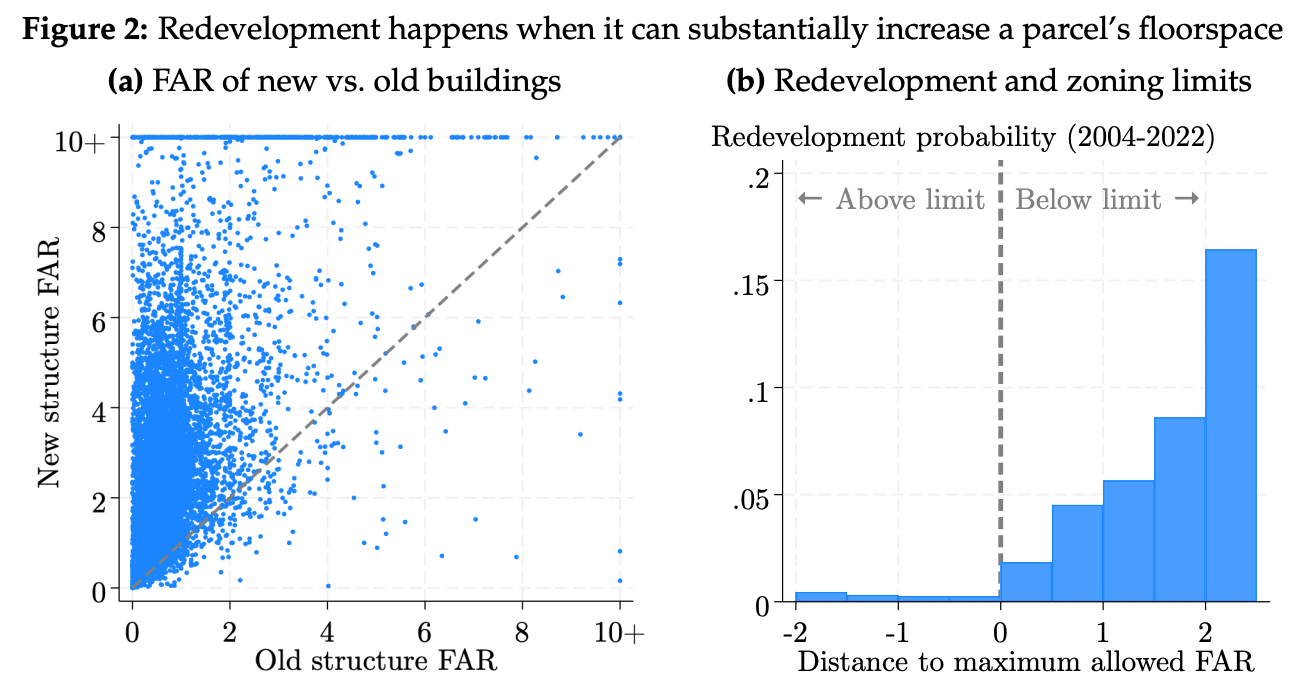
Proponents of incremental development often note, accurately, that NYC is a “3-story city”. If one could instantly and frictionlessly turn every 3-story building into a 5-story building, the housing shortage would be over for now. The problem is it does not make economic sense to tear down most 3-story multifamily buildings only to build a 5-story building. The average successful redevelopment in NYC is 3.4 times larger in floor area than the building that came before it. Thinly spread zoned capacity—generally meaning any zoned capacity that doesn’t allow a proposed building to at least double in floor area from its existing use6—is functionally trapped. It is uncommon to tear down a 3-story multifamily building to build a 5-story building, unless the 3-story building already happens to be in end-of-life condition; adds significant floor area beyond the immediately demolished site; or constitutes a rare exception, insofar as even buildings with a 1% annual probability of redevelopment do eventually get redeveloped.7
Vincent Rollet’s groundbreaking job market paper at MIT studied every parcel-level redevelopment in New York City from 2004 to 2022. He found that, on average, new buildings in NYC are 3.4 times larger than the building they replaced. The average torn-down building had a floor area ratio (FAR) of about 1 (i.e., a two-story building covering half the lot). To achieve even a ~15% chance of redevelopment over the nearly 20 year sample period, a parcel needed permission to build at least two extra floor area ratio points’ worth of square footage on top of the existing use. In simplified terms that means unless a typical property owner could add roughly 3 to 4 stories beyond the existing typical one-or-two-story building torn down in Vincent’s dataset, there was not a significant probability of teardown and redevelopment. The near-term production effects of upzoning are almost entirely concentrated on parcels with low existing density and high allowed capacity in high-priced neighborhoods. Upzoning parcels in the cheapest areas yields almost nothing—the reward for adding floorspace is too low to cover the large fixed costs of demolition and reconstruction.
To be sure, America’s oldest big cities are full of squat, unsprinklered, highly flammable wood-framed tenements reaching the end of their design life. Under current zoning, these get gut-rehabs without adding any new homes, but under incrementalist zoning, they’d likely add a story or two once the structure deteriorates enough to merit redevelopment. The incremental development advocates consider this century-long slow growth process a feature, not a bug. Outside the nation’s largest megacities (and the small but extremely high-wage “superstar cities” like San Francisco, Boston, & Seattle) slow growth might be enough.8 But in the cities with the largest housing backlogs, a human lifetime is far too long to wait for housing abundance.
Another key thing about the incrementalist “three story city becoming a five story city” vision that doesn’t get enough attention: the sheer physical disruption of redeveloping a city’s entire landmass within a single business cycle, by a small increment on each lot, would be staggering. As former Director of Planning in DC, Harriet Tregoning, astutely observed amid circa-2013 debates over lifting DC’s height cap: Adequate housing production at modest Paris heights would entail rapid Paris-scaled demolition and physical transformation of wide swathes of DC.
Even stipulating for argument’s sake that it would be economically feasible to quickly tear down and rebuild three-story apartment buildings to grow them by 1 or 2 stories each without invoking eminent domain, it would be a disruptive and politically troubled undertaking.9 We are almost lucky that regulatory approaches intending voluntary, wide-area lowrise intensification have low redevelopment probabilities on any one parcel, because if development were feasible widely, we’d have a political maelstrom of universal construction noise and tenant displacement on every lot in every block of the city.10
To unlock feasible housing supply in the highest-demand metropolitan areas now with minimum disruption, one must lift caps on density near downtowns and near rail transit altogether, allowing the important housing typology known as “Missing Massive”.11 Along frequent bus corridors and other high-resource locations, rezone to allow at least the building code’s “high-rise” threshold—usually 75 feet in most US states and cities—at which construction costs begin to spike as cheap light wood framing is no longer allowed. Everywhere else can be zoned for the incrementalist “gentle density” that will glacially produce new housing over the next century as existing buildings wear out and need major repair or replacement. Having said all this as a necessary corrective to pure regulatory incrementalists, it is nonetheless true that, in the highest-land-value metro areas with the biggest housing production backlogs, there’s no tradeoff or tension between legalizing rapid Missing Massive near transit and downtowns and incrementalist gentle density elsewhere. In the half dozen coastal superstar metros targeted by Coefficient Giving’s housing reform portfolio to date, both strategies will be required if we are to address the accumulated scale of housing underproduction through voluntary bottom-up action alone, without resorting to the coercive state-led eminent domain and urban renewal tools of Robert Moses or Baron Haussmann.
Zoned capacity confusion is doing real damage right now
This past week, DC’s Office of Planning released its draft Future Land Use Map (FLUM) for DC 2050, the city’s first comprehensive plan rewrite in nearly 20 years. Their reasoning was laid out plainly: DC has about 325,000 households today. The current comprehensive plan allows for 445,000. They estimate the city needs capacity for 460,000 by 2050 to keep prices from rising faster than inflation.12 So the proposed plan adds capacity for just 15,000 more households—a rounding error on a quarter-century planning horizon—because they figure it’s already almost there.
This is a huge disappointment. The Office of Planning’s 445,000 figure is a theoretical resource, not a proved reserve of buildable sites…worse still, it comprises the leftover “rump” of the last comprehensive plan, whose most feasible sites have disproportionately already been built out. It counts every parcel in the District where zoning technically permits more than what currently exists—regardless of whether the existing building is a rent-stabilized apartment complex that will never be torn down, a recently renovated rowhouse whose owner has zero interest in selling, or a parcel where the gap between allowed and existing density is so small that no builder would ever bother. Even California has recently begun forcing cities to stop the policy of simply “rolling over” planned sites that were not ultimately rezoned or built from one planning cycle to the next in full knowledge that these sites will not yield any housing production without further regulatory relief. DC’s planners shamelessly rolled forward all existing planned capacity without interrogation.
Nobody at DC’s Office of Planning (OP) did—or at least nobody published—a soft site analysis asking: of that 120,000-unit gap between 325,000 existing households and 445,000 theoretical capacity, how much sits on parcels where the economics of teardown and redevelopment actually pencil?
If the Office of Planning ran that analysis, the answer would almost certainly be that a large share of their 120,000-unit theoretical surplus is vaporware–or, returning to our petroleum engineering metaphor, “contingent resources” that are not realistically deliverable anytime soon, anywhere close to current prices. That means the actual shortfall between usable reserves and the 460,000 target is not 15,000 units! And because the city is planning on the assumption that it has nearly enough capacity already, it is not poised to create the deep, transit-adjacent and high-opportunity upzonings that would actually generate the housing equivalent of feasible “proved reserves”.
The confusion over zoned capacity becomes self-reinforcing: claim adequate capacity, do nothing, watch housing costs rise, blame everything except the zoning.
The zoned capacity problem is not limited to DC. California has the same problem on a massive scale. California’s Regional Housing Needs Allocation (RHNA) housing element law advises jurisdictions to zone for 15%–30% more capacity than their housing target, as a buffer. Since the housing element law’s inception in 1969, California’s cities have met RHNA nominal zoned-capacity mandates by upzoning land that is literally underwater, designating City Hall as a place likely to be demolished for new housing to be built, and counting narrow strips of abandoned railroad tracks and polluted brownfields.13 Though DC may not actively be gaming their zoned capacity estimates, their shockingly unambitious Office of Planning proposal’s 30% zoned capacity “buffer” above the existing number of built homes is still very Californian: A buffer of that size has historically been more than sufficient to give a city a passing grade under California’s benighted RHNA framework.
California’s preemption of local land use law yields a principal-agent battle between state government principals and local government agents, which entails a hostile intergovernmental dynamic in which cities try to game their way out of state law. But even outside California’s RHNA gaming dynamics, zoned capacity does not (and cannot ever!) have any fixed ratio or simple linear relationship with realistic development potential. Yes, the relationship gets directionally worse when a city is actively gaming the numbers to break state law, but even innocent attempts to measure zoned capacity—like DC’s—can’t distinguish between thinly spread development rights on already-built land versus thickly mapped, fully usable development rights on ripe underbuilt parcels. The ratio of theoretical zoned capacity to economically buildable soft sites must inherently (all else equal) decline over time as a result of increasing marginal cost or decreasing marginal desirability of the remaining sites left over after the good ones have been used up.
Environmental Review in NYC: The Rare Case of Tallying Soft Sites, not Zoned Capacity
New York City’s Department of City Planning has a forecasting framework for environmental review of rezonings called the “Reasonable Worst Case Development Scenario.” (The name itself reflects the anti-housing disposition of the people who devised NYC’s regulations. The “worst case” they’re worried about is the scenario where the most housing gets built.)
Rather than forecasting development from some concocted flat percentage of maximum theoretical zoned capacity, DCP does a lot-level analysis of “soft sites”: parcels that have a plausible likelihood of actually being redeveloped within a 10- to 15-year forecast period. To be a soft site, a lot generally has to be at least 50% underbuilt relative to its maximum allowable floor area ratio, and at least 5,000 square feet, among other things.14
Among the identified parcels, DCP sorts them into “projected” sites (likely to develop) and “potential” sites (could develop, probably won’t). Only the projected sites count toward the density analysis that determines whether a rezoning triggers mitigation requirements. This is NYC’s most rigorous attempt to convert raw zoned capacity into a realistic forecast of how many homes will actually get built—and even this method routinely misses the mark in both directions, historically underestimating production in the strongest markets and overestimating the weakest markets.
Housing watchers may notice that NYC’s recent citywide upzoning, called City of Yes, is forecast to unlock only 82,000 new homes as a headline result. That sounds small compared to other reported actions in smaller cities like San Francisco’s “Family Zoning Plan”–coincidentally also headlined with 82,000 new homes–or Columbus, Ohio’s “Zone In” upzoning at 88,000 units. The answer is partly that, yes, NYC’s City of Yes is much weaker than a true response to the housing crisis needs to be. But the bigger answer is that San Francisco and Columbus are reporting out theoretical zoned capacity figures, not feasible soft site estimates like NYC. San Francisco’s plan is likely to produce less than 20,000 soft site units over 20 years; Columbus does not have a soft site feasibility estimate.
The upshot: In evaluating housing production outlooks for particular reform scenarios across jurisdictions, compare apples to apples. New York City does not produce a theoretical zoned capacity estimate for rezonings like City of Yes, but if it did, the number would be enormous. Alternatively, if other cities reported soft sites like NYC instead of on-paper zoned capacity, their topline numbers would be smaller too.
What is to be done?
What planners in places like DC and California both need is to forecast feasible development the way Vincent Rollet’s earlier-described paper does: parcel by parcel, accounting for existing density, structure value, lot size, neighborhood prices, and the fixed costs of demolition. Not “how much does zoning theoretically allow” but “how much is actually plausible to get built, where, and by when.”
There is a growing consensus among housing expert practitioners that RHNA-style housing targets should upgrade from zoned capacity to soft site forecasts. This is helpful not only to start focusing on feasibility instead of symbolic zoning wins, but also to avoid the fear-mongering associated with theoretical zoned capacities in the millions of units.15
The first step is for planners to start thinking in terms of proved reserves rather than contingent resources. Until they do, they will keep producing comprehensive plans that look adequate on paper and fail in practice.
Saudi Arabia has light sweet crude near the surface, Venezuela has conventional heavy sour oil, the Gulf of Mexico has unconventional deepwater resources, America has fracking and other “tight oil”, and Canada has the dirtiest and toughest resources of all: tar sands. Oil is not always a perfect analogy to housing: the “Peak Oil” phenomenon was deferred in ~2011 after hydraulic fracturing technology unlocked more than enough unconventional oil to boil the climate. But the artificial regulatory equivalent, call it “Peak Housing”, is very real.
As will be explained below: NYC at least tries to estimate economically buildable “soft site” units that are at least 50% underbuilt below the amount allowed by zoning, not theoretical “zoned capacity”. See footnote 9.
Though it always sounds like “copium” to appeal to an unobserved counterfactual, pro-housing organizations like California YIMBY have rightly pointed out that the state's post-COVID permitting plateau is more impressive than it looks (while admitting that much work remains). Flat statewide permits after the Fed's 2021 rate hikes meant maintaining production despite tighter financial conditions, higher construction costs, and the ever-ticking depletion of easy-to-develop sites in the strongest submarkets.
Note that this entails the entire macroeconomic context, not just interest rates: The 2008 to 2015 era of zero interest rates coincided with record low housing production in the US. Sorry, interest rate bros.
As an aside: This is why the housing debate so often talks past itself. The FinTwit macro guys looking at aggregated national timeseries data conclude zoning doesn’t matter, it’s all macro, because America’s national-level supply elasticity is driven by the smaller & newer metro areas that have for decades had enough land & transport capacity to grow horizontally despite brutal infill restrictions. The YIMBY looking at cross-sections concludes interest rates don’t matter much, it’s mostly zoning & permitting. They’re both partly right, but the YIMBY is more right about the thing that matters for policy, because zoning is the constraint we can easily control, and that we can relax not only for free, but at a massive social profit in output, consumption, lower carbon emissions, higher alternative transportation usage, income integration, and more.
See CEQR manual in footnote 9; a particular lot is by default not considered a feasible “soft site” unless it is at least 50% underbuilt relative to proposed zoning.
I will offer a prize to any reader who can identify more than 10 examples of specific habitable multifamily residential apartment buildings of precisely 3 stories that were fully demolished and redeveloped into either a 4 story or 5 story multiple dwelling in NYC, located outside the boundaries of the legacy 421-a Geographic Exclusion Area, at any time between 2004 and 2022, and adding less than 2FAR, without having had a fire or similarly sudden involuntary destructive event that rendered the 3-story building uninhabitable.
The Strong Towns incrementalist zoning reform philosophy, originating in the Midwest, was custom-tailored for shoring up the finances and reusing the excess infrastructure available in depopulated Rust Belt & Midwest cities that had experienced “sprawl without growth”.
Paris, the most celebrated global example of uniform high lot coverage density at walkup heights, achieved the rapid demolition of up to 20,000 buildings, and the incrementally taller redevelopment of medieval Paris over 22 years, only through involuntary eminent domain and mass evictions without meaningful right of return. Even as an emperor, Napoleon III was eventually forced to make Baron Haussmann step down as Prefect of the Seine under political pressure.
The only obvious exception to my claim here is if the US could adapt a modern version of at-scale mansarding, which would still be wide-area disruptive but would not require full displacement of all residents to add 1 or 2 stories to existing buildings. Though “pop-ups” exist in rowhome neighborhoods across prewar US neighborhoods, they are expensive for their size. Even in the UK, the notion that mansarding can address the housing shortage is considered by professional architects to be “naive”. That said, if anyone can come up with a workable idea for the US context, we shouldn’t dismiss it out of hand.
“Missing Massive” is a cheeky neologism playing on the well-worn term “missing middle”. I coined it at YIMBYTown Portland in 2024 in the context of a discussion about why every American “plex” bill passed in the 21st century has thus far failed to produce more than a few hundred units per year in even the most successful cases; Max Dubler of CAYIMBY memorialized & popularized the term.
This too is probably wrong but it’s harder to prove and impossible to know for sure, because the answer depends on predicting future demand shocks in the DC labor market, and depends on predicting the supply shocks from regulatory & transport policy behavior of jurisdiction in DC’s commute zone but not under DC planners’ control.
Our grantees in California are well aware of RHNA’s problems, and have been working to progressively evolve RHNA into a “P(dev)” framework conceptually similar to NYC’s RWCDS soft site forecasting process and informed by cutting-edge urban economics. This critique is of RHNA’s long, dark past and troubled-but-improving present.
The CEQR Technical Manual actually says “substantially less than the maximum allowable floor area ratio” without specifying a numerical threshold. The 50% convention is a longstanding DCP practitioner norm applied in individual RWCDS memos and by outside analysts like Municipal Arts Society and Regional Plan Association. Even then, there are further hard exclusions: full-block utility uses; longstanding institutional uses with no known redevelopment plans; and residential buildings with six or more units built before 1974, which are likely rent-stabilized and functionally impossible to legally demolish.
Before zoning, all cities had “infinite” zoned capacity (and unzoned rural areas still do). Those eye-popping theoretical population capacity numbers were an easy “moral panic” talking point for the growth control movement. Today’s YIMBYs must constantly fend off mutually incoherent arguments that zoning reform will allow far too much housing, and yet also too little housing to meet demand and deliver abundance, all at the same time.
Although it is difficult to do for all relevant properties across a whole local government area/jurisdiction over the medium-long term, it is important to try to measure that part of the zoned capacity that is feasible or realistically available for development over the planning horizon. In part that is because you can't feasibly provide an 'infinite' capacity of no zoning limits with necessary upgraded supporting infrastructure across all catchments over the same period. The feasible or realistic planned/zoned supply (capacity), in response to expected growth over the medium-long term, needs to be aligned with planning for that supporting infrastructure.
I see this is an old post. Missed it at the time. Nice write-up.
Couple of points.
First, even if a change of use is feasible, it might not happen. Landowners delay feasible development until the most profitable time.
There's no mechanical or automatic connection between providing more feasible capacity and seeing faster housing production; the latter is governed by economic forces - it's not just a downstream consequence of policy choices.
So you don't need to worry about "a political maelstrom of universal construction noise and tenant displacement on every lot in every block of the city"
Second, what's your concept of feasibility?
This is important.
If you think of feasible capacity as being profitable arbitrage opportunities for developers to buy land with a tear-down structure at the market price and develop it immediately, then you're missing the point that while this might be a sensible decision threshold for a potential developer, it's not a meaningful measure of capacity provided by policy settings, since land prices capitalise the development profit achievable on the site at the most profitable time to develop.
If you use this measure, you can even find zero feasible capacity on a downtown vacant lot, if the lot is priced for development later at a more profitable time. Yet clearly the lot could be profitably developed today. We need to count the potential dwellings on this lot as feasible capacity for the measure to have any meaning.
The right measure of feasible capacity - not “how much does zoning theoretically allow” but “how much is actually plausible to get built, where, and by when” - is about how many feasible CHANGES OF USE there are. This requires comparing the income stream in current use of each site to the development residual if that site was redeveloped.
Unfortunately, this is analytically difficult. You can't just use the market price of the property.