Happy Friday! Here’s what we found interesting this week:
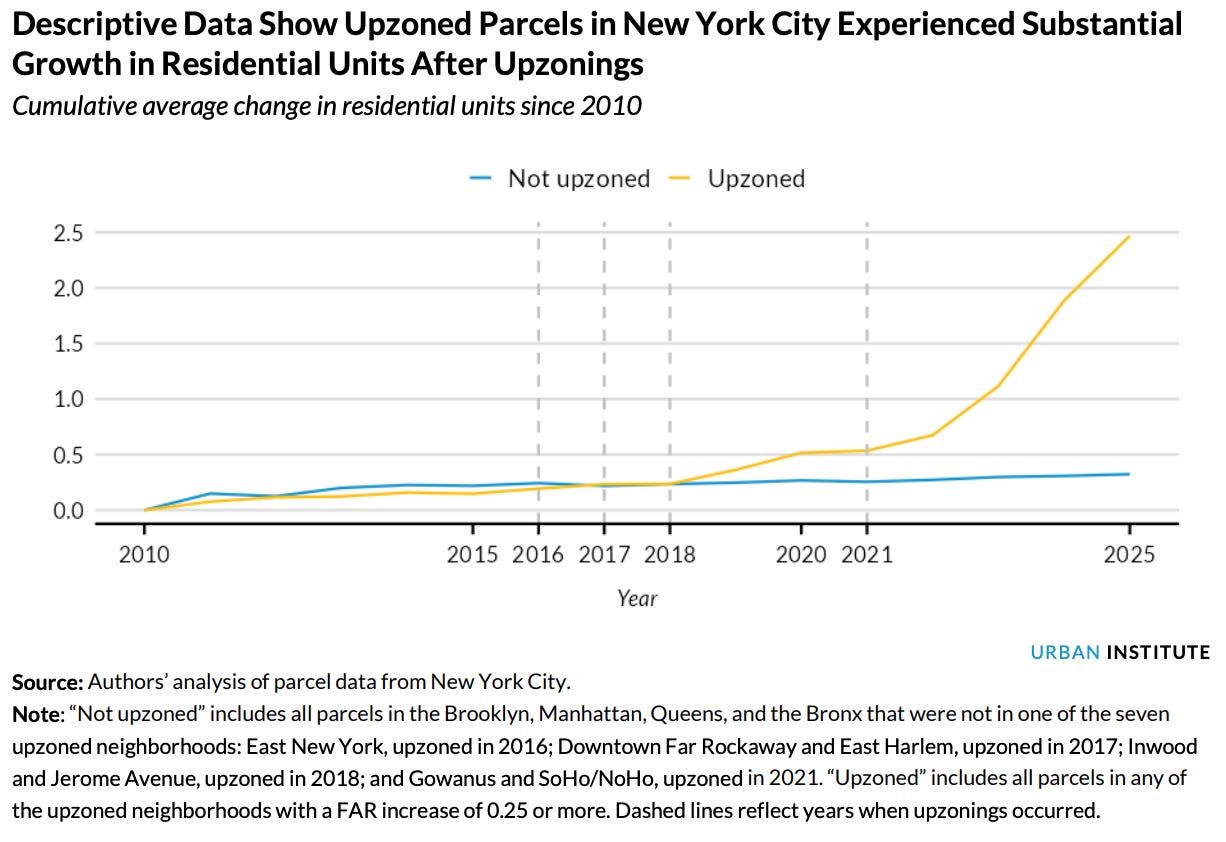
A new Urban Institute piece asks, what happens to housing production after “big upzonings” in strong housing markets? It turns out, a lot. Top economics journals have long considered case studies of upzoning too trivial to publish–it is obvious that lifting a quota on housing production in locations where homes sell for more than the marginal supply cost of homes will result in new housing production. But earlier peer-reviewed research in planning journals had focused on small upzonings that produce small changes–a corollary to our last blog post about the need for feasibility-oriented large upzonings. This new paper begins to fill the case study gap on large upzonings with by-right permitting in strong markets. — Alex Armlovich
Larry Katz, known today as a legendary labor economist, had a precocious side quest in urban economics as an incredibly incisive observer of the downzoning crisis that hit the Bay Area in the 1970s. His Commencement speech on housing at Berkeley recently did rounds on Twitter, but his 1981 article on how growth control regulations in San Francisco drove home prices from near the national median to the highest in the country, in just a decade, goes into even more detail (screenshots there, original is paywalled). Beyond Katz’s direct intellectual contribution, this hauntingly-contemporary time capsule is an important rebuttal to recent and troubling claims that housing underproduction in high-demand US cities only began after single family mortgage underwriting tightened in 2008. It’s important to understand the superstar city zoning crisis, and the roots of the YIMBY academic literature, both date back decades before 2008. YIMBYs should be proud to stand on the shoulders of giants, but also humbled to know simply having the correct answer is not enough to win alone. — Alex Armlovich
Sticking with housing, the burden of the housing shortage is falling disproportionately on new buyers and renters, according to a piece last month by Jess Remington. Prior to 2022, new homeowners and existing homeowners paid a similar share of their income to housing costs (~22% for new homeowners, ~20% for existing ones). But since then, the gap has rapidly grown, with new homeowners now paying 26% of income for homes. Meanwhile, renters who recently moved are paying a record high share of their income to rent - 33%. With the typical age of a new buyer slightly over 40, millennials are especially exposed to this trend - possibly that helps explain why they are the generation with the highest levels of economic anxiety. — Matt Clancy
The President’s Budget for fiscal year 2027 was released earlier this month - while it’s just the Administration’s proposal (actual appropriations will be enacted by Congress later this year), it’s a worthwhile barometer of the Administration’s goals. For the Department of Energy (DOE), the proposal is a stark cut, representing an 11% reduction from enacted FY26 levels for civilian energy programs. As expected, the proposal aligns with the fossil fuel-oriented restructuring that started last year, including $15 billion in Infrastructure Investment and Jobs Act rescissions alongside large transfers to baseload programs and major cuts to most renewable energy offices (worth noting that transfers of this scale would require additional cancellations of obligated awards - it’s not clear where this stands). Former DOE staff at the DOE Alumni Network published a helpful summary that highlights some of the less-expected pieces - for example, the budget proposes rescissions to:
the same grid accounts that funded DOE’s recent SPARK solicitation
accounts supporting hydropower facilities that the same budget proposes targeting with the Baseload Power program
critical minerals processing and recycling programs that the administration announced a new solicitation for last month. — Willow Latham-Proenca
Beyond the budget request, DOE has also been slow-walking grants it already committed to (a similar pause is now in place at NOAA) as well as slowing the pace of the new solicitations and award obligations that keep appropriated funds moving. — Willow Latham-Proenca
In the Endless Frontier, Vannevar Bush famously posited that “scientific progress… results from the free play of free intellects, working on subjects of their own choice, in a manner dictated by their curiosity.” In a characteristically generative piece, Ben Reinhardt suggests that the reign of this framework, which has shaped science policy and practice since WWII, was a historical anomaly that is nearing its end. In its place, Ben calls for researchers to think more deeply about who their customers are, and why those customers would want to “buy” their science. This is not simply a call for shifting research up the TRL scale; reasons for buying research can include not just health or profit, but “wonder, status, guilt, and existential dread” – what’s important is figuring out what it is you’re selling and to whom. This mindset applies not only at the level of research agendas, but also research ecosystems, and Ben highlights the need for the independent research ecosystem (think coordinated research programs, FROs, BBNs) to more carefully define and cultivate its own value proposition for the set of potential customers. Realistic options for what independent research could offer its customers seem to include: superior quality, clear ownership over outcomes, and status; the first seems most compelling to me (and seemingly Ben), so let’s do what we can to prove that one out. — Jordan Dworkin
One thing I’m not reading this week: your writing about metascience policy. If you’d like to fix that, Emergent Ventures just announced a new tranche of grants for (1) metascience policy entrepreneurs and (2) science & metascience communicators. If you’re interested, you can apply through their general portal. — Jordan Dworkin
My friend Lauren Gilbert has launched a new magazine called In Development, aiming to be the New Yorker (or Works in Progress?) for global development. I enjoyed reading the inaugural piece by Paul Niehaus, co-founder of GiveDirectly, on the rise of cash transfers as a form of foreign aid. From the piece, I learnt that a dollar is worth roughly 250 times more to someone living in extreme poverty compared to the average American, mostly because of diminishing marginal utility: at low incomes an extra dollar goes toward basic necessities like food and shelter, while at high incomes it tends to go toward discretionary spending or savings. Another was that Harvard’s IRB nearly killed GiveDirectly’s first RCT on the grounds that giving people money might harm them; they had to argue transfers were safe in order to study whether they were safe. And finally, it was interesting to think about how, while most research on foreign assistance was focused on showing donors how to achieve their priorities, research on cash transfers helps donors understand recipients’ spending and priorities – the most important ones being housing, food and business investment. The idea that people in extreme poverty would spend money they received on alcohol and tobacco instead of basic necessities was in fact unfounded. – Saloni Dattani
Eroom’s Law (the reverse of “Moore’s Law”), for those of us who don’t spend all our days thinking about pharmaceutical innovation, is a term describing the historical trend that the R&D cost of developing a new drug seems to have gone up a lot over the past sixty or so years. Interestingly, the “Law” flattened out since 2010, but it’s merely stagnated, not reversed. There’s a lot of optimism in the biotech world that AI could turn Eroom’s Law in reverse. Investor Elliot Hershberg has a thoughtful essay arguing that the Law emerged partially because only a few large pharma companies are currently able to take promising research leads and commercialize them. That means innovation is essentially “rate-limited” by those firms’ ability to move drugs through the pipeline. What we need are regulatory changes that make it easier for small biotech firms to work through that pipeline themselves. This is one of many reasons we’ve been prioritizing clinical trial abundance here at AGF. — Dylan Matthews
I’ve been thinking a lot about AI lately, and how it relates to the kind of work our team does to try to chip away at bottlenecks to economic growth. One key question here is whether the economy of the 2030s and beyond is going to be, well, recognizable: are most people going to be working? Will they earn enough to meet their basic needs? Will humans be economically necessary anymore? One of the better contributions I’ve seen to this debate is a new post from UChicago’s Alex Imas on the rise of “relational work.” Some stuff, like food, people spend less of their income on as they get richer. Other stuff they spend more on, and this stuff, Imas argues, tends to include irreducibly human elements. Present-day billionaires, for instance, spend more than normal people on just about everything, but especially more on services: spas, waitstaff, private chefs, personal trainers, etc. It’s a compelling case that human labor will still matter and the economy will remain somewhat recognizable, though still very, very different from what we’re used to. — Dylan Matthews
We also wanted to share some updates from our grantees and team:
It’s a good week for evidence that the YIMBY playbook is working. Besides the piece Alex highlighted in our first item above, Nolan Gray looks at the evidence that the policy changes pushed by California YIMBY (one of our long-time grantees) are working.
In the current political moment, how can environmentalists best achieve their climate goals? Aliya Haq of Clean Economy Project at Harvard Belfer Center (a recent grantee) recently gave a talk (video) highlighting the importance of moving from obstruction to meeting clean energy demand, making clean energy faster and more affordable, and creating credible and verifiable measurements.
Earlier this week, Jordan Dworkin blogged here about a new website he has created, ScienceSpending.org, to track how well US science funders are spending down their budgets.
Congratulations to Saloni Dattani for her Ted Talk earlier this week!