


Hope your week is going well! Here's what caught our attention:
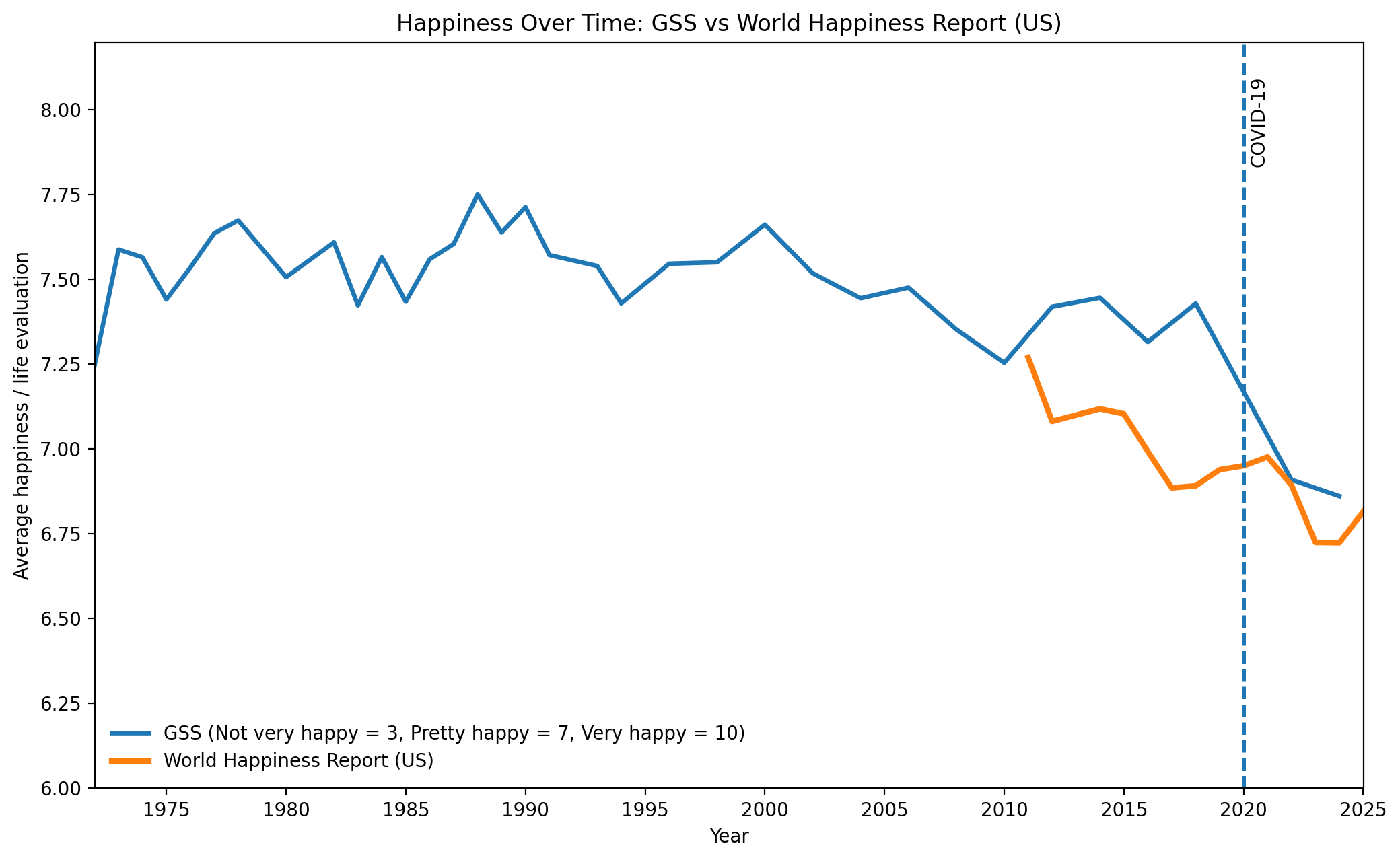
Sam Peltzman has an alarming new paper about American happiness. Since 1972, the General Social Survey (GSS) has asked a random sample of Americans how happy they were, and in the blue line of the figure above I’ve plotted average happiness by assigning numerical values to the possible answers. Peltzman documents a big negative trend break starting around Covid-19, which has persisted into at least 2024, well after the abatement of the worst of the pandemic. I was curious if this was some fluke in the GSS, so in the figure above, I added US data on self-reported life satisfaction from Gallup’s World Happiness Report. Gallup only has data from 2011 to 2025, and the two series do not exhibit the same year-by-year fluctuations. Nonetheless, both show American well-being remains near unusually low values, at least circa 2024 and 2025. — Matt Clancy
When I’m arguing to more AI-pilled friends that the tech’s diffusion through the economy might be slower than they think, one of my go-to examples is “doctors still use fax machines.” But another good one, that I just learned from global development expert Todd Moss, is “31 percent of the World Bank’s policy reports are never downloaded, but the bank still writes them.” It’s not just the World Bank, though; NGOs and think tanks across DC and the world are putting out myriad reports, dozens if not hundreds of pages long, every month, despite compelling evidence that very few people read them. The biggest problem with this, as Moss says, is that it’s a tragic waste of talent: “The opportunity cost to busy people – who should be world-leading experts on vital social, economic, and political issues – is actually mind-boggling. Imagine the social good such smart capable people could do with all the time not spent on long reports.”— Dylan Matthews
Everyone’s talking about building codes! Though we have not yet fixed most of the obvious growth control regulations, like zoning, permitting, & procedural review laws, housers are also looking ahead to the more obscure rules that set breakeven construction costs, especially the building code. Though YIMBYs have been looking into building codes since 2020, and scholars long ago archived express regulatory intent to use building codes to shadowban apartments in the 20th century, YIMBYs didn’t have a building code agenda until the 2021 breakout of “single stair” reform popularized by Eliason, Speckert, & Smith, and more recently elevator reform, plumbing, and more. California YIMBY just summarized an excellent UCLA Lewis Center report on how the building code writing process works and how we got where we are now. — Alex Armlovich
Our AGF post on the “Zoned Capacity Illusion” got a warm reception, with shoutouts from NYC’s Deputy Mayor during Mayor Mamdani’s Reddit AMA on housing; and from Matt Yglesias on why YIMBYs need to center zoning feasibility in addition to incrementalist zoning strategies. In high-rent cities, where construction costs for hi-rise fireproof construction will pencil if allowed, Missing Massive is an essential tool for unlocking what Jane Jacobs called “cataclysmic money”, a.k.a. an upzoning for large multifamily, in the most attractive central locations, that pencils out immediately instead of decades from now. — Alex Armlovich
The National Science Foundation’s 2027 budget request makes for some high variance reading. Two things that have me excited are the proposal for an NSF metascience unit to “champion agency-wide efforts to explore non-traditional R&D funding mechanisms and drive evidence-based optimizations to the R&D
portfolio” and the request for $50mn to the NSF Tech Labs (a number I hope grows). A metascience unit at the NSF is the kind of thing metascience geeks have dreamt of for many years. But two things that have me the opposite of excited are the proposal to eliminate the Social, Behavioral, and Economic Sciences Directorate and cut overall funding to the NSF by a 55%. Fortunately, appropriations are set by Congress, and last year they largely ignored the proposal for a similar cut (this tweet by IFP’s Matt Esche provides a lot of useful context for how to interpret this proposal). My hope is that we land in a world where we avoid the bad parts of the proposal and retain the good bits. — Matt Clancy
The legal fight over the NIH’s proposed 15% indirect cost cap is over (for now). STAT reports that the administration let the Supreme Court petition deadline pass without filing, ending 14 months of litigation. The courts found that NIH violated congressional appropriations language in trying to unilaterally replace negotiated rates. But indirect cost reform isn’t off the table; the administration may still attempt changes through OMB’s Uniform Guidance, and Congress is looking at alternatives like the FAIR model. If you want to understand the substance, two pieces are worth your time. This week, writing for the Good Science Project, Jeremy Berg published a detailed explainer that walks through how indirect cost (IDC) rates are negotiated, what they cover, and common misunderstandings. And over the summer, Pierre Azoulay, Daniel Gross, and Bhaven Sampat wrote a policy brief for IFP (adapted from their NBER working paper) unpacking the history of IDCs, the details of their calculation and implementation, and the pros and cons of proposed reforms. A key takeaway from both is that the negotiated IDC rate and the percent of total funding that universities take home for indirect costs differ significantly, primarily because (a) not all direct costs or grant types are eligible for IDC funding, and (b) the numbers use different denominators. For example, a 50% negotiated IDC rate applied to a grant with $1mil of direct costs, $250k of which are exempt from indirects, would yield: a total indirect cost of 50% * ($1mil - $250k) = $375k, for an effective IDC rate of $375k / $1mil = 37.5%, and a total indirect cost share for the university of $375k / ($1mil + $375k) = 27%. If that’s not clear, don’t worry, the administration conflated the total indirect share and the negotiated rate in their original 15% cap announcement too. — Jordan Dworkin
Niko McCarty, founder of Asimov Press and now a fellow at Astera Institute, recently ran a bounty to surface new ideas to reduce the cost of lab experiments in biology. I found his reflections really interesting. He received far more interest than he expected (430 submissions in total), and though he expected to award prizes to only 4, he ended up awarding 20. Some ideas I found interesting were: “a protein printer fabricated using DNA origami” and a way to run protein synthesis reactions on a gel filtration column. He explains that the micro-grants (<$5000 each) aren’t likely to push the projects forward materially, but might still do so by providing a vote of confidence in them. — Saloni Dattani
And we hope Willow is enjoying some beach reads while on holiday this week!

Some updates from our team and grantees:
Matt Clancy published A Little Progress Is Worth a Trillion Dollars this week, making the case for why even modest improvements in economic growth have enormous value over time. The post is part of a suite of related projects: a web tool where you can adjust assumptions and see how different growth scenarios play out, and an interactive explainer walking through the model step by step.
The Institute for Progress published a new analysis of Section 901 of the ROAD to Housing Act, examining how the Build-to-Rent provisions would affect rental housing supply and what the exemptions mean for innovative construction methods.
Ben Holland joined David Roberts on the Volts podcast to discuss why climate funders should be investing in housing policy - arguing that reducing housing costs in climate-vulnerable regions and enabling dense, transit-oriented development are critical climate strategies that philanthropy has largely overlooked.
Clinical trials today are highly bureaucratic, expensive, and time-consuming. Most trials fail to recruit enough participants to answer their questions at all. A great new post by Adam Kroetsch explains how things got this way.