

In 2019, Tyler Cowen and Patrick Collison wrote an article for The Atlantic titled We Need a New Science of Progress, which helped kick off the Progress Studies movement. In that article, they wrote:
For example, if our discoveries and inventions improve standards of living by 1 percent a year, children will by adulthood be 35 percent better off than their parents. If they improve livelihoods at 3 percent a year, those same children will grow up to be about 2.5 times better off. Whether viewed in terms of large or small improvements, progress matters a lot.
This is a common rhetorical strategy to justify why we ought to care about faster progress, and it’s one that I agree with: the magic of compounding means small differences in growth rates, sustained over time, add up.
But the case for caring about progress doesn’t rely only on the magic of compounding interest rates. Even small one-off changes in the rate of broadly shared progress are worth huge sums.
Ballparking the value of a small boost to progress
Let’s illustrate this by estimating the value of a relatively small one-time increase in the rate of technological progress. Economists like myself generally assume increases in living standards are brought about by technological progress, so let’s consider the impact of a one-time increase in the rate of per-capita economic growth from 2% to 2.1% in the United States (2% is the long-run average). After one year of faster growth, assume we drop back down to the usual 2% per year. Going from 2% to 2.1% would be a 5% relative increase in the rate of growth. What would that be worth?
To ballpark it, consider that US GDP per capita is around $90,000. Growing by 2.1% instead of 2% means this increases by an extra 0.1pp, or $90 per person. Shared over 340 million Americans, that works out to $30.6 billion.
But that’s only in the first year. Even though we’re imagining a one-off change in the rate of progress, that doesn’t mean the benefits are one and done. Technological progress is a cumulative process, where new technologies are built off older ones. If we grow by an extra 0.1%, in the next year we’ll be working off a slightly more advanced technological base from then on. So even if we drop back down to the historical average rate of 2% per year thereafter, we’ll still be 0.1% richer than we otherwise would have been. It’s like a runner who briefly sprints before reverting to their former pace. Even after they are no longer sprinting, they remain ahead of where they would have been, had they merely maintained a steady pace.
To keep things simple, let’s assume the current cohort of Americans enjoys an additional $90 per year for the rest of their working lives and not worry about discounting (we’ll come back to that). The average American is about 40 today, so if they retire at 65, that’s 25 years of earning another $90 per year. Ninety dollars a year, over 25 years, across 340 million people is $765 billion.
Another important benefit flowing from technological progress is health. In the USA, life expectancy has been on a long-run upward trajectory, increasing by about 0.1 years per year for several decades.1 If we think that is mostly driven by technological (in this case biomedical) progress, then an increase in the rate of progress should also have some health benefits. Just as we increased the rate of economic growth by 5% (going from 2 to 2.1%), let’s increase the annual gains to life expectancy by 5%: that means during our year of accelerated progress, we’ll add 0.105 years to life expectancy instead of 0.1. That’s an increase of life expectancy of 0.005 years, or 1.8 days.
To put a crass dollar value on that, let’s turn to the Value of a Statistical Life Year.2 The US Department of Health and Human Services has a range of estimates of the Value of a Statistical Life year, ranging from $282,000 to $1.5 million (see Table 3). The conservative lower bound will work fine for us. If we assume an extra year of progress yields an extra 0.005 years of life expectancy, this is valued at $1,410 per person. Across 340 million Americans, that’s $479 billion.
Add the long-run income and health benefits up and the upshot is this: the health and income benefits of a 5% one-time boost to the annual rate of technological progress are in the ballpark of $1.2 trillion.
Leaving the ballpark
The above calculation is illustrative, but takes a lot of shortcuts. It ignores changes in population. It assumes economic benefits are $90 per year, which is not correct if we assume growth is exponential. It ignores the impact on people not born today, who might still benefit from technological progress. And it doesn’t properly discount for benefits that arrive in the more distant future.
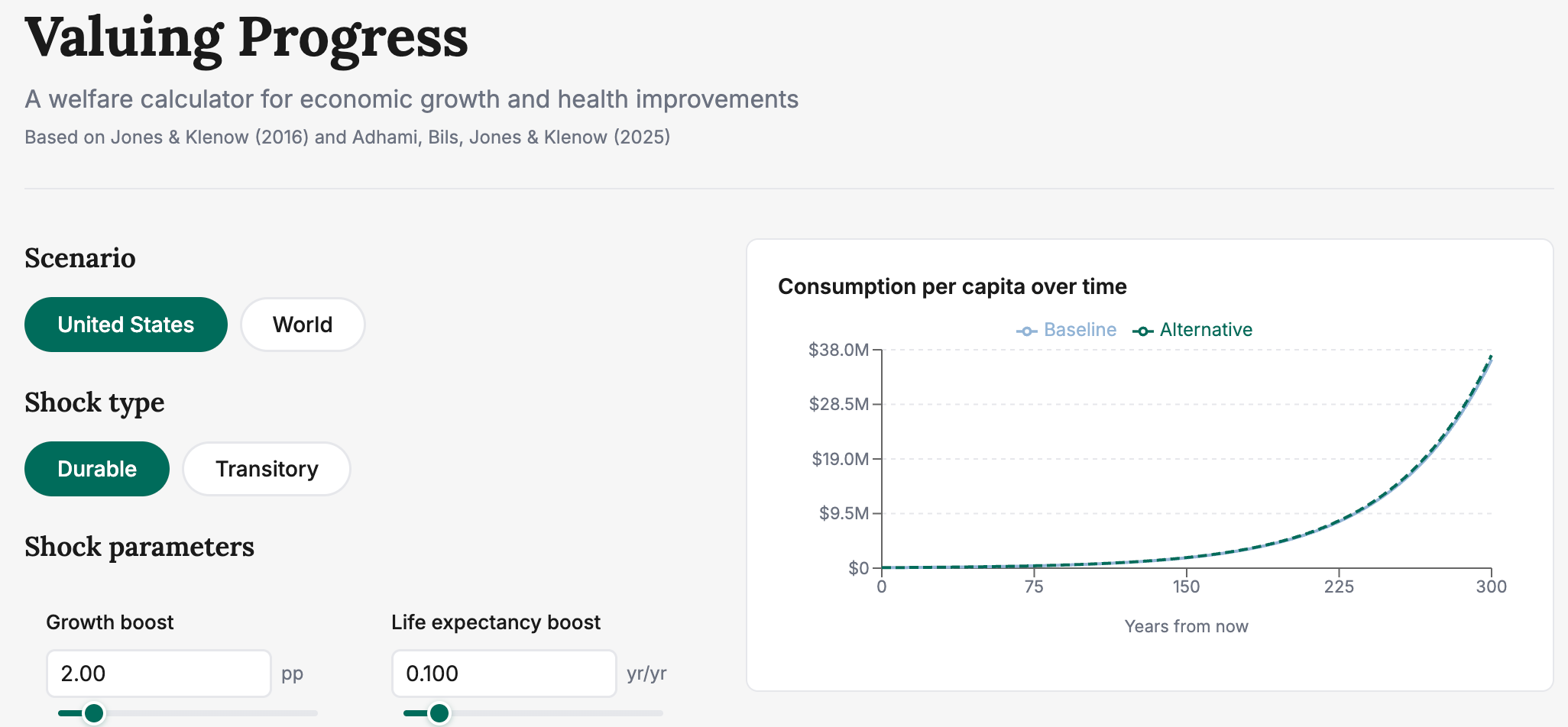
To try and capture all that, I’ve built a simple economic model that incorporates all this and more, and with the help of Claude code I’ve written a web tool you can play around with to value different kinds of interventions to the rate of progress. Under my default settings, this more realistic model also values the above policy change at $1.2 trillion. If you are interested in using this tool, read the explainer here. We’ve also put the underlying code up here as a commented python file, in case you want to build your own version. Just give the code to a frontier LLM and ask it to modify it to incorporate any changes you want to make.
What is an ocean but a multitude of drops?
The important takeaway from this exercise is that even tiny increases in broadly shared progress are almost inconceivably beneficial. Mechanically, this is because we’re assuming the kind of progress we care about is shared by many people over many years.3 The import of this fact can be hard to grasp intuitively. We’re all individuals, but this is a situation where focusing on an individual experience can give us the wrong intuitions. As individuals, if we think of what it would be like to be 0.1% richer and live an extra 1.8 days, it seems good but hardly something to get passionate about. But aggregated across the generations, the import is qualitatively different. The extra income cumulates to hundreds of billions; the extra days add up to more than a million years.
If we take the conclusions of this post seriously, then we should be willing to put a lot of effort into raising the rate of progress. And I see that as precisely what we, and the broader abundance and progress studies movements, are trying to do.

These gains stalled out during covid, but they are rising again. For the purposes of this thought experiment, this doesn’t substantively affect the conclusion.
This is derived from the Value of a Statistical Life, a measure of how much society is willing to pay to reduce the probability of death. It is sometimes inferred by the wages that are necessary to induce people to accept more dangerous work.
There is a rich philosophical tradition debating the implications of summing up individual welfare. As we discuss in more detail in our explanatory essay about our web tool for valuing progress, the way we approach this is to value progress by the cost of endowing a fund to provide cash transfers to people now and in the future, which are sufficient to compensate them for foregone progress.
This analysis completely fails from a longtermist perspective. See Paul Christiano's 2014 EA Forum post On Progress and Prosperity. Also recommended: Zach Stein-Perlman's LessWrong quick take comment "Value Is Binary."