


The 2027 National Science Foundation Budget Request proposes to eliminate the Social, Behavioral, and Economic (SBE) Directorate, which funds social science research.1 So far, all signs suggest it means to follow through on this proposal (the NSF’s SBE Directorate has made essentially no research awards so far this year, which is highly atypical). We care a lot about R&D at the Abundance and Growth Fund, but let’s set aside for a minute the question of whether the NSF should be supporting social science research.2 What I find interesting about this whole episode is that we’ve been here before, a little over 40 years ago.
Reagan Revolution
Let’s go back to 1981, shortly after Ronald Reagan took office. The following account of the social science fights of the first Reagan administration are based on a few histories of the period that I read earlier this year.3 The Reagan administration ultimately ended up cutting inflation-adjusted non-defense R&D by a third by 1983, but it was especially hostile to the social sciences. In the FY1982 President’s Budget, the administration called for a sharp reduction in spending on social science research, more severe than proposed for the overall NSF.
The Executive Branch wasn’t an outlier though; Congress was also skeptical. In the same year, it passed a rescission package reducing the appropriated funds for social science at the NSF by $10mn, out of a total allocation of $33mn (Congress eventually restored $1mn). The next year, the Reagan administration proposed cutting the NSF social science budget from the post-rescission level of $24mn by an additional $14mn, but Congress split the difference and appropriated funds equivalent to another $6.4mn cut. Funding bottomed out in 1982 and then began to slowly recover. But the social sciences would not attain the inflation-adjusted level of funding they had enjoyed in 1980 until 1996.
While the scale of these cuts caught the social sciences off guard, they didn’t come out of nowhere. Support for social science research at the NSF had always been more tenuous than other fields: some draft legislation founding the NSF had even banned the social sciences from receiving funding, though an outright ban wasn’t in the legislation that ultimately established the NSF. Decades later, in the lead up to the 1981 cuts, multiple bills had been proposed that cut social science funding at the NSF (one passed the House, but not the Senate, in 1979). Social science research was also the frequent subject of ridicule, for example via Senator Proxmire’s “Golden Fleece” awards, which kicked off in 1975 with a criticism of an NSF-funded social science study on why people fall in love. Perhaps as a consequence of all this doubt, funding for the social sciences had been growing at a significantly slower rate than other sciences at the NSF leading up to the 1980s.
Make America Great Again
Fast forward 44 years to 2025, and the second Trump administration had just come into office. It also arrived highly skeptical of federal support for R&D; President Trump’s FY2026 budget proposed a 20% cut to overall R&D, with much larger cuts for non-defense R&D (57% at NSF, 40% at NIH4). This time, however, Congress was not on board with the proposed cuts. The normal appropriations process for discretionary spending (like R&D) is subject to the filibuster, which means any large cuts to NSF and NIH would have had to garner supermajorities to pass. This meant a large cut through the normal appropriations process was pretty unlikely.
That said, it was possible Congress might pass large cuts at the NSF and NIH with a rescission package instead. Rescissions are a mechanism for the executive branch to seek approval not to spend appropriated funds, and as noted above, Congress passed one in 1981. Through much of 2025, the administration’s spending at NIH and NSF was below trend (see figure below); a large pot of unspent funds near the end of the year could potentially be used as a pretext for rescissions, which unlike normal appropriations, can be passed by a simple majority.5
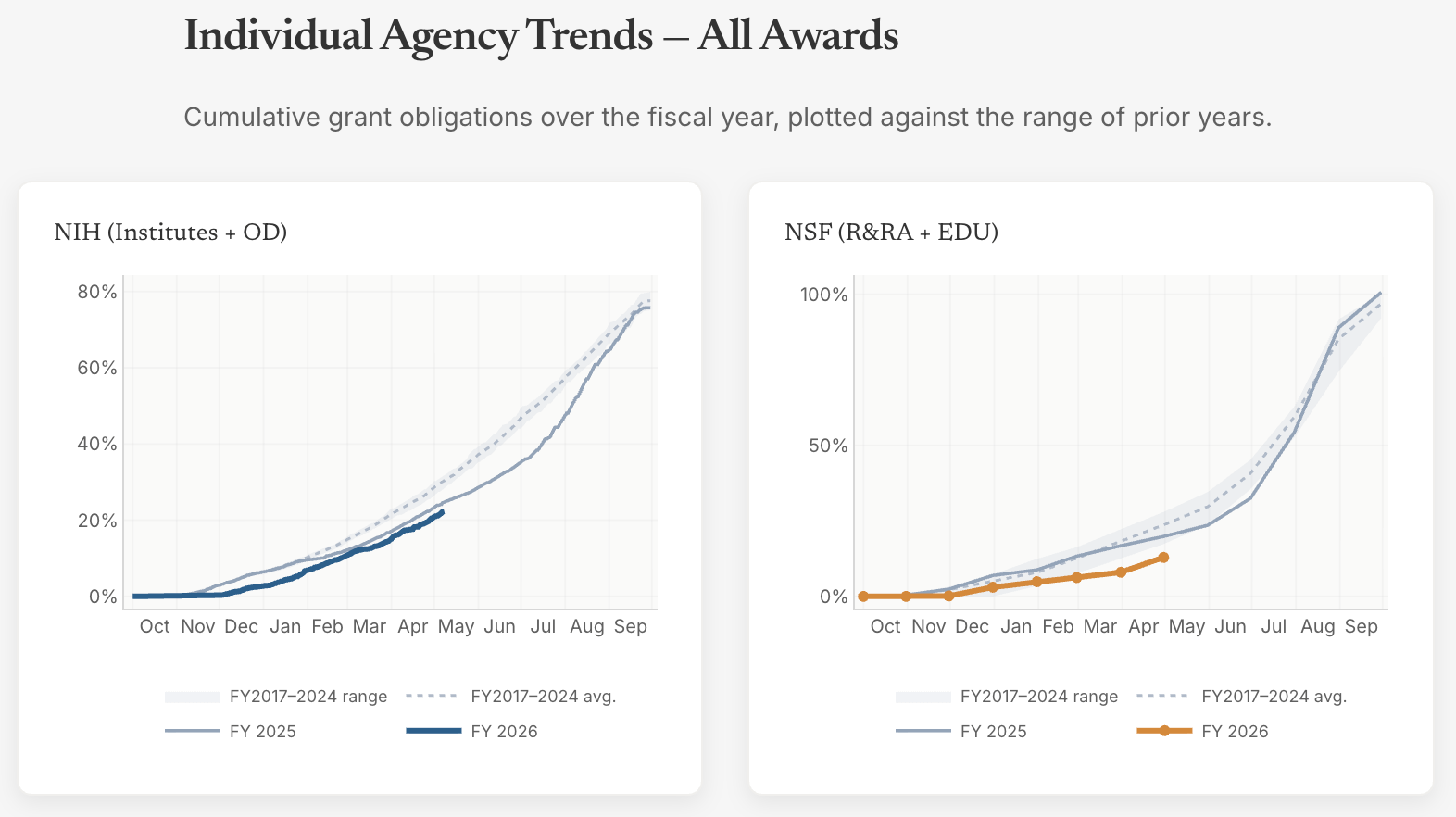
However, that isn’t what ultimately happened. In the second half of the summer of 2025, spending at NSF and NIH accelerated and ended the year on trend or above (see figure). No rescission packages targeting R&D were proposed. And the eventual appropriations from Congress cut the budget of the NSF by 3.4% (roughly $300mn), rather than 57%. The budget appropriated for NIH actually increased.
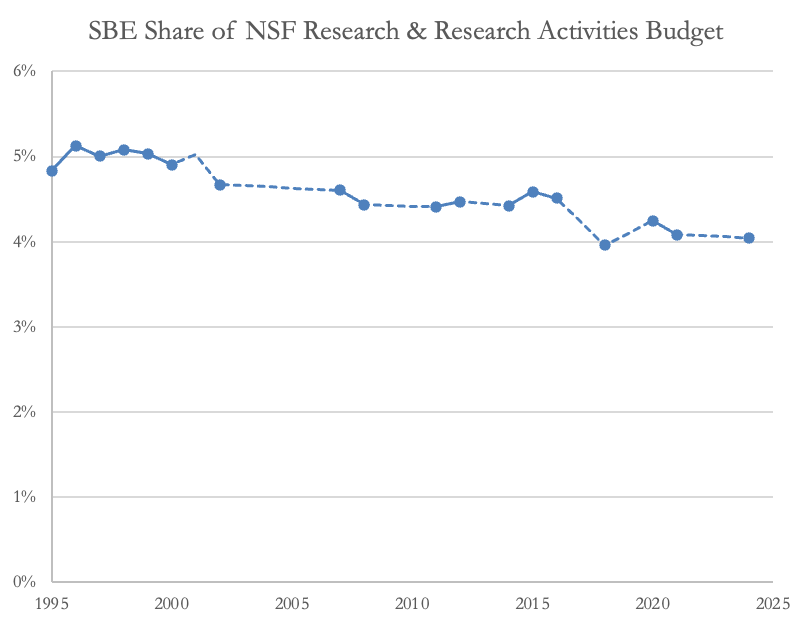
The social sciences, however, fared worse. As under the Reagan administration, one can see some indications that support for the social sciences has been less robust than for the rest of the sciences for many years. SBE as we know it today was formed in 1991, following years of advocacy from social science associations. But since then, support has gradually weakened, relative to the overall NSF Research and Research Activities Budget. While it made up 5% of research spending in 1995, that has drifted down to 4% at the time the Trump administration took office.
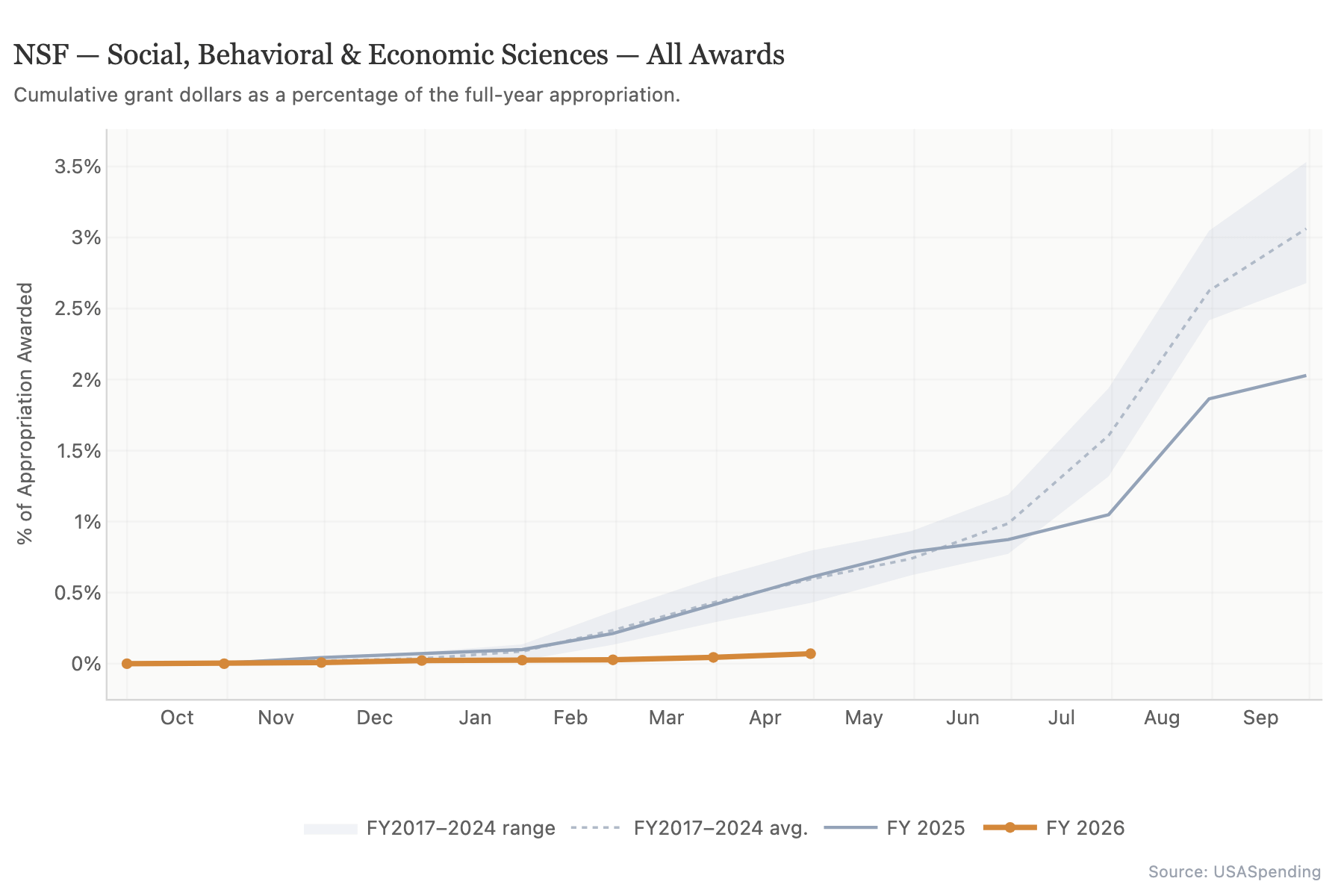
In 2025 though, support plunged. At SBE, spending in the first half of the year was on trend. But spending in the second half of the year failed to keep up with normal trends and the budget for the social sciences ended the year significantly below trend.6 And five months into the new year, new spending is close to zero.
What happens next?
Perhaps the past can give some clues as to how things might unfold in the future this time around. In response to the 1981 cuts, various disciplinary associations of social sciences founded the Consortium of Social Science Associations, an organization that had been previously proposed but never formally established. This new organization, COSSA, followed a pretty standard playbook to influence the US Federal budget: it hired staff to lobby Congress; mobilized social scientists to visit, telephone, and send letters to their representatives; focused on winning over members of Congress with large universities in their district; and targeted both Democrats and Republicans as part of a message that funding for the social sciences was not a partisan issue. The size of the proposed cuts (the 1982 proposal was a 75% cut relative to what the previous administration had proposed) also galvanized significant media coverage.
The timeline is consistent with this response working, at least a bit. COSSA would have had more time to develop and execute its strategy ahead of the 1982 budget battles than the 1981 rescission fight, and the budget cuts in 1982 were indeed smaller in absolute terms and as a share of the administration’s proposal, than the 1981 cuts. That said, if the campaign moderated the proposed cuts, it could not stop them. According to a contemporaneous article by James Zuiches, the partial reversal of the cuts that began after 1983 owed less to anything specific the social sciences did, and more to a renewed interest by the Reagan administration in research in general. Social science benefitted from the halo around all research (though even so, its growth rate remained below the growth rate of other sciences at NSF).
COSSA is still active today, but it’s less clear what Congress can do in 2026. The explanatory text for the latest NSF appropriations package already specified “No directorate shall receive more than a 5 percent reduction relative to the fiscal year 2024 enacted level.” However, while the overall budget of the NSF is set by Congress, the executive branch has considerably more latitude in how that funding is allocated (see my colleague Jordan’s earlier blog post about this). The preceding explanatory text, for example, does not have statutory force (though such statements usually guide agency actions).7
Zooming out, is there some future where the social sciences can enjoy the levels of political support more common in the life sciences and hard sciences? That’s an interesting question, and one I’ll come back to in a follow-up to this post.
Note: there will be no “What we’re reading” blog post from the Abundance and Growth Fund this week, as a large share of the team is traveling.
This does not mean all social science research will necessarily cease. The request states “Continuing grants that align with Administration priorities, such as in behavioral and cognitive science, ... will be transferred to other parts of the agency.”
I think so, and plan to write more about the utility of social science in the future. But for now, curious readers should check out the Journal of Economic Perspectives’ 2016 symposium on this question, with Tyler Cowen and Alex Tabarrok taking the skeptical position and Robert Moffitt arguing in support.
Originally for our weekly “What we’re reading” blog post, but I had too much to say!
And in fact, a rescission package targeting foreign aid was passed in 2025.
In FY25 the directorate awarded roughly 40% less money in new grants, and 30% less money overall, than it typically has in recent years.
Congress could make it law in future appropriations.