


Here’s what caught our attention over the last week:
Where is housing slow to build? — Alex Armlovich
Giving up on homeownership — Matt Clancy
Taste vs. cost — Nisha Austin
Why biotech companies go to Australia — Saloni Dattani
The real math was the dead-ends we found along the way — Jordan Dworkin
Data center announcements and property values — Willow Latham-Proenca
Where is housing slow to build? — Alex Armlovich
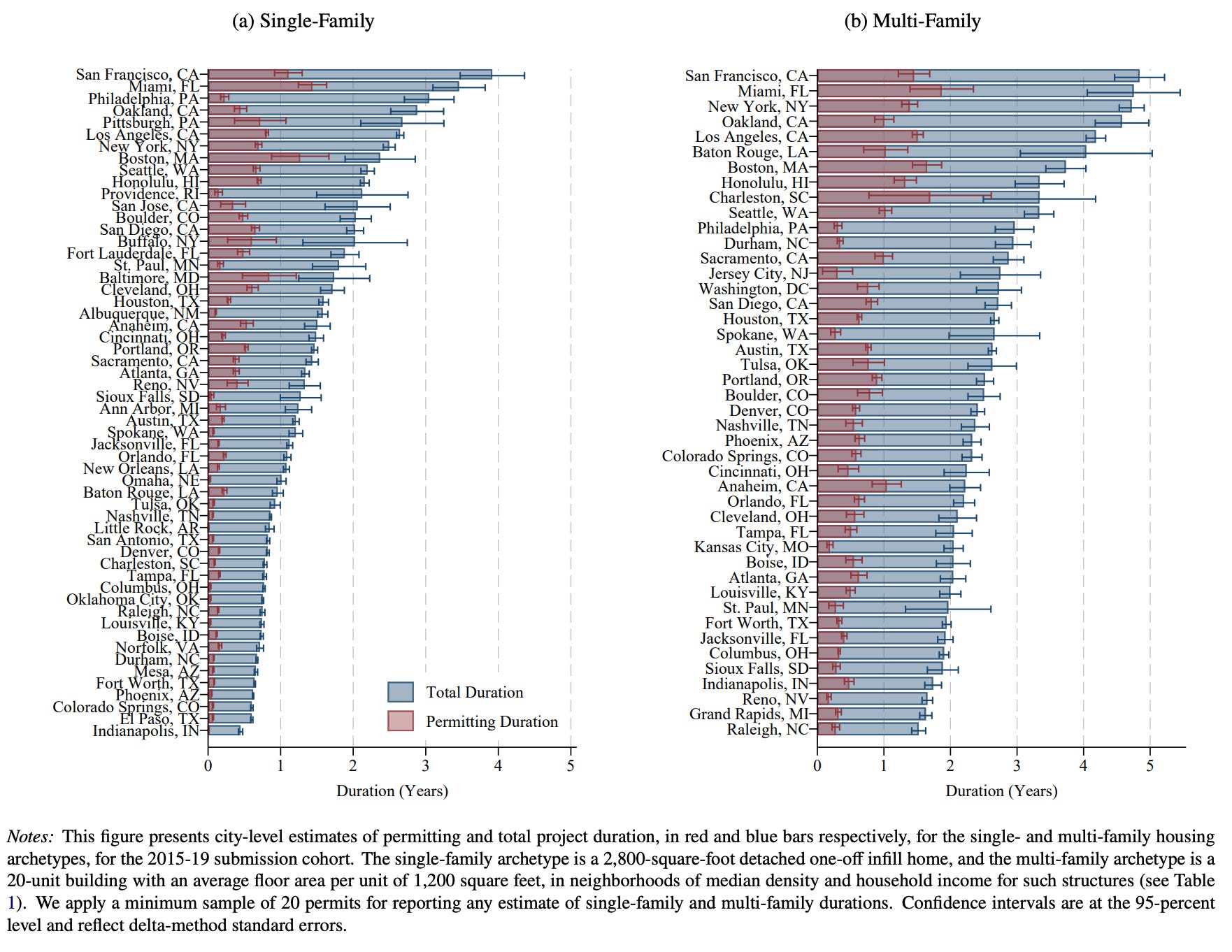
Evan Soltas has a big first-of-its-kind paper measuring permitting and construction durations for standardized housing projects across 60 US cities from 2000 to 2025: A standardized 20-unit apartment building takes 4.6 years from permit submission to completion in coastal cities like LA, New York, and San Francisco, but just two years in Sunbelt cities like Raleigh, Orlando, and Phoenix. The fastest cities finish entire multifamily projects in the time the slowest cities take to merely approve a permit. Across cities, each additional year of permitting time is associated with 39% higher rents, an economically and statistically huge relationship that survives controls for income, density, and neighborhood characteristics.
Tragically, permitting is getting slower: the probability that a multifamily project gets approved within six months fell from 71% in 2000 to 44% in 2025, holding project characteristics fixed. Construction time fluctuates with the business cycle but shows no secular trend…in other words, the problem is permitting, not building. This paper is the knockout blow the YIMBY movement has been missing: systematic evidence that permitting generally, and permitting delay specifically, does indeed belong in the “growth control toolkit” hall of shame as a first-order regulatory driver of housing costs alongside zoning. Beyond the paper’s findings, I like to note that obvious out-of-pocket carrying costs during development aren’t the only source of permitting time project savings: Because of the pure time value of money, moving the exact same cashflows forward in time mechanically increases returns and project viability even if carrying costs are zero.
Giving up on homeownership — Matt Clancy
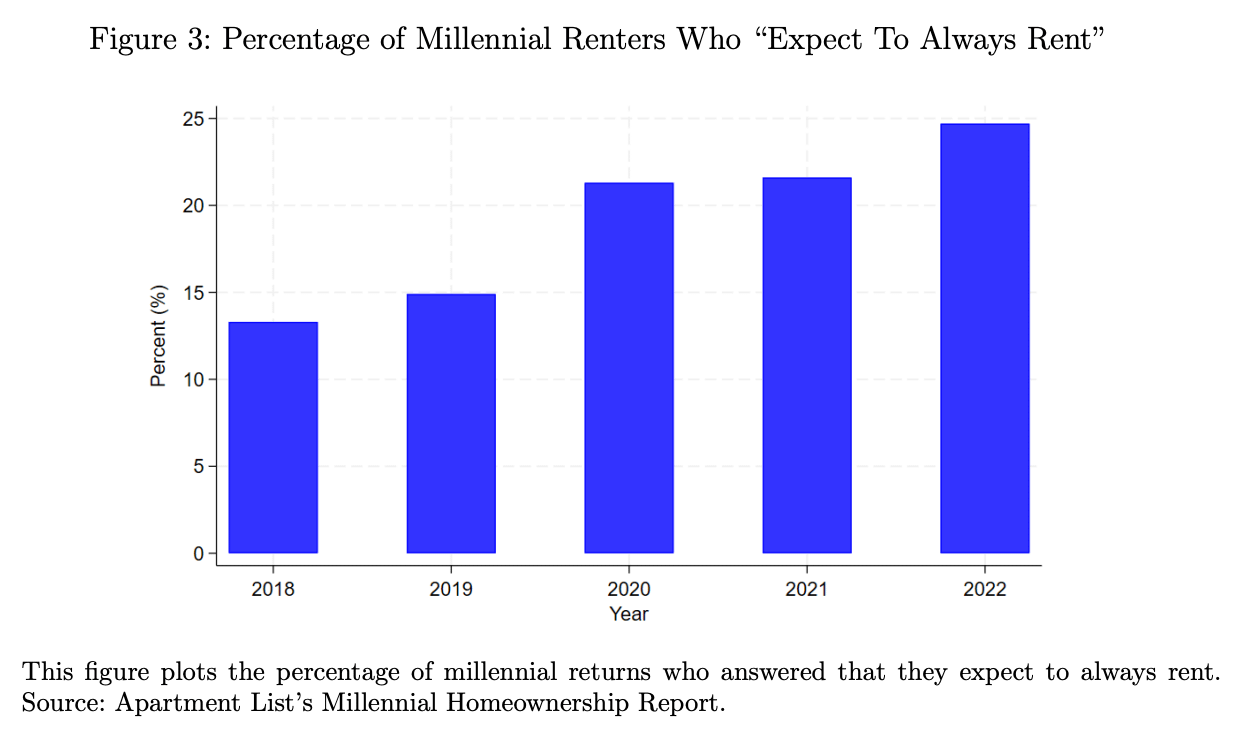
As I’ve written before (see item #3 here), the housing shortage is disproportionately affecting the young, with first time buyers and renters paying unusually large shares of their income to housing, compared to long run trend. A 2025 working paper by Lee and Yoo looks at what happens when owning a home becomes out of reach. They argue that when people decide that a home of their own is unattainable, they give up on home ownership which leads to a cascade of behavior changes: less saving, less hard work, and more interest in riskier investments.
Lee and Yoo present a variety of evidence to back up their argument. The share of Millennials who report they expect to rent forever has risen from under 15% in 2018 to 25% in 2022, and the share who say they currently have $0 saved for a house down payment is up from 48% to 67% over the same period. Lee and Yoo also conduct several comparisons of renters and homeowners, focusing on people with a low to medium net worth: this group has higher monthly credit card spending, is more likely to say “ Working hard: always giving my best effort” is not important, and more likely to invest in cryptocurrencies. These behaviors can be reinforcing; those with an income just below the threshold needed to buy a house end up with much less wealth and income than peers whose income is just above the threshold. The paper is a bit of a grim complement to the set of papers I recently wrote about for my post The non-material consequences of growth, which looked at how slow growth is associated with less trust in your government, less trust in democracy, and more zero-sum thinking.
Taste vs. cost — Nisha Austin


My career began in architecture, so reading Robert Kwolek on whether people prefer traditional buildings and Samuel Hughes on ugliness and housing, I wasn’t surprised that architecture students want different things than everyone else. We do! Part of it is that we are trained to imagine ourselves standing in the room rather than looking at the facade, and that is hard to unlearn. And part of it is that we think “modern” is the harder problem. Classical at any scale is often reproducing something already designed, or scaling up something that already exists, and I’d argue plenty of it isn’t really designed at all, certainly not to the degree a context-appropriate modern building is. Also, a lot of what these surveys call modern is actually postmodern, which is a different conversation.
Kwolek ends on the question worth pointing out here: “Why are we commissioning styles that we say we dislike?” I think the answer is mostly that almost none of us are commissioning anything. Architecture and engineering came to 1.5%, or $6,480, of the $428,215 it cost to build the average American home in 2024. Only about one in five new single family homes is built for a particular owner on their own land, and the ten largest builders account for 44% of all new single family closings.
I have a related personal anecdote: we are swapping our home oil system for heat pumps, which means sealing the envelope, which means replacing the siding, which is about as close to a free opportunity to change how the house looks as we will ever get. Both the material and the design costs of going more contemporary would have been significantly higher, so we’ve landed on a nominal material update and effectively no aesthetic change (same color, scale, etc), though I would have readily gone the other way if the cost had been comparable. I assume a lot of these types of decisions land here, and for the same reason, and that most of them are about houses that already exist rather than houses anyone is commissioning.
Of our collective affordability problems this is very much the least of them. But if a dread of ugliness really is hanging over our cities, maybe the lever is cost rather than taste. About forty jurisdictions now pre-review house plans and publish them, which either solves the problem or hands everyone the same house, and I don’t actually know which. How to make good design cheap and widely available is a question for another day!
Why biotech companies go to Australia — Saloni Dattani
This week I read what I wished I was reading last week: a detailed explanation of how Australia’s clinical trial system compares to that of the United States. The key difference is in their phase one trials, which are the first test of a new drug in humans. They’re used to get an initial sense of the drug’s safety, but can also provide biological clues as to its efficacy, and be used to learn, iterate and improve, before drugs progress into the later and more expensive stages of clinical trials. In a recent report for IFP, Ruxandra Teslo and Adam Kroetsch explain why Australia does these trials faster: in short, they use more streamlined pathways and make asks that are proportional to risk.
I found the specifics quite interesting and sometimes surprising: in the US, the FDA decides whether a phase one trial can proceed, while in Australia, this is left to independent ethics committees. Drug developers in the US generally get only one formal meeting with the FDA before submitting their application to start a phase one trial, while Australian committees can meet with them weekly, which helps them learn more precisely what to include. FDA reviewers typically ask for months of stability testing for the drug, even if it is only used for hours, days or weeks, while Australia asks for testing that covers the dosing period. Australia also accepts research-grade components for the laboratory tests in an application, rather than pushing developers toward using commercial grade components, as the FDA tends to do. Australian developers can also submit different components as they become ready, rather than waiting to compile everything at once. And while US applications face a fixed 30-day waiting period before the trial can proceed, Australia’s do not. All that results in a more streamlined process that’s, in my view, more reasonable, predictable and, on average, several months shorter.
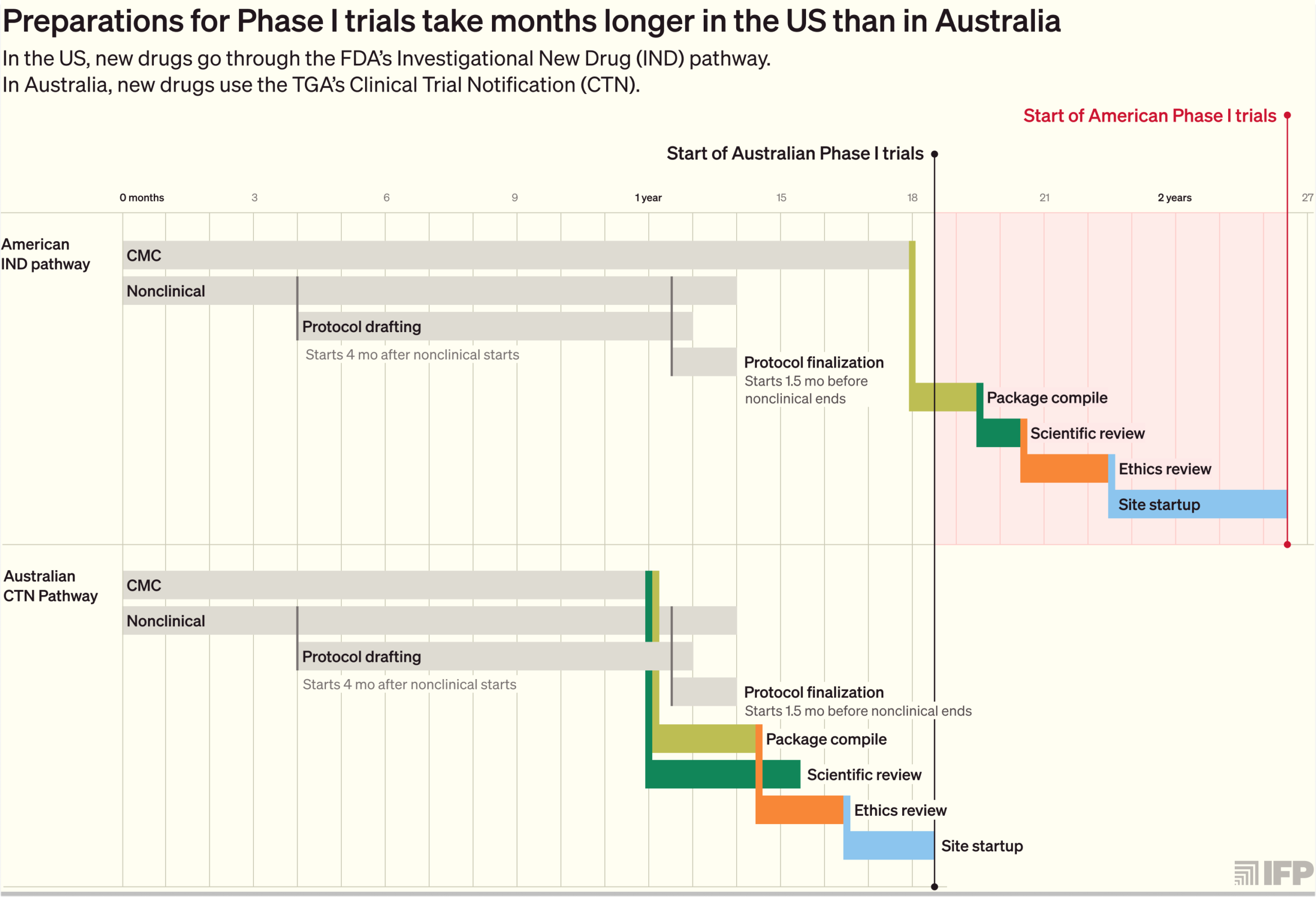
This all matters because delays have a range of consequences. One, for learning: the process of iteration and learning happens faster if scientists can start running trials faster, which hopefully improves a drug’s success rates at later stages. Another is for patients in the trials themselves: if they have a terminal disease, months of delay can mean it becomes too late for them to receive the drug. And this effect applies more broadly to patients outside trials too, if the overall timeline (from research to an effective drug becoming available) is reduced. It’s a great example of how, sometimes, saving more lives isn’t about improving a new drug’s efficacy, safety, or accessibility, but just getting it to patients faster.
The real math was the dead-ends we found along the way — Jordan Dworkin
Back in May I wrote about David Bessis’ essay “The fall of the theorem economy”. In it, he argued that theorem proving has historically been a reliable proxy for producing conceptual innovation and insight in mathematics, but that this coupling was contingent on the manner and pace with which mathematicians conducted, shared, and canonized their work; AI – by breaking that coupling, hyperoptimizing on the proxy itself, and making an end run on the socially rewarded output – could thus dramatically speed up result-generation without a corresponding increase in knowledge.
The past few weeks have brought these concerns back into the spotlight. On September 8, OpenAI announced a resolution of the Navier-Stokes existence and smoothness problem (one of the Millennium Prize problems) produced by an internal model running roughly 10,000 coordinating agents. A few days before the announcement, Terry Tao wrote a thoughtful and prescient thread laying out why scenarios like this troubled him, somewhat eerily using Navier-Stokes as his animating example. His concern was an extension of Bessis’: problems like Navier-Stokes are valuable primarily for the insights thrown off in the process of trying to solve them, rather than in the solutions themselves. The failed paths, the new obstructions, and the unexpected connections can add more value to the field than a regularity result itself adds to our knowledge of fluid dynamics. An agent swarm that runs that entire iteration internally in a day and then emits only the solution is therefore producing a fraction of the value that a comparable human-led solution might provide, even if the proof itself is easy to understand and canonize. If the underlying process is shared, it may be possible (with a lot of help from AI agents) to sufficiently parse the preceding work and recover some of that insight; but not when the process is obscured by the labs or researchers. A few days after the OpenAI announcement, 25 Fields Medalists released a signed declaration titled A Severe Misalignment of AI in Mathematics. The declaration makes a series of related arguments, warning against rushed, benchmark-driven production of proofs and highlighting the misalignment between the goals of AI companies and the math community.
Do the growing concerns of mathematicians generalize to other domains of AI-for-science? On one hand, “the real treasure was the dead-ends we found along the way” is a dynamic that applies fairly broadly across basic research. On the other, many fields have made enormous progress using something approximating a “discover first, ask questions later” approach (drug discovery being a prime example), and it would be a great day if an agent swarm spat out the molecular structure of an Alzheimer’s preventative even if it came with no mechanistic explanation or stepping stone knowledge. Upstream of cures, however, there are many questions for which it is not obvious whether the answer or the search would provide more value. It will be increasingly important to figure out how to tell those types of questions apart.
Data center announcements and property values — Willow Latham-Proenca
A new working paper by Garrison Schlauch and Simon Greenhill last week tries to estimate the property value impact of large data centers, based on a new sample of nearly 350 data center announcements since 2003 (drawn from a dataset of nearly 1000). For each announcement, the authors trace surrounding home prices for 5 years before and after and compare with matched comparison areas, first with the announcement and then with the opening of a new data center.
Consistent with increasing public salience, the authors find that before 2021 data center announcements barely moved prices, with most of the discount concentrating after the center opened. Starting in 2021, discounts became significantly more front-loaded, with the price drop shifting almost entirely to the announcement. Unfortunately, there’s not enough data to conclusively say much about the trend in the total discount over time (the current data doesn’t find much of a change to the sum of the post-announcement and post-opening discounts, but it’s too small a sample and too short a window for a definitive answer), which would be an interesting check on how public opposition translates into home prices. Larger data centers and those in areas with fewer existing data centers, though, do see higher discounts.
The effect is, unsurprisingly, higher for homes closest to the data center – while the authors find a roughly 3% average discount for homes within a 3-mile radius of a large center, it jumps to about 7% for homes within a mile (this is, as the authors point out, net of the capitalized benefits of tax revenues or other community amenities). This relatively tight geographical concentration of property value impacts aligns directionally with the wind farm impacts we discussed earlier this year. Both cases illustrate that we’re still clearly short on targeted compensation mechanisms that align with the geography of impact.
Here are a few other highlights from our team and grantees, and announcements worth sharing:
Matt published "The non-material consequences of growth," a review of the academic literature on how slowing growth shapes trust in government, support for democracy, and zero-sum thinking.
Arnold Ventures and IFP launched US Energy Data, a clean, searchable interface for EIA energy data covering prices, generation, demand, and grid reliability across all 50 states.
Ruxandra Teslo published an op-ed in the New York Times on clinical trial reform, a nice complement to Saloni’s blurb this week on the IFP report Ruxandra co-authored.
The Inclusive Abundance Institute published their September newsletter.
The Urban Climate Solution is running during Climate Week NYC next week (September 21-25), with ten free sessions on housing abundance, parking reform, and transit investment as climate strategies.
John Mangin was appointed to NYC's Board of Standards and Appeals, a win supported by Open New York.
Asimov Press is back! They are returning from a six-month hiatus with a sharpened focus on intensive reporting in biotechnology.
CleanEcon launched Energy Frenemies, a new podcast co-hosted with ExxonMobil’s Vijay Swarup and CEBA CEO Rich Powell.
One really interesting dimension of going to Zagreb earlier this year was seeing the comparative frequency of 'classical' structures in various states of disarray — it was quite common, said my friend/guide/homie Grgur, for the norm to just completely ignore the exterior of a building.
Which was revealing to me, because of how common it was for everything to look like just complete ass.
I mention this because — in addition to just straightforwardly aesthetically disagreeing with a lot of the "but why can't we build beautifully anymore?!" thesis — I think underdiscussed massively is the very substantial increase in maintenance burden a lot of the associated materials changes, increase in ornamentation, squirrely surfaces, and just general superfluity of form often buys you.
That's a cost we could decide to incur because we want to, for sure. But too often I think it's easy to go to some gleaming European capital or whatever and assume that if we BUILT buildings a certain way, they'd REMAIN that way by themselves like automatically.
And they don't.