




Here’s what caught our attention over the last week:
This week at Climate Week — Alex Armlovich
OMB's intrusion into NIH — Matt Clancy
The great American property tax freak out — Dylan Matthews
Your flying car will still have AM radio — Dylan Matthews
Hiring impossible: FDA fallout — Saloni Dattani
The state of think tanks — Nisha Austin
Willow and Alex are at Climate Week, and Jordan is on parental leave and will be away from the blog for the next few months. Congratulations to Jordan and his family!
This week at Climate Week — Alex Armlovich
I'm writing this from Climate Week, where Coefficient Giving is a sponsor of “The Urban Climate Solution” series, ten free sessions with the Parking Reform Network, Pew, and WRI's Ross Center, making the case that urban policy is the most neglected form of climate policy for climate funders. Wednesday's track is of particular interest to housers: The opening panel's framing device is the 2007 McKinsey global cost curve for climate abatement, which ranked all kinds of decarb interventions…and never included land use at all. But infill housing cuts VMT and carbon while running on infrastructure that already exists, and the policies that legalize it (ending exclusionary zoning, permitting infill by-right; ending parking mandates) cost governments nothing in fiscal terms, and generate large social benefits by breaking the tradeoff between economic growth and emissions reduction. The spiciest session might be "Build More, Electrify Faster," which takes seriously where housing abundance and building decarbonization could conflict if tradeoffs aren’t managed carefully. Transportation sessions run Monday, Tuesday, and Thursday, including a congestion pricing retrospective now that even New York’s heavily-compromised launch edition of congestion pricing has strong numbers: 11% less congestion, 22% cleaner air, 7% more transit ridership.
OMB’s intrusion into NIH — Matt Clancy
When an agency proposes a significant regulatory action, the Office of Information and Regulatory Affairs (OIRA) has the power to first evaluate it to ensure alignment on policy and the minimization of regulatory conflicts. This review step slows down policymaking, but that might be worth it if the review helps avoid costly regulatory errors. Given that the review is intended to be used for significant regulatory action, it is no surprise that it has not often been used at the National Institutes of Health, which primarily fund research rather than regulate.
But as Christopher Marcum notes in a guest post for the Good Science Project, something has changed in 2026. We’re not even all the way through 2026, but 27% of NIH documents ever reviewed by OIRA were documents from 2026. Even more puzzling, since this specific OIRA review power was established in 1993 (under Executive Order 12866), it has never before bothered to review NIH requests for information; now it is reviewing all of them. The upshot is a slowdown in the ability of the NIH to make policy changes.
NIH seems to be the subject of special attention here - there has been no uptick in review of documents at NSF, the other large federal science grantmaker. Meanwhile, there are other signs of conflict between NIH and OMB (where OIRA is housed). The Washington Post reports that NIH director Jay Bhattacharya refused a recent request from the president to cut funding to Harvard, and in response OMB Director Russell Vought proposed the creation of a board that would oversee NIH grantmaking. According to reporting from Politico, the proposed board would include Vought and need to reach unanimous agreement for all grants, essentially giving OMB a veto over NIH grant decisions. As we’ve written about before (see Jordan’s sections of this post and this post), this follows OMB’s other attempts to expand political control over the scientific grantmaking process. So far those efforts have been put on pause.
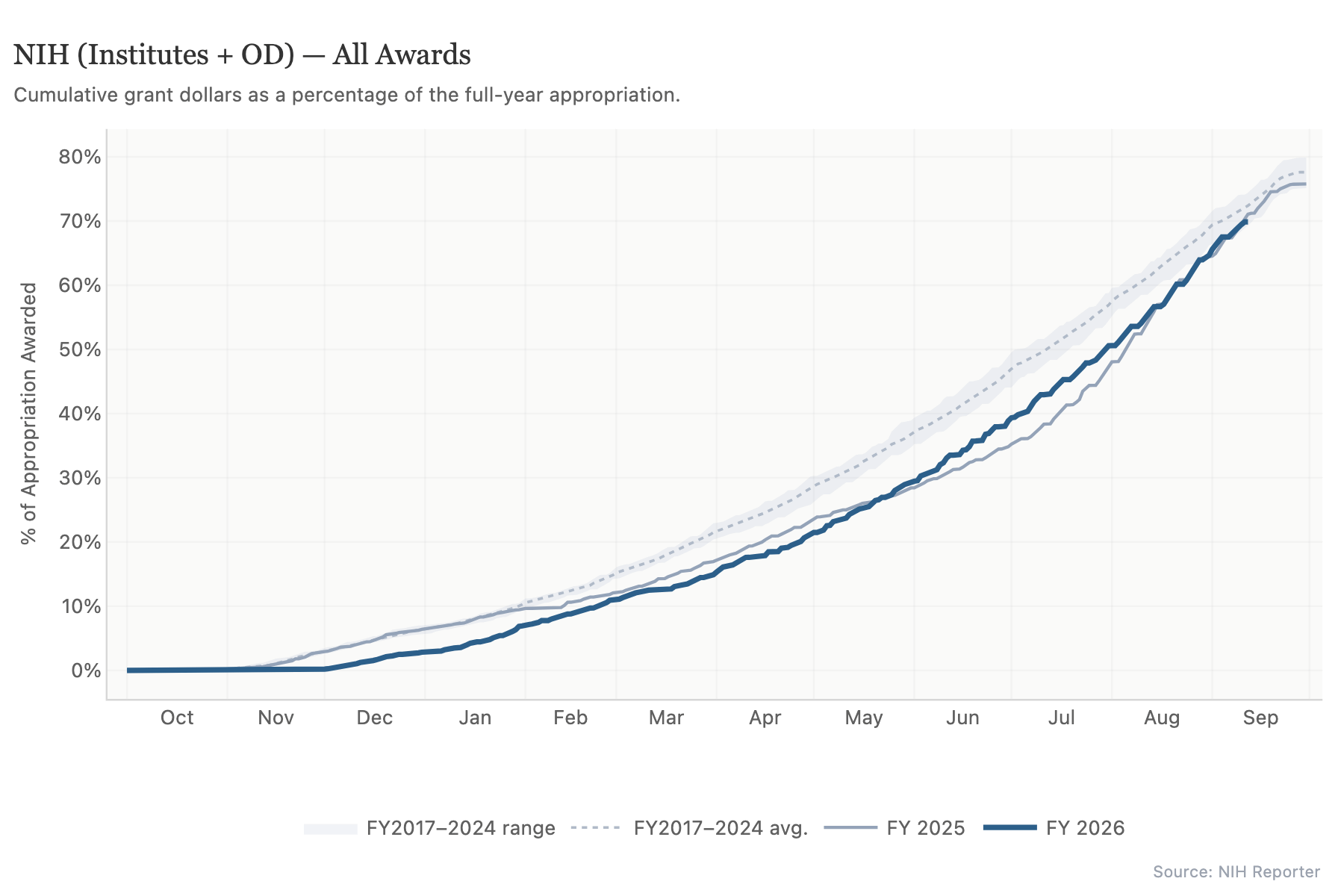
It’s worth noting that despite the interference, NIH in 2026 is close to being on track to spend the funds that had been appropriated to it according to Jordan Dworkin’s science spending tracker.
The great American property tax freak out — Dylan Matthews
Building state capacity in the US is hard, but a good starting principle is to not do any harm. Alas, US states appear committed to doing harm.
In a nice new paper, Yale law professor David Schleicher tracks the ongoing post-Covid property tax revolt, which threatens to starve states and localities of desperately needed revenue in coming years. Last year, Texas adopted $51 billion worth of property tax cuts; Florida legislators put on the ballot a cut that would exempt most homeowners from paying any non-school property taxes. Several other states have adopted large credits and exemptions meant to exclude large shares of homeowners from paying property tax.
Property tax is the main way state and local governments pay for themselves in the US. They generate up to 30 percent of combined state-local revenue, and 70 percent of local revenue specifically. As Schleicher and Nick Bagley have argued elsewhere, the state capacity problem in the US is disproportionately state/local in nature. State and local governments employ the vast majority of government employees, are responsible for most infrastructure for services like transportation, water, sewage, and electricity, and handle permitting for most private construction projects.
The failures of capacity at the state/local level are not solely matters of insufficient funding. Indeed, on infrastructure the problem is more that most projects are too expensive on a per-unit basis. But there are key areas of underfunding, and the property tax revolt is likely to make those problems all the worse.
Your flying car will still have AM radio — Dylan Matthews
A lot of abundance and growth discourse can be summed up as, “some people really don’t like change.” Case in point: the US House of Representatives has passed a measure that requires all new cars to include an AM radio, and the Senate is expected to follow suit. Now, you may be asking, “who the hell still listens to AM radio?” I remember being five or six and asking my dad about the “AM” option in our car, and him saying that AM radio was a bit older and lower-quality than FM. I am thirty-six years old, and AM radio was old-fashioned when I was a child.
AM is actually worse than old-fashioned, though; AM receivers can interfere with the electrical currents in electric vehicles, and EV manufacturers have argued that it will cost them billions of dollars to develop technology to overcome this problem and keep AM radios in cars.
But the National Association of Broadcasters, representing radio stations, is still pretty powerful, and despite the vast majority of Americans getting emergency notifications these days on their phones, the broadcasters have successfully pushed the idea that AM radio is an essential backup if the phones, FM radios, TV broadcasts, terrestrial internet, satellite radio, and all other alert mechanisms all fail.
The AM Radio for Every Vehicle Act would not be the most egregious wasteful act of overregulation the US has adopted, and it might not even be the worst this year. But it’s a great example of how short-term political considerations can lock in bad, costly policy for a long time. We could be zooming around in our self-piloted flying cars in the year 2100, and those flying cars will still, by force of law, have to have AM radios.
Hiring impossible: FDA fallout — Saloni Dattani
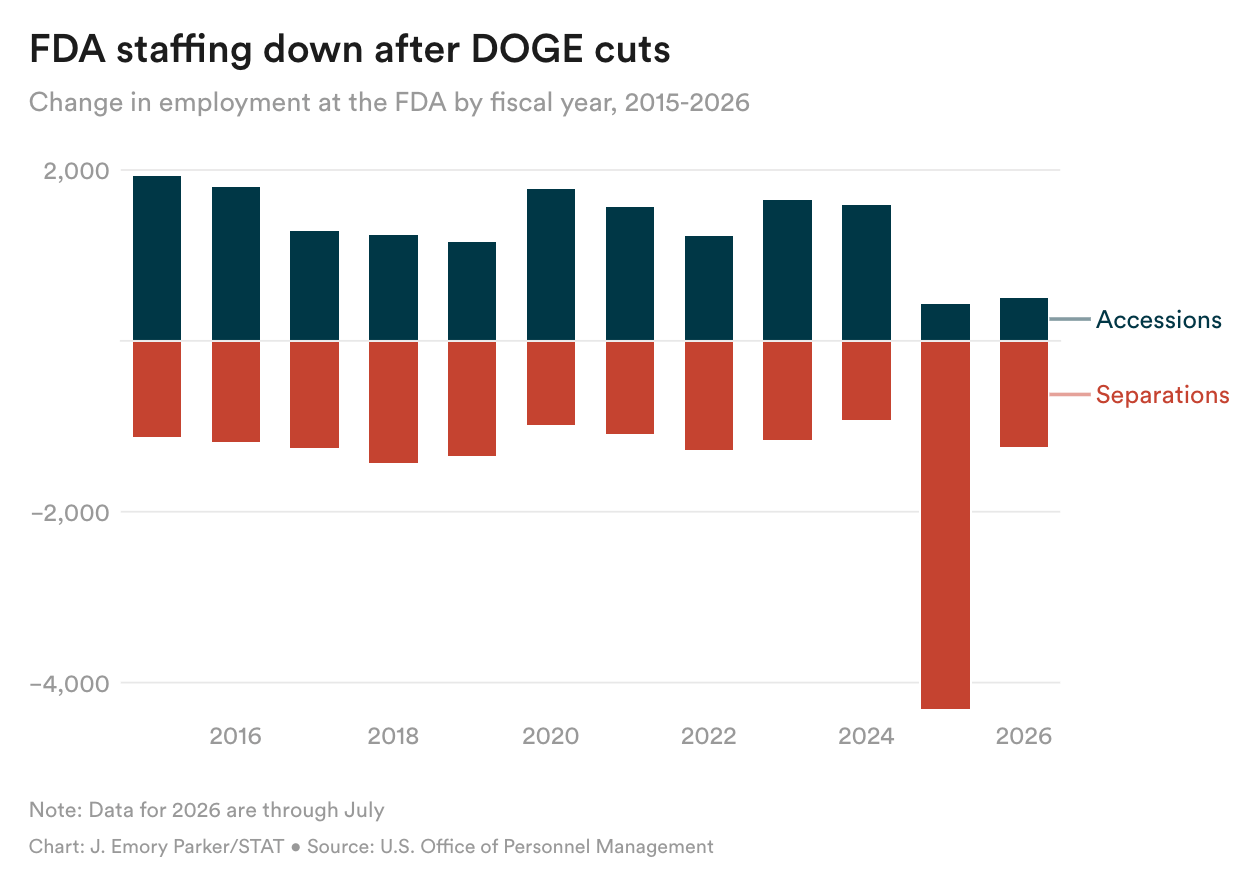
This week I’ve been reading about the FDA’s hiring struggles. For context, last year, as a result of cuts led by DOGE, the FDA laid off nearly 1,900 staff and another 1,200 staff took early retirement packages – combined, that’s roughly one-sixth of its workforce. The lay-offs seemed to have reversed last October, when the agency started rehiring. That rehiring process, according to STAT, is still ongoing and is bottlenecked, partly because the FDA’s HR teams also lost staff and because DOGE consolidated multiple administrative teams into one office that's understaffed.
It’s worrying because greater staffing levels at the FDA allow drugs to be reviewed more quickly, as well as inspections of facilities, investigations of safety problems, and allows staff to work more proactively on new initiatives, while shortages force them to focus on essential tasks. There’s also been pushback over whether the cuts could jeopardize the FDA’s targets under PDUFA, under which it's committed to review applications within set targets.
The state of think tanks — Nisha Austin
On Think Tanks published its State of the Sector report last week, surveying 299 think tanks across 94 countries. Two thirds of the respondents named funding as a challenge this year, and almost half expect the environment to get worse, which is surprising to read when many are expecting a huge surge of philanthropic money.
The report describes this as being a structural issue, which makes sense to me. 40.5% of these organizations hold less than three months of operating reserves, and 22.1% have none. This is mainly because they run on short-term project grants that don’t cover overhead (only 18% are predominantly core-funded, and over a third work on contracts of a year or less). It tracks that organizations with no reserves overwhelmingly expect funding trouble, while those with a year’s cushion mostly don’t.
I also found it surprising that pessimism is worst in the wealthiest regions. The Anglosphere has the deepest reserves and the most core funding in the survey, and also the largest share of organizations expecting mergers or closures. I’m still figuring out what to make of that!
Here are a few other highlights from our team and grantees, and announcements worth sharing:
California YIMBY was named a Fast Company 2026 World-Changing Ideas winner.
The Institute for Replication launched a newsletter tracking their work on verifying key findings across the social sciences.
Willow published What to expect from energy abundance on the AGF blog earlier this week.
The OpenAI Foundation announced funding for CTD Commons, a project to preserve and publish regulatory data from failed drug development programs so future teams can learn from them.