


There’s a strange tension in the conversation on energy. On one hand, converts of energy “superabundance” claim that energy is economically critical, worth making so readily available that it’s practically too cheap to meter. On the other, textbook growth accounting holds that since energy is a fairly small share of the economy in developed countries1 (about 5 - 7% of US GDP in recent decades, depending on how you measure it), increasing energy supply will have a fairly moderate effect on GDP. How to resolve this tension, and more pointedly, how to value energy’s contribution to US growth?
Fortunately there’s at least a partial resolution to this dichotomy, one that respects both the intuition that energy can matter a lot and the evidence that it’s not a large share of most developed economies. Put simply, additional energy is very valuable when it’s scarce, since it becomes the binding constraint on all growth. When it’s already broadly available (although not necessarily too cheap to meter), the returns to additional supply drop back towards the unspectacular figures that stingier neoclassical models would suggest.2 Importantly, since energy demand in developed countries is on the rise, we may be entering a period when energy is scarce relative to our ability to make use of it, and therefore highly valuable for growth.
There’s another sub-argument that even scarcity is only a temporary phenomenon. Since energy is very difficult to substitute over the short term but gets a lot easier to replace over time as firms adapt, a sort of “keep calm and wait for efficiency” perspective argues that even shortfalls can and will be mitigated by improved technology. However, this doesn’t account for how economically costly that adaptation could be, potentially seriously understating the value of avoiding scarcity in the first place.
A clearer best guess at how energy drives growth is a road map of what policies and interventions are likely to work best (should we prioritize short-term supply bumps, or long-term structural change?) Since policymaking is an exercise in tradeoffs, it’s important to have an educated guess here, even as we look to new evidence to inform our understanding. The following discussion is a starting point for how we’re thinking about the energy-growth relationship at the AGF.
Why energy is missing from mainstream growth models
In an affront to the superabundance theory, most of the classic economic growth models (Solow 1956; Romer 1990; Aghion and Howitt 1992) don’t even include energy. Okay, this is a bit of an oversimplification – technically, energy purchases are netted out as an intermediate input – but broadly, we can’t independently observe or manipulate the role of energy using these models. And while energy and GDP clearly move together, efforts to prove a causal relationship have been largely inconclusive (Stern 2019).
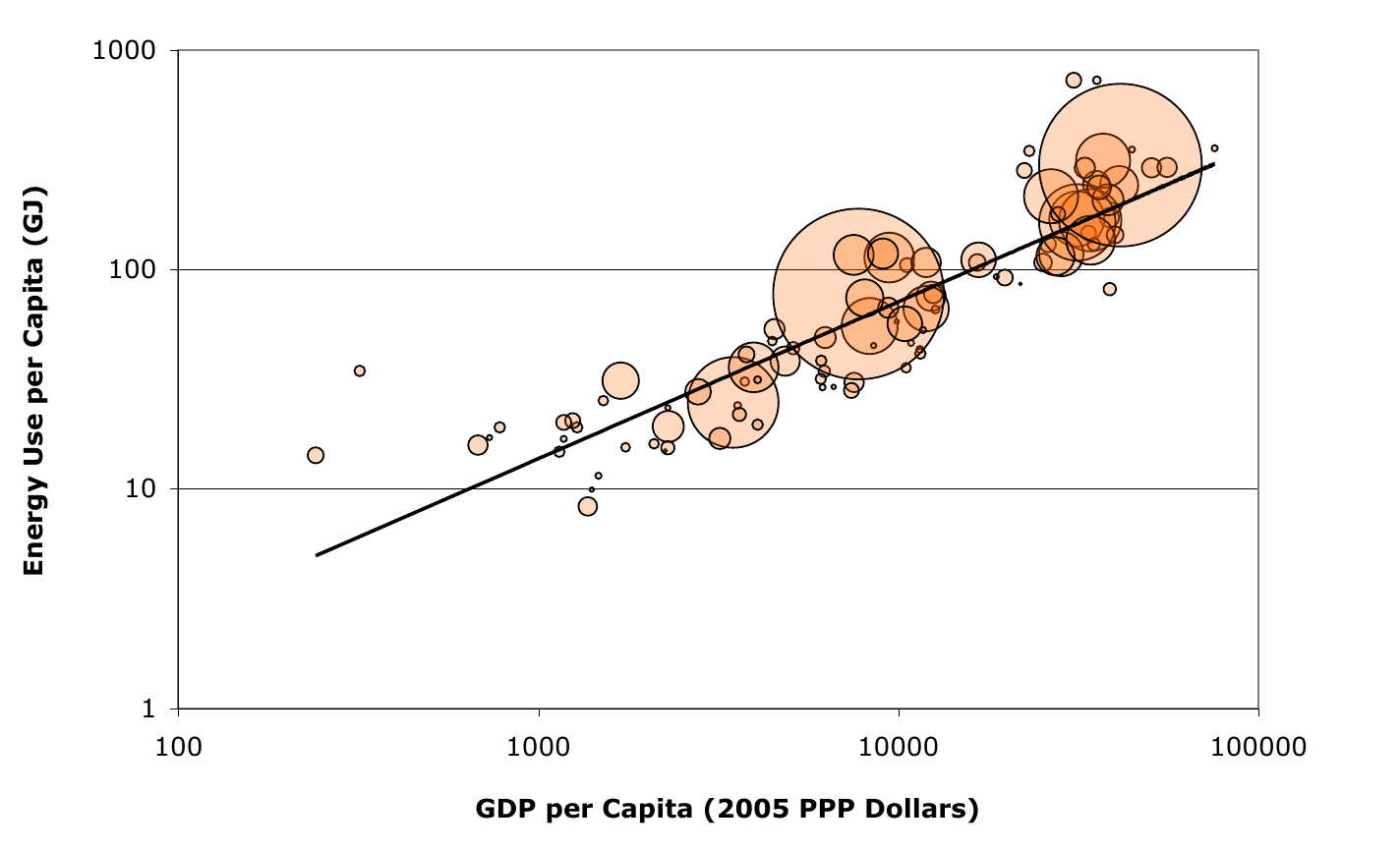
The 1970s oil shocks, which showed that energy could behave in unexpected ways with outsized impacts even in developed countries, began to change this – somewhat. There was a rough split in the treatment of energy: while mainstream growth theory stuck with improvements to the classic, energy-less workhorses, some did start to add in an explicit energy component.3 Among economists that added energy, there was another schism, with some models starting to explore the idea that energy and capital could be complements, not substitutes (Berndt & Wood 1975), and others arguing that energy’s small cost share, and the possibility of capital / energy substitution over time, would, for the most part, keep its effects moderate (Hogan & Manne 1977).
Since energy typically isn’t a very large portion of GDP in developed countries – spending on electricity, for example, is only around 2% of US GDP – using this share to extrapolate a GDP effect from changes in energy supply yields a modest assessment of energy’s economic impact. However, this simplification remained a widespread best guess of energy’s role in developed economies as supply and demand moved mostly in sync (for instance, this is roughly the shorthand we at CG were using ourselves in late 2025).
It’s not hard to see why that’s an incomplete answer, though. If electricity supply drops dramatically, production doesn’t drop by 2% – since you can’t (quickly) substitute energy, you can’t produce much of anything. This is intuitive enough that it’s its own metaphor, but to belabor the point, energy is like water in Adam Smith’s classic paradox – while you might not spend much on it day to day, its absence would be distinctly noticeable. This relationship doesn’t just apply to a loss of supply that’s already online (and blackout losses are unique in several ways), but also to new potential growth on a fixed energy budget. Once you account for the possibility of a shortage, a fixed cost share shorthand is clearly missing something.
The complementarity literature continued to develop exactly this missing piece. While this literature is extensive, I find that Stern & Kander (2012) came up with a particularly convincing, lean articulation of the energy-growth relationship. Their modified version of the classic Solow production function frames energy and capital/labor as separate inputs to growth that can’t be easily substituted for one another. As a result, as energy becomes scarcer, it becomes an increasingly binding constraint on all growth.
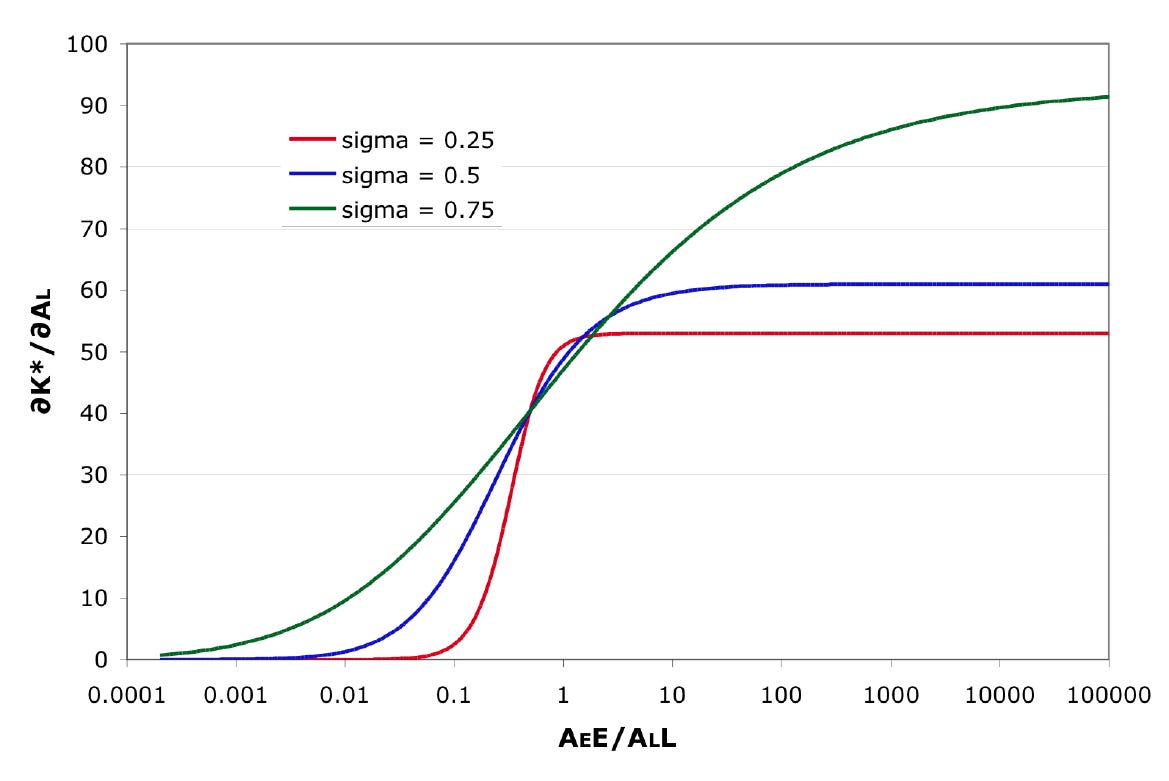
Stern & Kander’s model formalizes the intuition that the energy-growth relationship is non-linear: energy’s effect on growth could be very different in periods of energy scarcity versus periods of abundance. If energy is a bottleneck, relieving the constraint is very valuable; if it’s not, returns will be much more muted. This resolves the contradiction between the apparently central role of energy in certain periods and geographies but not others, or the economic havoc apparently wreaked by shortfalls. It also explains why it so often goes missing in classic growth economics: in times of “normal,” unconstrained supply, since energy is a small and stable fraction of firms’ spending, valuing it at that share (or even simplifying it away) doesn’t cause too much of a problem.
It’s probably fine to meter your energy
So far, we’ve mostly argued that energy matters more than a naive application of mainstream growth economics would suggest, since it acts as a bottleneck during times of scarcity. But that’s a two-sided coin, with implications for the limits of energy abundance as well. Stern & Kander’s model implies that although energy is a limiting factor on growth, sufficiency is enough – once demand is met, additional energy supply will have strongly diminishing returns. The growth function converges back towards the energy-free version (with energy valued at its relatively modest cost share) once energy stops being scarce.
“Not scarce” in this case doesn’t mean free, or even radically cheap: under this binding constraint model, energy scarcity is a spectrum, defined in relation to the effective labor and capital available to employ it. Effective energy can become the binding constraint either due to supply issues (e.g. the 1970s oil shocks or the current Hormuz situation), or if the labor/capital deployed in energy-using industries increases faster than supply can respond (e.g., due to AI and electrification). However, once the bottleneck resolves and energy is again a small share of GDP, available labor and capital again become the binding constraints.
To be clear, this model doesn’t disprove the “too cheap to meter” thesis – it’s just a different conceptualization of how energy and labor/capital inputs relate. The superabundance case holds that if energy prices drop far enough, we’d see an substantially changed demand regime, with cheaper energy supply inducing a large crowd-in of capital and labor to energy-hungry industries. The binding constraint case is much more restrained on the marginal contribution of energy once energy is already abundant.
Beyond Stern & Kander’s own empirical evidence4, we have some real-world indication that a binding constraint model is a better approximation for how energy really works (although this is such a tricky question precisely because it’s hard to test given the data we have). First, alternative ecological economics models (e.g. Ayres & Warr 2005), which envisioned a more central role for energy in driving growth, fit the data noticeably less well after 1970 (Stern 2019), suggesting that a simple “[useful] energy drives growth” model doesn’t quite work.
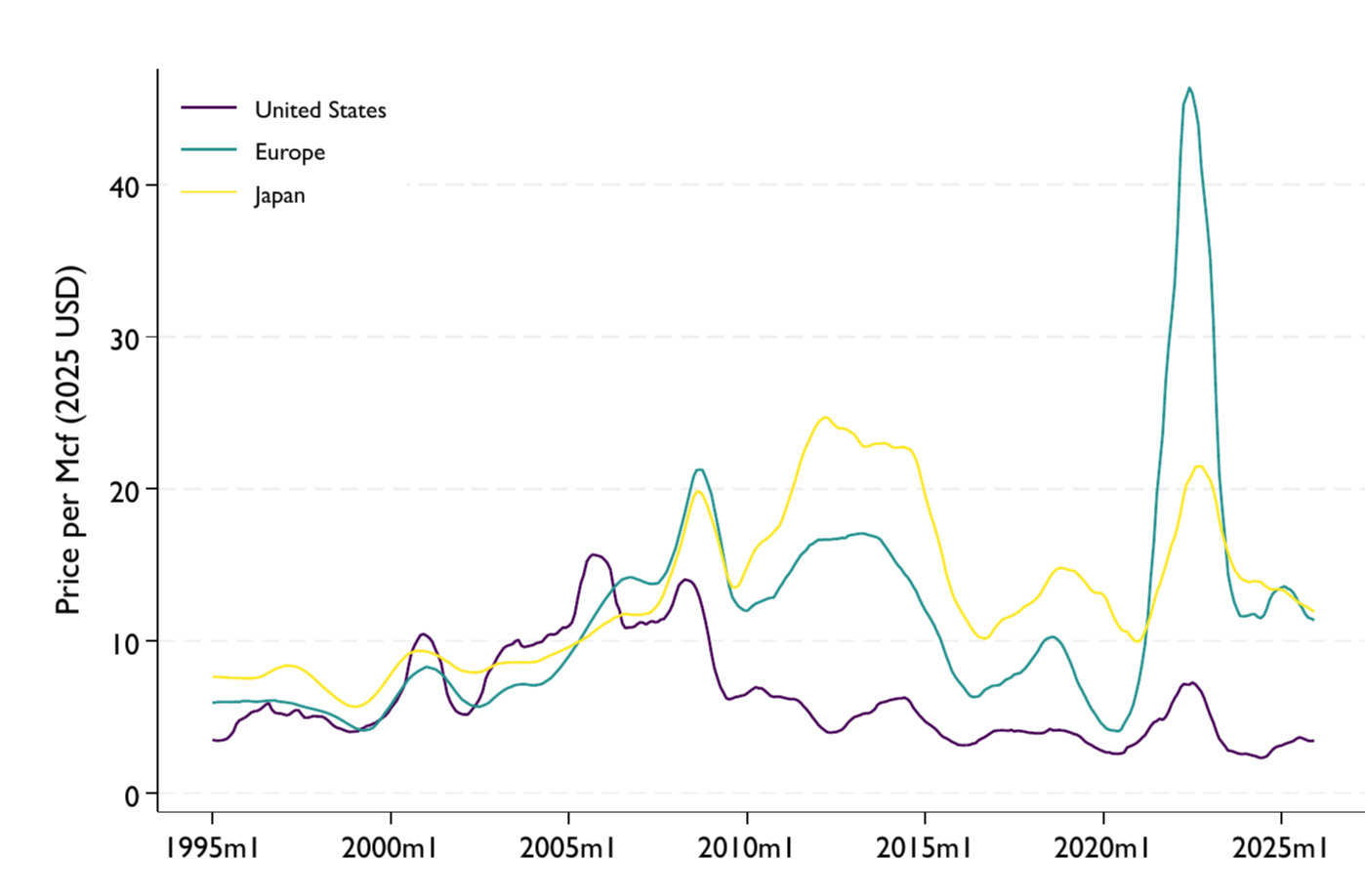
Additionally, more recent real-world examples of positive shocks to energy supply don’t seem to bear out the argument of a transformative boom. While it’s admittedly hard to pull out a single effect at the GDP scale, we didn’t see a step-change in productivity as a result of the shale revolution. This doesn’t mean that the shale revolution didn’t have positive growth outcomes, including some industrial effects (and on fronts like inflation mitigation, which I don’t investigate here) – just that the clearest test of whether cheaper energy would kick-start a boom in industry or innovation, absent the latent capital/labor demand to effectively employ it, yielded a relatively modest result.
Even the role of energy in the industrial revolution, probably the clearest argument for an energy transition driving economic transformation, is debated. Although Allen (2009) and Stern & Kander themselves actually do argue for (in S&K’s case, scarcity-relieving) coal as a trigger of modern growth, others (Clark & Jacks 2007; Madsen et al. 2010) are much more skeptical of the effect of coal on British productivity.
However, to (at last) address the obvious and critically important point — there’s a good chance that we are staring down the initial stages of an energy shortfall, in this case driven by a combination of growing demand and artificially constrained supply. We therefore likely are entering a period where energy will act a bottleneck, and where the economic returns to unblocking it could be very significant. While it’s important to try to accurately forecast how long the shortfall will last if we expect returns to energy investments to drop sharply once it’s over, it’s equally important to be clear about the short-term costs – and the long-term implications – of entering a scarcity regime in the first place.
The catch: adaptation over the long term
Now that we’ve at least somewhat reconciled energy’s ambiguous relationship with growth, we can return to the more nuanced critique of an energy-forward strategy: namely, that we shouldn’t worry too much about an energy shortage over the longer term because the economy will adapt to scarcity, either by improving efficiency or through other means.
This short vs. long-term distinction was somewhat glossed over in the older complementarity literature, which assumed constant, exogenous substitutability between energy and labor / capital. However, later efforts found that effective substitutability could actually change over time in response to energy scarcity – even if energy is hard to substitute over the short term, it becomes increasingly (although not fully) substitutable over the long term as firms find more energy-efficient ways to produce goods and services. As a result, scarcity-driven prices themselves cause the energy constraint to become less binding over time, blunting the shortfall cost that a naive fixed-technology model would predict.
At first glance, this sounds great! Technological improvements make it easier for us to use less energy relatively painlessly, firms shave their energy usage to bring their energy cost share back down, and the economy basically stabilizes, despite the energy constraint. This yields a neat mental model of efficiency as a way to get most of the outputs associated with more energy, without actually needing more energy.
Unfortunately, this is only half of the story. The second half is that firm-level adaptation, whether it’s increasing efficiency or building out alternative generation, is costly – if firms could just use more cheap energy, they’d do that instead. This is because adaptation doesn’t spring into being from nowhere; rather, firms have to re-direct brainpower and budgets to make those scarcity-adaptive improvements. Assuming R&D budgets are relatively fixed,5 a redirection towards efficiency crowds out other productivity-enhancing technology. The opportunity cost of that crowding out – in addition to the growth directly foregone before adaptation gets up and running – should be added to the tab for an energy bottleneck, not ignored.
Adaptation can have lasting costs even if a bottleneck turns out to be temporary. First, once the constraint lifts and energy is no longer scarce, the knowledge of how to produce more with less is much less useful. Second, because knowledge compounds as future research builds on existing stocks (Acemoglu 2002; Aghion et al. 2016), the long run effects of misdirected R&D can compound – each year of foregone general R&D also leads to a weaker foundation for future general innovations (relative to the non-scarcity counterfactual). Scarcity drives which giants’ shoulders future research will stand on.
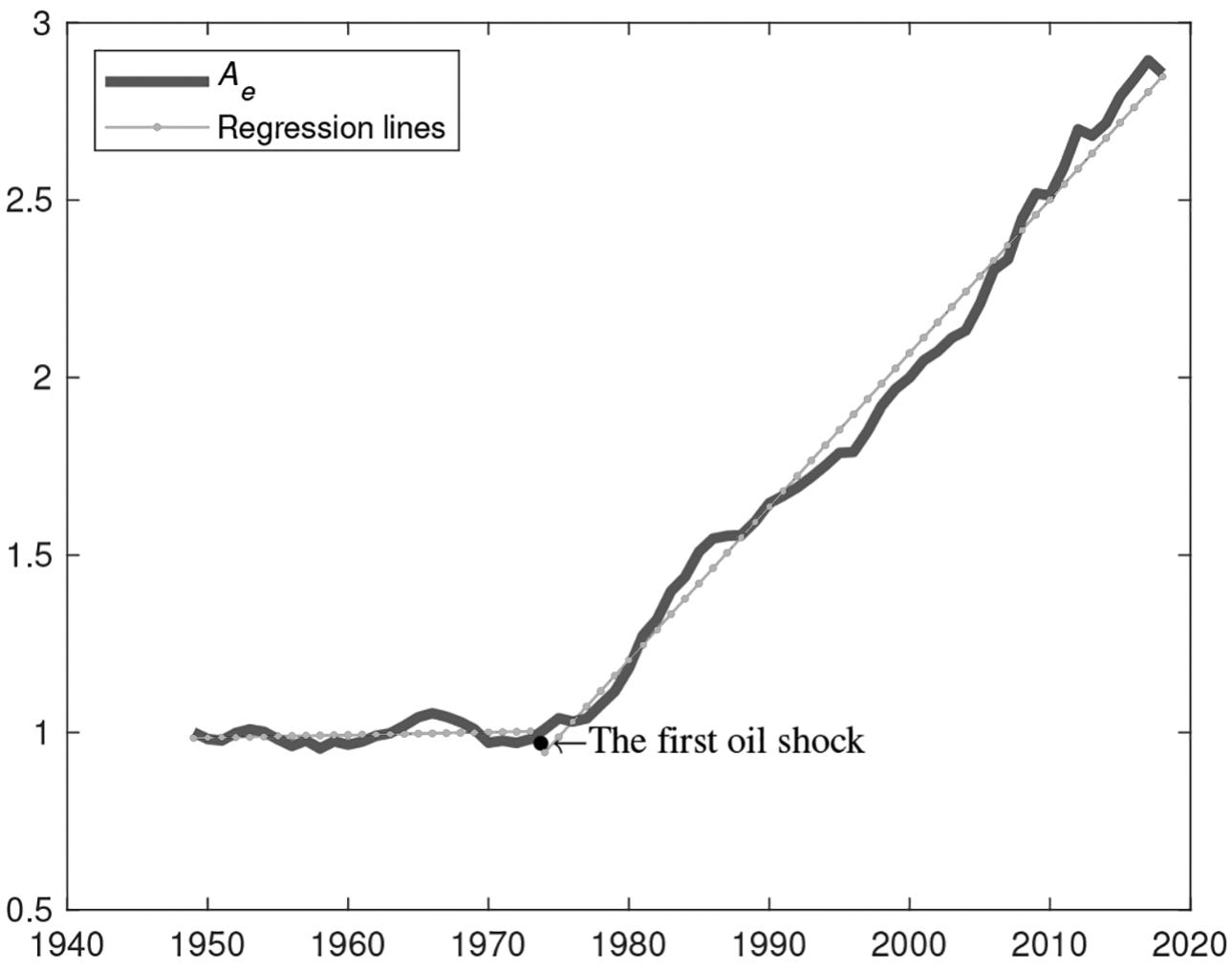
Hassler, Krusell, and Olovsson (2021) came up with a model for this process, estimated on postwar US data with the 1970s oil shocks as the key episode, indicating that firms substitute energy-saving technology (R&D targeting energy efficiency) for labor- and capital-saving technology (the more classic productivity-enhancing improvements) when energy is scarce. As a result, they attribute part of the post-shock productivity slowdown not just to the direct growth-constraining effects of scarcity, but also due to the adaptations firms made in response. They find that from a productivity perspective, technology-driven efficiency is a necessity if scarcity is unavoidable (firms are optimizing for the scenario they’re dealt), but it’s very far from a free lunch.
Overall, this is a kind of counterintuitive way to think about efficiency. But I think some of the dissonance this might provoke is due to two increasingly outdated heuristics that don’t fit cleanly onto today’s (or tomorrow’s) energy system.
Reassessing the efficiency - abundance tradeoff
The first of these is the nature of scarcity. Firms aren’t making an irrational substitution when they redirect budgets towards adaptation – they’re intentionally maximizing their future profits based on their expectation of the binding constraints, now and in the future. So if we expect that energy scarcity will last a long time, it makes perfect sense to invest in efficiency; conversely, if you’re facing a short-term constraint, you might decide not to invest in efficiency and just accept a period of constrained output.
For most of the waning 20th and early 21st century, we lived in a world where the predominant energy supply was derived from fossil fuels and therefore finite. In the context of a “peak oil” world, accounting for scarcity was not only rational but unavoidable – the long-term decline of economically viable fossil resources was fundamental to the way we thought about energy usage. In practical terms, this meant that efficiency would be an (eventual) economic necessity, even before any climate arguments.
The second, of course, is the climate benefit associated with using less energy. In a fossil fuel world, nudging the path of innovation towards efficiency has meaningful climate benefits – less energy used means less emissions produced, and as a result efficiency itself could be a useful knowledge stock. In that world, it’s tricky to weigh foregone productivity improvements against the efficiency improvements that crowded them out (especially if the replaced knowledge stocks were in fossil energy).
Both of these frameworks, fully reasonable in their contemporary context, helped to stack the deck in favor of efficiency. However, neither of them applies with quite as much force today, and it’s likely that they’ll become increasingly unhelpful ways to think about the tradeoff. To start, under a bullish clean energy / electrification scenario, the climate benefits of reducing energy use are severely undercut.
Second, to put my abundance hat back on, you’re not supposed to inflict scarcity on yourself. When models like Hassler’s find efficiency to be an economically optimal response, that’s assuming that scarcity is an unavoidable fact of life. In contrast, one of our most important constraints on energy supply in the US is permitting and regulatory systems that delay new energy projects, preventing new supply from coming online fast enough to meet demand. Few would argue that such a system should be permanently enshrined in its current form. Especially in an era of rapidly falling solar and battery costs, there’s no reason to think that costly firm-level adaptation is an economically optimal, or even a particularly effective way to meet our goals for climate and growth.
In effect, we’ve imposed a constrained optimization problem on firms. Rather than deciding how to allocate R&D resources based on their best guess of real energy availability over the next decades (which to be clear, could absolutely involve efficiency or other forms of adaptation), we’re forcing firms to make those decisions based on artificial scarcity. It’d be better to take on those institutional handicaps directly – by streamlining permitting and interconnection, for example – than to force firms to work around them at what might be an exceptionally high societal price.
When we think about efficiency as costless, or judge its net cost against that of facing an unavoidable energy constraint without adaptation, we’re not using the right counterfactual for an artificial scarcity world. The right way to measure the costs of adaptation to artificial scarcity is not against the costs of not adapting, all else held equal – it’s against the potential growth we would have enjoyed in a world where that redirection never had to happen.
Conclusion
Are we headed into an entirely new growth regime, where the relationship between energy and GDP will be fundamentally different and none of this will apply? Maybe! However, even if we are, we should still ground our discussion in our best guess about how the mechanics of energy and the economy actually work. That doesn’t mean making wildly conservative assumptions, but disciplining the assumptions we do make, without having to abandon our empirical grounding.
I also want to be clear that there are plenty of ways I could be wrong here. Radically available energy could guard against inflation, helping bring down the chances of recession. Cheaper electricity could make the electric tech stack more competitive, with long-term implications for the direction of American innovation. The question remains, though, whether energy prices are really the main, or most direct, channel to the desired outcome, or whether you mostly just need better battery energy density for that flying car.
For clarity and brevity, I’m not going to discuss much of the literature on energy-growth in developing countries since it uses such a different framing, but another way to frame the same puzzle is how energy could simultaneously be so economically critical in countries where it’s scarce and a rounding error in countries where it’s abundant.
This isn’t altogether unexpected; at a nodal scale, we’re already used to pricing energy (very!) differently across time and space based on its relative availability. Valuing energy’s non-linear economic contribution is, in a way, just applying the same concept at a macro scale.
An extensive literature on the economics of climate change also incorporated energy; since most of those mechanisms are less relevant to the argument here, I’ll leave that history aside for clarity’s sake.
200 years of Swedish data, from 1800-2000
Hassler, Krusell, and Olovsson (2021), Acemoglu (2002) and Acemoglu et al. (2012) all assume fixed research labor. Popp (2004) allows partial crowding out.
There are only two resources that limit humanity: Energy and human creativity.