


Happy Thanksgiving to our American readers! In lieu of our normal “what we’re reading” post, we thought we would do a special “what we’re thankful for” post. While the correct answer to “what are you thankful for” is “friends and family” for this post we’re staying on brand and focusing on things related to abundance and growth. Lastly, one thing we’re collectively thankful for is our new colleague Matthew Meyers, who joined the Abundance and Growth Fund last week from the Niskanen Center!

Operation Warp Speed — Matt Clancy
The price of a faster FDA — Saloni Dattani
arXiv at 35 — Jordan Dworkin
Digital service delivery at the VA — Matthew Meyers
Wins we didn’t fund — Alex Armlovich
The blogosphere and beyond — Nisha Austin
Operation Warp Speed — Matt Clancy
From an abundance and progress perspective, Operation Warp Speed had it all: clinical trials, regulatory streamlining, innovation policy, state capacity. (OK, almost everything - no housing policy). Arielle D’Souza wrote a nice primer for IFP back in 2023 about how the US government deployed advance market commitments, milestone payments, and other purchase guarantees to provide strong economic incentives to pharma companies to get a vaccine safely to market in record-setting time. As Saloni reminded us this summer, in the early days of the Covid-19 pandemic many didn’t expect a vaccine for years. But thanks to strong incentives, coordination, regulatory streamlining, parallelizing operations, and a surplus of willing clinical trial volunteers, a vaccine was developed in less than a year. And it really mattered - one estimate found that it saved 140,000 American lives and generated $1.8 trillion in economic benefits. I’m thankful it helped us take off the masks and get back to normal life. This reminds me - I need to get my booster.
The price of a faster FDA — Saloni Dattani
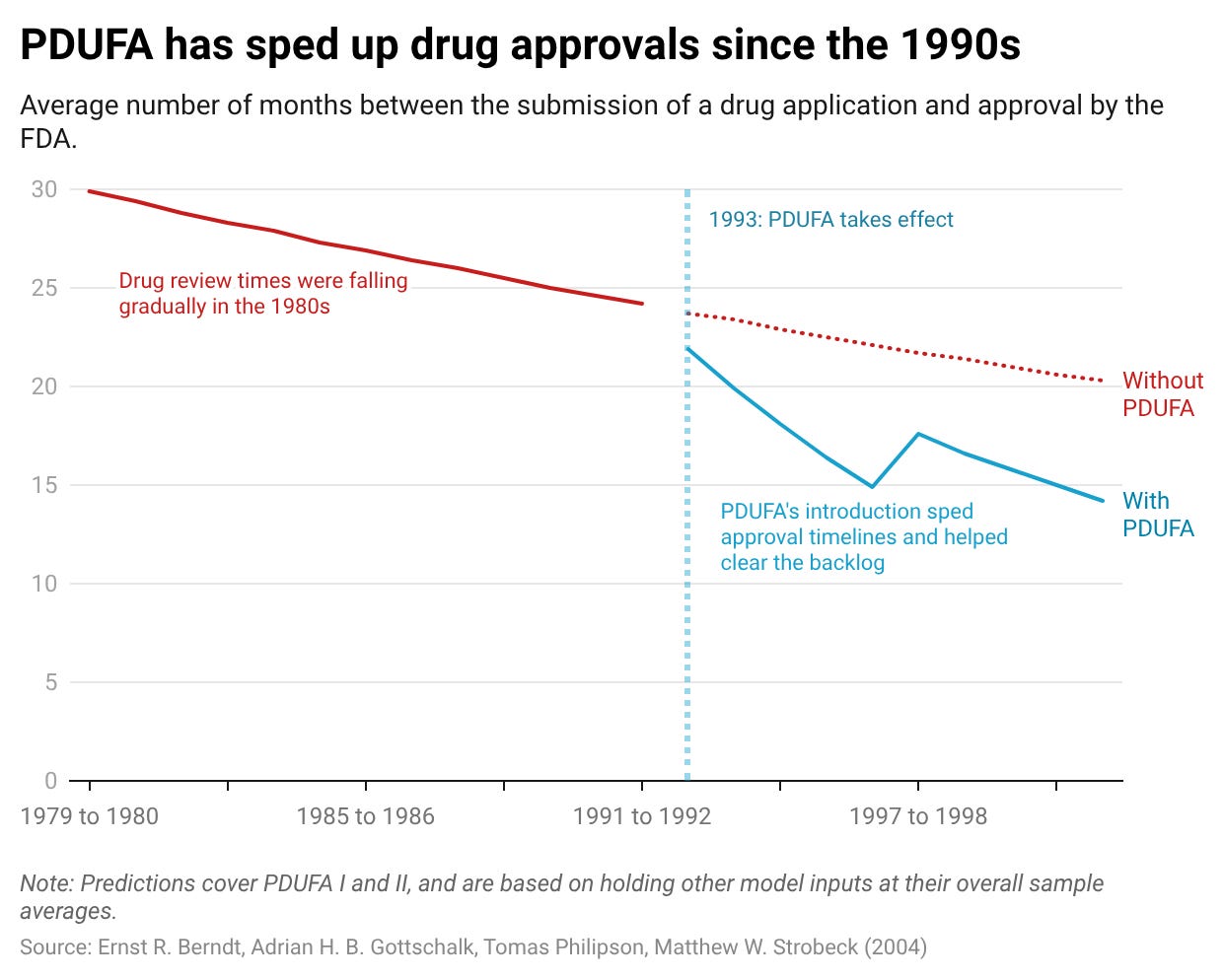
Since Matt took my obvious pick, I’ll go with PDUFA, the Prescription Drug User Fee Act, which has improved the FDA’s capacity in reviewing drug submissions since 1992. Before the act, it took an average of almost 25 months for the FDA to review a drug application, though this was improving gradually. After the act, however, the figure dropped much more rapidly, and has reached roughly 12 months today.
The act involves companies paying fees for drug applications they submit, as well as annual fees for approved products, and the funding goes toward increasing the agency’s capacity to regulate drugs, allowing it to hire more staff and conduct more research, helping it clear backlogs, meet deadlines, and perform more broad-based regulatory research (such as setting up datasets to track the safety records of drugs already on the market, building digital health systems, and running initiatives to support innovative trial designs). Economists estimate that review times were shortened by roughly 3.3 months per 100 additional FDA staff.
To me, it’s a good reminder of the importance of improving regulatory capacity in promoting abundance. That’s especially relevant now, because of the FDA’s large layoffs last year (of roughly a fifth of its workforce) and because improvements in AI and drug discovery could make the backlog grow: as more new drugs are tested in clinical trials, we’ll still need lots of reviewers to evaluate them. But more importantly, innovative ideas for FDA and clinical trial reform will need more staff to work on them as well as its core functions. It’s also timely because PDUFA is up for reauthorization next year, and could include additional acts such as the Faster Clinical Trials Act and the Clinical Trial Modernization Act.
arXiv at 35 — Jordan Dworkin
In the late 1980s, new physics results were mostly shared by mailing photocopies directly to a handful of colleagues. If you weren’t in the right networks, you were dependent on the generosity of more senior or connected faculty or would have to wait until publication. In 1989, Joanne Cohn, a postdoc at the Institute for Advanced Study, started emailing string theory preprints to anyone who asked; by the summer of 1991 her list had grown to 180 physicists. That year, after hearing a colleague worry that emailed papers would fill up his computer’s storage while he travelled, Paul Ginsparg had the idea to create a centralized repository that would send full texts on request. That idea became xxx.lanl.gov, and later, arXiv. According to Paul:
“It was originally intended for about 100 submissions per year from a small subfield of high-energy particle physics, but rapidly grew in users and scope, receiving 400 submissions in its first half year. The submissions were initially planned to be deleted after three months, by which time the preexisting paper distribution system would catch up, but by popular demand nothing was ever deleted.”
35 years later, arXiv holds more than three million preprints, has become core infrastructure across physics, math, and CS, has inspired dozens of other disciplinary repositories (most notably RePEc and bioRxiv), and has changed the way scientific results are disseminated. Some important metascience occurs top-down, with new policies put in place by institutions, funders, or governments. But arXiv is my favorite example of bottom-up metascience; scientists noticed a problem in their own work, built a fix, and watched it spread naturally. I’m grateful for people like Joanne, Paul, and the hundreds of volunteer moderators who dedicate time not only to their own research, but to efforts to improve how science itself works.
Digital Service Delivery Transformation at the VA — Matthew Meyers
While much of the work on state capacity focuses on reforms that cut across all of government like personnel systems, procedures, and permitting, in many cases agencies need individual attention. Because of how particular problems can be to one agency, it can be hard to tackle these reforms and to know how to generalize from successes and failures. That’s why I am grateful that we have a recent example of successful service delivery transformation in the Department of Veterans Affairs (VA), where reformers diagnosed a problem, the agency mobilized to fix it, and some of the key players wrote a report with the Niskanen Center (where, disclaimer, I used to work) to help other agency reformers know which lessons generalize.
The VA is one of the most administratively complex departments in government; it boasts the second-largest headcount, manages a national healthcare system, and administers a host of other benefits, pensions, insurance programs, and services. In 2014, the VA’s Office of Inspector General found that VA hospitals were using improper scheduling practices to hide months-long wait times, turning veterans’ already frustrating experience dealing with slow and fragmented government service delivery into a national scandal. But over the course of 10 years, thanks to the efforts of reformers, the VA has become a model of effective delivery for many services. Principally, it shifted its model for software modernization from periodic, one-off, expensive overhauls to constant renewal with teams responsible for iterating and improving in response to veterans’ feedback. It also replaced the maze of entry points with a single portal, VA.gov, and consolidated forms and information gathering processes. These reforms and others can be a guide for other agencies facing similar issues.
Government technology is already behind, and building systems for continuous improvement will only become more important as software teams test and improve the implementation of AI tools and digital systems must increase their capacity to handle the volume of AI-assisted applications and screen out AI-enabled fraud.
Wins we didn’t fund — Alex Armlovich
Our housing model values new homes in America’s six most supply-constrained metros, so this Thanksgiving I’m thankful for three reforms that worked well outside them:
Texas’s SB 840 took effect in September 2025. It allows apartments and mixed-use buildings by right on commercial and retail land in the state’s 19 largest cities, and it limits what those cities can demand. Heights can’t be capped below 45 feet, density can’t be capped below 36 units an acre, there are no FAR limits, and cities can require no more than one parking space per home. A report from AEI, Texas Appleseed and Texans for Reasonable Solutions counted 1,529 units in by-right projects through May 2026. It found another 7,235 in rezonings that cities approved with SB 840 hanging over them. That’s a floor after nine months.
Florida’s Live Local Act got there before Texas, in 2023, and it came from well outside the national YIMBY ecosystem. Developers can build in a commercial or industrial zone if they rent 40% of the units below 120% of AMI for 30 years. In return they get administrative approval at the highest density allowed anywhere in the jurisdiction, the tallest height within a mile, and property tax breaks on the affordable units. By March 2026, the Florida Housing Coalition had tracked 182 proposed projects with 55,000 homes in 20 of the state’s 67 counties, about 6,300 of them already under construction.
(Blue states should take note following in these RICZ upzoning footsteps: California’s AB 2011 passed before either Florida or Texas’s bills, and offered a good zoning envelope, but as we noted in April, its unfunded inclusionary zoning and prevailing wage rules have kept it far short of its 2022 forecast. We still don’t have a blue-state commercial-to-residential preemption that delivers at this scale.)
Finally there’s Auckland. Its 2016 Unitary Plan upzoned roughly three-quarters of the city’s residential land, and Ryan Greenaway-McGrevy and his University of Auckland coauthors have spent years measuring what happened. They estimate about 22,000 extra homes consented in the first five years, mostly townhouses. Six years on, three-bedroom rents were 26–33% lower than they would otherwise have been. Auckland is the cleanest natural experiment we have that broad upzoning works in the Anglosphere, and it didn’t take a dollar from us.
The blogosphere and beyond — Nisha Austin
I’ve always thought of the blogosphere and Substack as basically the same thing (the more seasoned writers on the team helped clarify), but for the purpose of this post I’m lumping them together; a lot of abundance thinking got worked out on both long before it was a movement. Alex Tabarrok traces the roots of YIMBYism on Marginal Revolution back to a 2005 guest post by Tim Harford, and to Ed Glaeser and Joseph Gyourko’s 2002 paper “Zoning’s Steep Price,” which he calls “the YIMBY fountainhead.” Matt Yglesias put out The Rent Is Too Damn High as an e-book in 2012, and a decade later wrote about ten years of YIMBYism. It went beyond housing too: Tyler Cowen’s The Great Stagnation was a short e-book, and Scott Alexander’s 2017 post Considerations on Cost Disease asked why schools, hospitals and infrastructure keep getting more expensive.
I’m grateful for the way writing helped people find each other (and still continues to do so!). The format has changed (from short daily posts on the blogosphere to longer pieces on Substack), and I appreciate both, and for everyone who was writing before anyone was paying attention.