


A few of us spent last weekend at the Roots of Progress Conference, so instead of our usual roundup, we’re sharing what we heard. Willow is catching up on what she missed while deep in permitting last week, and Saloni is publishing a clinical trial spotlight tomorrow. Here’s what caught our attention:
The kids are all right — Nisha Austin
Preferences for density — Alex Armlovich
Progress in education, flight, and flight safety — Matt Clancy
What I missed last week — Willow Latham-Proenca
The kids are all right — Nisha Austin
One of my key takeaways from the Progress Conference echoed Jason Crawford’s closing remarks, and it was pretty simple: the kids are all right.
This was reinforced through a number of chance meetings I had. In one session, I chatted with some chapter leads for Abundance Corps who shared a number of activities their group was doing from internships with policymakers to policy hackathons. In another session, I sat next to two high schoolers who were part of the Progress in Medicine program and lightly pitched me on their biotech startup. I came away inspired by these and many other conversations.
I also came back with a much heavier suitcase, filled with free books, and a long list of things I want to read, including:
Of Smallpox and Sewing Needles & Other essays, by various fellows at the Roots of Progress Institute
The latest issue of WIP magazine; the managing editor claims this is the best one yet (Saloni says this is what they always say, but it looks pretty good to me upon first skim!)
Nick Bagley’s latest book Why We Can’t Have Nice Things. Bagley basically argues that the legal safeguards reformers built up starting in the 1960s have become a “procedure fetish” and the government ends up prizing process and litigation over getting things done.
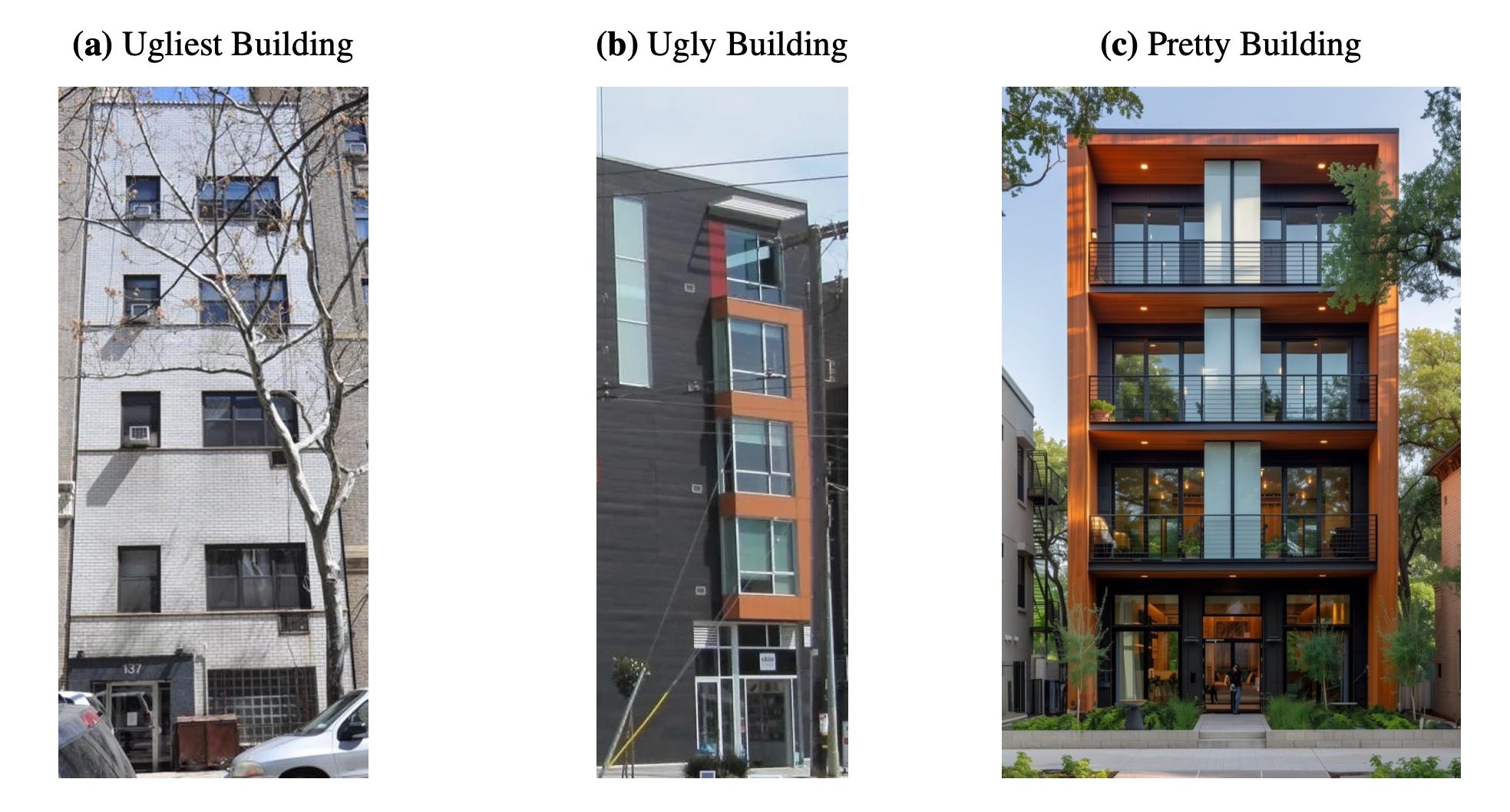
David Broockman’s papers (here and here) with Chris Elmendorf and Josh Kalla on what actually drives opposition to housing. Surprisingly, it has less to do with property values than with how voters feel about developers and how new buildings look. More on this from Alex below!
Peter Leyden’s The Great Progression; Peter compares our current era to the turn of the 19th century and the years preceding Teddy Roosevelt’s election. My curiosity is piqued!
Inspired by Marc Canal’s talk, McKinsey Global Institute’s A Century of Plenty, which asks what it would take for every country to reach today’s Swiss standard of living by 2100.
Generally revisiting some of the architecture school books on my shelf after Micah Springut’s talk on stone craft. Aesthetics aside, constructing buildings using robots and structural stone sounds fundamentally pretty modernist to me.
Preferences for density — Alex Armlovich
David Broockman spoke about some of his work on factors that influence opposition and support for new construction. In one strand of his work, Broockman and coauthors Chris Elmendorf and Josh Kalla find that people who live in dense parts of a city are more supportive of building a 5-story apartment building than those living in less dense parts of the city. Broockman and coauthors interpret this as sorting: people with a taste for density choose to live in denser parts of the city. But there was a lively discussion afterwards about where this taste comes from. Maybe a taste for density is really a taste for the familiar, and people initially aversive to density get comfortable with it over time. Or maybe it’s about what kinds of aspirations are depicted in media: do movies and TV celebrate owning a single-family home or a trendy downtown condo? Or perhaps the health of cities (in terms of crime, education, order) during your formative years affects your lifelong preferences. Broockman noted that at least one unpublished source of age-gradient preferences for density used to be inverted, suggesting at least some degree of preference endogeneity formed by life experiences: Today young people prefer density more than older people, but when the Boomers were young, older people liked density more than younger people. You can make arguments for all of the above!
Progress in education, flight, and flight safety — Matt Clancy
Some things I learned at Progress con:
It can often seem like there is no progress in education at all - for hundreds of years, the expert has stood at the front of the room and the students sat at desks listening. But Matt Bateman argued progress is real, even if glacial. Exercise books, grade-appropriate readers, stories tuned to the interests of children, were all invented at one time or another. These, plus many other innovations, have allowed the typical student to learn more in less unpleasant environment.
The Wright brothers plane looks backwards to us today, with a tail-like protrusion sticking out of the front. According to Brian Potter, this unintentionally had the effect of converting a deadly stall into a gentle descent. That was one factor that let the Wright brothers successfully conduct the hundreds of tests they needed to develop manned flight.
Speaking of flight, one of the most successful drones at the DARPA lift challenge was successful because it “cheated”: it was able to run its engine at speeds that would normally overheat and kill it by rotating the whole drone as it flew, then shunting the rotating air into the engine to cool it. Watch more drones crash here.
What I missed last week — Willow Latham-Proenca
My roundup last week was inevitably inadequate in capturing all the great writing on BAAJA. A (still non-exhaustive!) list of some more pieces worth reading includes:
A magisterial but highly readable digest of the main problems BAAJA takes on, and the mechanics of how the bill addresses them, by Aidan Mackenzie at IFP
A discussion of how a (potentially short-term) ebb in utilities’ political influence created a window for BAAJA’s oversight provisions, by Catherine Boudreau at Latitude Media
A deep dive into why reforming Clean Water Act Section 401 matters so much for transmission and hydropower by Marc Levitt at Breakthrough Institute
A statement from 21 Republican state governors in support of BAAJA
Daniel Palken and Pavan Venkatakrishnan breaking down the bill with Milan Singh of The Argument
Daniel Palken again breaking down BAAJA with David Roberts at Volts
A “hard look” (pun intended?) at BAAJA – I don’t agree with all of it, but I appreciate the thoughtfulness – by Holly Bender of the Sierra Club:
“If Congress fails to get this right, it could mean continued reliance on fossil fuels, higher costs for families, and ever-worsening extreme weather events”
Senator Whitehouse on why unlocking clean energy matters so much from an affordability perspective, on Jigar Shah’s Energy Empire podcast:
“...Folks are [...] certainly noticing what their electric bills are now….And it’s not that complicated to understand how the generation stack works. It’s not that complicated to understand that when a gigawatt of clean power gets delayed or removed, then you have to have a gigawatt of something else to meet demand. And if that happens to be fossil fuel, which it always does … you can actually track additional consumer costs”
Jigar Shah and Jane Flegal on many BAAJA topics, including what “remand without vacatur” actually means, and why BAAJA’s fair share provisions go so much further than expected in putting data centers on the hook, on Latitude Media’s Open Circuit.
Here are a few other highlights and announcements from our team and grantees:
Willow published A Bigger, Better BAAJA, breaking down the permitting bill.
The Build America Caucus released the Build More Agenda, a bipartisan policy platform covering housing, energy, and infrastructure. More from our team on this next week!
The White House announced a set of science initiatives, including several that align with areas we care about.
The Pop-Up Journal held its inaugural conference at NBER, surveying economists on their estimates of the returns to R&D.
Matt was interviewed at the Roots of Progress Conference.
Saloni’s latest Hard Drugs episode is out, asking whether can we switch off diseases.
Alex shared some thoughts on the Nobel Prize in Economics, awarded to Michael Woodford.
The BBN Fund at Renaissance Philanthropy is looking for technical scouts to help identify and support ambitious applied research teams.