


Here’s what caught our attention over the last week:
The ROAD Act and the Transit Abundance Playbook — Alex Armlovich
A new threat to economic data — Dylan Matthews
Refine sets the benchmark for AI review — Jordan Dworkin
Remember data centers in space? — Willow Latham-Proenca
Operation Trial Blazer — Saloni Dattani
The limit of human felicity — Matt Clancy
We’re also planning to post a separate What we’re reading spotlight by Matt tomorrow. Stay tuned!
The ROAD Act and the Transit Abundance Playbook — Alex Armlovich
The Senate passed the 21st Century ROAD to Housing Act 85–5 on Monday; the House takes up the amended package today, and President Trump is expected to sign it within the week. The bill’s 45-plus provisions cover a wide array of reforms: cutting red tape, overhauling funding and financing, and providing technical assistance plus carrots and sticks for state and local reform. The supply-oriented measures trim federal permitting friction, expand the definition of manufactured housing by relieving the HUD code chassis mandate, raise and index FHA multifamily loan limits, lift the bank public-welfare-investment cap from 15% to 20%, and stand up grant programs to convert vacant buildings and rehab aging homes. Most of the binding constraints on housing still live at the state and local level, but this provides direct cleanup of key paperwork burdens and bad rules that exist at the federal level.
IFP just launched its Transit Abundance Playbook: fifteen memos from transit practitioners and researchers on why the US pays the world’s highest prices to build and run transit (and how to bring those costs down). Rohan Aras and I wrote on bus procurement: US agencies pay anywhere from $500,000 to over $1 million per bus, while peers abroad buy comparable vehicles for under $400,000. Bad incentives in federal-local cost-sharing compound with excessive customization at the agency level…plus burdensome procurement regulations, bans on trade in buses even with US allies, and weak federal state capacity, to produce the world’s least competitive & most expensive domestic bus market.
A New Threat to Economic Data — Dylan Matthews
Economists, sociologists, demographers, and other researchers need accurate, ideally individual-level data to understand what’s going on in the world. At the same time, most people don’t want information like their address or income available for everyone to see. How do we reconcile these two goals? Some countries, like Norway and Sweden, err on the side of openness, making even individual income tax records public. The US typically values privacy highly, which means the Census has begun to use “noise infusion,” a technique for anonymizing individual and business-level data by adding random changes to individual data points. At a high level, the random noise cancels out, in theory letting you still learn accurate facts about, say, a county or industry, without violating specific people or businesses’ privacy.
When the Census announced they would do this to the 2020 Census data, leading to strange conclusions like finding that 48 people live on the same island as the Statue of Liberty (in reality zero people do, at least legally), there was a major backlash and the agency eventually backed down. Now, the Trump Commerce Department is proposing to ban any use of noise infusion. Nathan Goldschlag, a former staff economist at the Census Bureau, has a post at the Economic Innovation Group’s blog arguing this goes much too far and risks leading the Bureau to just not release certain data at all. I am far from an expert on this and honestly think the US tends to overweight privacy in these matters, but it’s the kind of debate that could have far-reaching ramifications for how we understand the economy.
Refine sets the benchmark for AI review — Jordan Dworkin
There are a growing number of AI tools for various components of the scientific process, but there are rarely careful, public evaluations of how they perform and compare. Last week Refine, an AI-powered review tool for economics research, published the kind of benchmark and evaluation study that I would love to see more of in this space. They ran ~1300 head-to-head matches on 150 economics preprints, comparing the quality of Refine’s reviews to both single-shot frontier LLM reviews and scaffolded review systems. Refine won roughly 90% of the match-ups (~95% against single-shot models and ~85% against scaffolds). Worth caveating that the benchmark’s unit of evaluation is a “paper-grounded atomic concern”, a specific verifiable issue tied to a location in the paper; this is a reasonable operationalization of review quality, but is also one that informed Refine’s design. Refine’s win rate is also strongest in matchups where it raises more unique concerns than the competitor (~90-95% when it has more concerns vs ~70% when it has fewer) - that could very well be signal, but it could also be an evaluator bias towards longer/more detailed reviews (a preference that has been observed in human evaluators), which would be both useful and interesting to check. But overall, it seems clear that one major takeaway is “Refine is very good at producing high-quality, technical feedback, and if you’re an economist you should consider giving it a try”, and another is “more tool-builders should run and publish studies like this.”
Remember data centers in space? — Willow Latham-Proenca
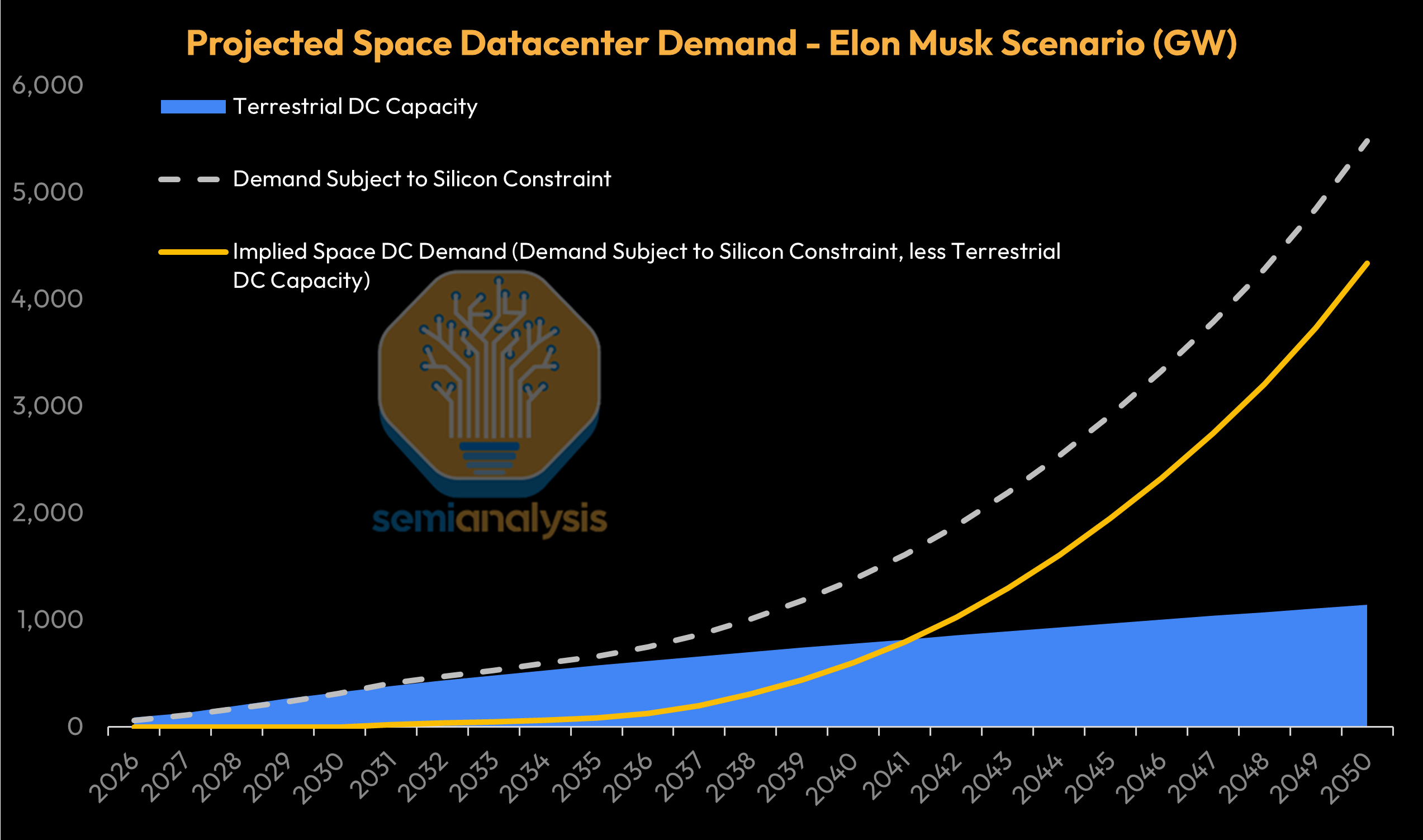
(...probably). Semianalysis is out with a comprehensive comparative analysis of the costs and uncertainties around space-based datacenters, arguing that while technical, operational, and cost barriers mean that space-based data centers start out at at least 4x earth-based costs, we shouldn’t completely discount the idea. They’re not exactly bullish on timing, though – in their base case, space doesn't reach cost parity with earth until ~2040, driven by falling launch and hardware costs. Even then, space would be a genuine necessity only if earth-based data centers have exhausted all potential capacity from grid supply, BTM generation, converted bitcoin mining, and industrial capacity/manpower to build additional infrastructure, which their base case doesn’t show happening at a meaningful scale through the middle of the century. However, what’s interesting is how quickly regulatory barriers (and capacity barriers dressed up as regulatory barriers) could potentially start to bite – by the early 2030s, space-based data centers could be running at only a ~30% premium, easily in the range where permitting and regulatory barriers become the deciding factor on whether to launch if earth-based capacity remains artificially constrained. Depending on how fast we solve some of the technical hurdles that currently make space-based centers a financial non-starter – as well as the universal constraint on chip deployment anywhere, semiconductor production – political will could end up being of central importance, making the most important argument for space…well, the space (and even that is limited by narrow orbital regimes!).
Operation Trial Blazer — Saloni Dattani
This week, the US Department of Health and Human Services (HHS) announced a new initiative called ‘Operation Trial1 Blazer’ that aims to bring back early-stage clinical research, which has increasingly been outsourced to countries like China and Australia, by reducing how long it takes to get approval to start phase 1 trials as well as how long it takes the FDA to review data from phase 1 trials.
The initiative includes several parts. One is an FDA pilot program to set up a network of qualified research institutions that help researchers prepare the protocol and supporting components before they submit it, though the FDA still decides whether a trial can proceed. It also provides more guidance on what manufacturing (CMC) data is needed for phase 1 and clarifies this is lower than for later-stage trials – companies have so far tended to submit more data than necessary to secure approval. And it includes guidance on choosing the first doses given to humans, recommending these are based on statistical modelling of the drug’s pharmacology rather than animal toxicology studies, which were often poor predictors of side effects in humans. Finally, there’s a rolling platform for the FDA to review components of the package as they arrive rather than all at the end.
Most of this sounds positive, though I’d add a caveat of the main bottleneck facing the FDA right now: staffing capacity, given the cuts over the last few years (roughly a fifth of the agency’s workforce, around 3,500 FDA staff, were cut last year), and whether these reforms ease that problem or worsen it further. Rolling reviews especially require more staffing time, because reviewing at the end typically means some attrition from researchers who don’t make it to that stage; similarly, if the FDA still has to make the final decision on whether phase 1 trials can proceed, especially given this initiative is new and will take their input. Still, there’s good stuff here: the guidance on manufacturing data and dose selection doesn’t depend on FDA capacity the way the pilot does, so some of these changes could result in improvements soon.
For more thoughts on the new policy, Ruxandra Teslo and Adam Kroetsch also weighed in.
The limit of human felicity — Matt Clancy
I’ve been listening to the wonderful new podcast Everyday Abundance (no affiliation!) by Virginia Postrel and Charles Mann, based on Dylan’s recommendation two weeks ago. Each episode looks at the history of some aspect of modern life, which we tend to take as just part of the background now. The last episode I listened to was about listening to music, and featured this quote from Edward Bellamy, writing in 1888:
[I]f we could have devised an arrangement for providing everybody with music in their homes, perfect in quality, unlimited in quantity, suited to every mood, and beginning and ceasing at will, we should have considered the limit of human felicity already attained.
I estimate I spent about 16% of my waking hours in 2024 listening to music.
We have just one announcement to share this week: our colleagues at Coefficient Giving launched a $10-30 million RFP on global health and wellbeing in an era of transformative AI, looking for proposals on everything from LMIC clinical trial infrastructure to how labor market disruption could reshape health systems. Applications are open through August 21.
Yes, this is intended to be ‘Trial’ and not ‘Trail’
How IYO might one best go about evaluating the question of balancing those privacy/accuracy considerations? Has there been public opinion or revealed preference work on this, either in terms of the slate of opinions or of actual harms? To me the injection of literal falsehood seems very high cost since the balance of future queries is impossible to model, but I am sure other people have thought way more about this.