



Here’s what caught our attention over the last week:
Everyday Abundance — Dylan Matthews
Geothermal policy — Willow Latham-Proenca
The cost of building and the cost of insuring — Alex Armlovich
Clinical trial innovation barriers — Saloni Dattani
Data center power lines in Loudoun County — Nisha Austin
Jordan is whale watching in Alaska; he’ll be back next week. And we’re also planning to post a separate post by Matt on the Atlas of Innovation launch later this week.
Everyday Abundance — Dylan Matthews
I just finished reading Charles Mann’s The Wizard and the Prophet, which has to be a top-ten abundance and growth book for its description of the Green Revolution’s effect on crop yields and recounting of the failed apocalyptic predictions of “prophets” like William Vogt and Paul Ehrlich. So it was serendipitous that just as I wrapped up that Mann work, I heard about a new one: Everyday Abundance, a new podcast he and Virginia Postrel (another science journalist I love) are starting. Their first episode is, naturally, about the history of brushing your teeth. If anyone can make that interesting, it’s these two.
Geothermal policy — Willow Latham-Proenca


The House passed a bipartisan geothermal package (plus a freestanding bill) last week – big hits are statutory formalization of a NEPA categorical exclusion, expanding on the April 2026 categorical exclusion to cover development (not just exploration) of geothermal resources, and a faster leasing cadence (while provisions setting timelines for approvals are a move in the right direction, they’re probably less likely to be effective). Whether this passes the Senate, either on its own or riding on a larger permitting bill, remains an open question.
While it’s exciting to see policy movement on America’s most basically likeable energy source, it’s worth remembering that two of the most important binding constraints - better characterization of underground resources to make projects more bankable, and transmission to get electrons to where they’re needed - remain to be addressed. And Fervo’s March ‘26 comment on a California PUC transmission financing concept paper illustrates (part of) why transmission is an unpopular, if critical, cousin - allocating the costs remains fiendishly controversial. Nisha’s dispatch from Loudoun County this week shows what that opposition looks like on the ground.
The cost of building and the cost of insuring — Alex Armlovich
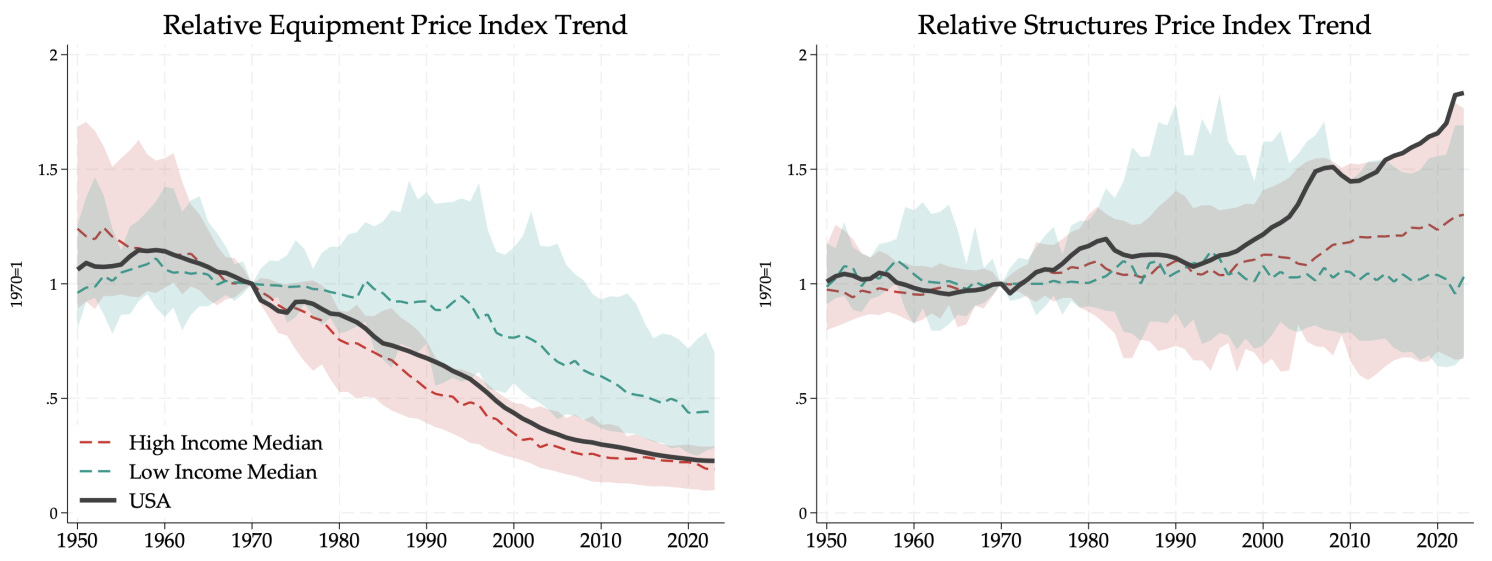
A new VoxEU column argues that declining construction productivity has fueled an 80% increase in the relative price of US structures since 1970, offsetting the benefits of continued declines in the cost of equipment. “Construction productivity is no longer a sector-specific concern”, they say, positing more expensive structures as a key drag on economy-wide growth. The authors don’t cleanly distinguish between land costs and construction cost inputs, so their model includes the combined effects of land use regulations and pure construction costs on the final user cost of real estate. While endorsing land use regulation reform, they point to reforms to building codes and investigating other construction cost inputs as the neglected next frontiers (a view widely shared among professional YIMBYs).
Meanwhile, insurance costs have also been a hot discourse topic, especially in housing and real estate. Some of this is pure money illusion: The average price level of all goods and services increased ~30% since 2020 because of the largest coordinated fiscal and monetary policy stimulus since the New Deal, so it’s easy to find a trend piece about almost any product up by 20% to 40% in nominal dollars. Still, Florida had a real problem with homeowners insurance, reportedly originating 76% of US insurance lawsuits from just 9% of US homeowners. After recent liability and tort reforms, insurance firms and Florida regulators are reporting a sharp drop in litigation costs and premium growth. Every insurance market is different, but there’s never a bad time to identify and reform rent-seeking that threatens housing affordability.
Clinical trial innovation barriers — Saloni Dattani
Have you ever wondered why some innovative approaches only get used once or twice? It’s something I’ve often thought about with clinical trials. Take platform trials, which test multiple treatments within a single trial, or adaptive trials, where new treatments can be added as they become available, or protocols can change in response to incoming data (in a predetermined way).
Designs like these are often piloted or used by academic researchers, and sometimes they even show up in FDA guidance, but they rarely get adopted widely by pharmaceutical companies. A new post by Adam Kroetsch explains why.
The recurring theme is uncertainty on what regulators will accept, and since trials are so expensive and slow, with a lot riding on whether a drug application is accepted or rejected, the stakes of failure are enormous. The first company that tries an innovative design carries huge risks. But even a single pilot trial usually isn’t enough to convince companies that a given protocol will be accepted more widely.
He lays out how to get these designs to scale: the FDA should formally recognize modern trial practices so sponsors know in advance what protocols will be accepted; the government should set interoperability standards so trial software can be harmonized; and the NIH should fund more large, phase 3-scale trials and build reusable infrastructure, de-risking innovative designs by making them ready for regulators, repeatable, and adoptable.
Data center power lines in Loudoun County — Nisha Austin
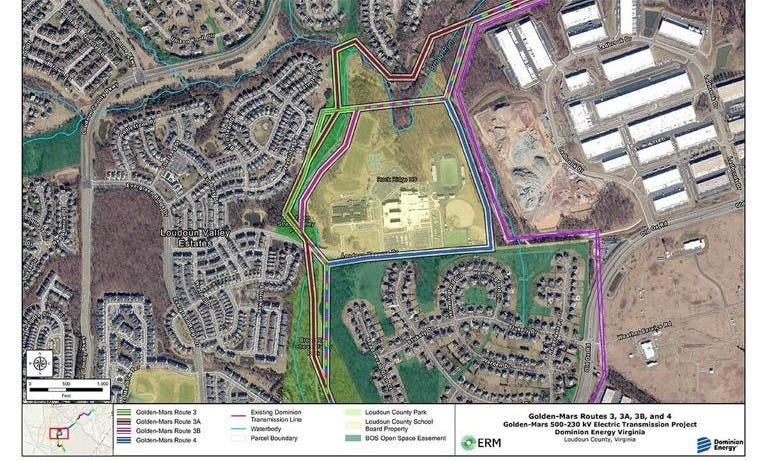
Last month, Dylan wrote about Loudoun County, Virginia, home of the largest concentration of data centers in the world, and where data centers account for 45 percent of county revenue, lower property tax rates, and well-funded schools. But there’s a flip side playing out over the transmission infrastructure needed to power them. Dominion Energy’s Golden-Mars line, the final piece of a reliability loop, was approved by Virginia’s State Corporation Commission in April, but residents have turned out by the hundreds to fight the route, which runs near schools and homes. The county school board asked for the lines to be buried; the commission said no. County Chair Phyllis Randall captured the shifting politics: residents used to accept data centers for the tax benefits, but “now I say, ‘this is what it does for your tax rate’ and they say, ‘I don’t care.’”
If there’s a local story like this you think we should know about, we’d love to hear from you.
Here are a few other highlights and announcements from our team and grantees:
We provided prize funding for the Metascience Novelty Indicators Challenge with UKRI, a global competition to develop scalable methods for assessing the novelty of research papers (see coverage in Science here). The winning team from Forschungszentrum Jülich built an AI-based approach that compares the knowledge contribution of a paper to the state of knowledge, as represented by the text of the papers it cites.
The Zoning Project launched a publicly available national dataset of housing regulations, built using LLMs to read and code zoning documents across U.S. municipalities. It makes it possible to systematically compare how rules like minimum lot sizes and density restrictions vary across the country.
Lauren Gilbert published “Immigration and House Prices“ in her Migration Living Literature Review, reviewing the evidence on whether immigration increases housing costs.
California YIMBY published their latest Homework newsletter, rounding up recent housing legislation and policy developments across the state.