



Here’s what caught our attention over the last week:
Cutting off your drugs to spite China — Saloni Dattani
Cambridge’s upzoning dashboard — Alex Armlovich
Panic procurement — Willow Latham-Proenca
Who owns the problem? — Nisha Austin
All models are wrong, but some are playable — Saloni Dattani
Matt shared a spotlight on the state of science policy yesterday.
Cutting off your drugs to spite China — Saloni Dattani
Last week, under the COINS Act, which aims to restrict US foreign investment in sensitive technologies (including semiconductors, AI, quantum tech, high-performance computing, and hypersonic systems), the Treasury released a draft rule adding biotechnology as well. It would cover a wide range of medicines – including drugs, vaccines, antibodies, cell and gene therapies – and prohibit US investors from buying stakes in some Chinese biotech companies, including through licensing deals that involve ownership investment. It would also cover joint ventures, although it’s unclear which kinds of arrangements would be affected. For example, Pfizer’s licensing agreement with 3SBio, a Chinese biopharma company, included a $100 million investment in the company’s shares; future investments like this could be prohibited under the proposed rules. (It seems that ordinary drug licensing deals will mostly remain unaffected.) The rules are still a proposal and public comments are open until December 7.
Personally, I think it’s a frustrating response to China’s rise in biotech and pharma, and worry that it’ll mean losing out on many genuinely lifesaving innovations developed in China; this week’s oncology conference (ESMO), for example, featured promising results for several cancer drugs developed by Chinese companies and tested in China, like ivonescimab and sacituzumab tirumotecan. I see China’s catch up as a sign of how comparatively slow the pace of development has become in the US, often for bureaucratic and administrative reasons that could be made far more efficient, and think they should spur FDA and clinical trial reform, rather than being a reason to restrict tech.
Cambridge’s upzoning dashboard — Alex Armlovich
Cambridge passed one of the country’s most politically ambitious locally-led upzonings (initiated without a state mandate) in February 2025, allowing four-story multifamily buildings as of right on nearly every residential lot, with extra height for projects that include affordable units. Twenty months later, the city has launched a public dashboard to track what the reform is producing. The early numbers look the way physically incremental zoning reform uncoupled from permitting and building code reform always looks: modest but promising (4 stories is a real change for an American suburb, but Cambridge is starting from a denser pre-war urban core baseline than a typical suburb). Unfortunately, the Globe also reports a run of four-story projects with three to nine units, a size that ducks the city’s unfunded inclusionary zoning requirement, and the new dashboard shows only four permitted projects so far include inclusionary units. 15 newer applications do, however, so the IZ-conditioned height bonus might not always and everywhere fail. But overall builders are responding to the unfunded inclusionary notch the way a public finance economist would predict: As a tax on buildings above 4 stories.
Panic procurement — Willow Latham-Proenca
I’m reading the Energy for Growth Hubstack1 on panic procurement this week, and I’m again struck by how closely some of the “novel” problems of energy demand overshoot facing the US rhyme with the shortage symptoms developing nations like Ghana and Nigeria have faced for decades. The authors here round up a set of emergency procurement fiascos, where countries rushed the contracting process for new energy to avoid or address an energy shortage. Unsurprisingly, rushed procurement often leads to decades-long bad deals: when “speed becomes the dominant policy value,” questionable clauses (e.g. long-duration contracts and take-or-pay clauses) make their way into contracts under duress, locking in high prices and setting up long-term fiscal and/or affordability consequences.
The clearest US analogue in this case – utility contracts with power users, rather than suppliers – is a bit of a mirror image. In the developing world case, utilities are taking too much demand risk through rigid take-or-pay contracts with developers – in the US, utilities may be failing to offload it through sufficiently binding commitments with offtakers. However, the root problem of misplaced risk is identical: utilities in both cases are absorbing a risk they’re not well-placed to mitigate, putting ratepayers (or taxpayers, if the government is ultimately the backstop) on the hook for the long-term consequences of rushed decisions
In both cases, as the authors argue, the answer is probably accelerating, rather than discarding, “normal” processes. In the “panic procurement” these include competitive procurement, public disclosure, and long-term demand forecasting; at the highest level, the US analog might be streamlining grid interconnection rather than facilitating off-grid solutions. In both cases, strong regulatory oversight – too often a scarce resource in itself – is essential.
Who owns the problem? — Nisha Austin
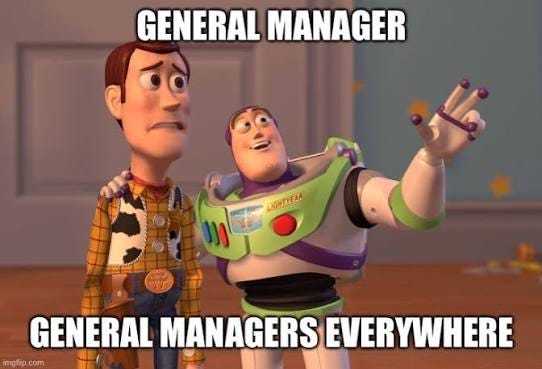
I made my way through Issue 26 of Works in Progress while travelling last week and Nan Ransohoff’s piece about needing General Managers for orphaned problems caught my attention (it’s an edited version of this piece, originally published in January).
She basically says that plenty of people work on slices, but nobody thinks it’s their job to deliver the whole thing. She wants “general managers,” i.e. founder-types who feel personally on the hook for an outcome. With field building and also with the type of work we support through our fund, this isn’t totally clear cut and sparked some interesting debate on our team. One objection from the team was that a general manager optimizes for their outcome, which isn’t the same as the best use of the next dollar.
Every example she admires had an outcome you could check. Smallpox had a last case, in 1977. Marriage equality had Obergefell. Frontier has a tonnage number. I have no idea what it would mean to “solve abundance”, and I’d be suspicious of anyone who told me they did. Though if we break down our portfolio this more clearly translates (e.g. you could fix housing or you could fix how long a trial takes). Which maybe just means the general manager belongs to the problem and not the field, and a fund like ours is a portfolio of problems. I guess that means we already have general managers and they’re just a level below where Nan is looking.
I’d also love to hear from anyone on abundance problems you think are sitting orphaned!
All models are wrong, but some are playable — Saloni Dattani
Ever since I made the clinical trial bottlenecks game, I’ve been thinking about simulation models and games as a way of understanding complex issues. It’s not just that it’s fun, but designing one really helped me think through lots of assumptions and how impactful they were, and I’ve found that a complex game (or model) helps understand how multiple ideas interact in a way that would be difficult to simply imagine.
So I was excited to see the launch of a thinktank, the Innovation Majority Institute, that designs simulations, video games and other interactive explainers to explain complex policy ideas. It seems really cool! But I have to admit, their games are actually games – unlike mine, which was essentially a slider model in a trench coat. For now, they’ve started with a bike courier game where you deliver goods and a model where you set fees on autonomous vehicles and see how that affects trip times and costs, but it seems like there are more to come.

Here are a few other highlights from our team and grantees:
Matt published our Q3 2026 Progress Report, covering what our team and grantees have been working on over the past quarter.
Dartmouth is hiring an economic policy researcher to work with Heidi Williams on innovation and science policy.
Abundance NY published their 2026 voter guide ahead of next week’s election.
Not a typo.
Just adding that the IMI people are *authentically gifted game designers*, which is a prerequisite to making those products good imo, and also that every think tank really should be thinking about the hires it needs to make in order to ensure its information products are successfully conveying the relevant ideas.