

I live in Washington DC, and here there’s a natural tendency to obsess over the federal government. But for a lot of issues that the Abundance and Growth Fund cares about — housing supply, renewable energy buildout, transportation, state capacity, commercial deployment of scientific innovation — state-level policies can be as, if not more, central. In housing, states can overrule intransigent NIMBY localities to allow more building. On energy, they can roll back regulations that delay or doom things like solar farms and electrical transmission lines.
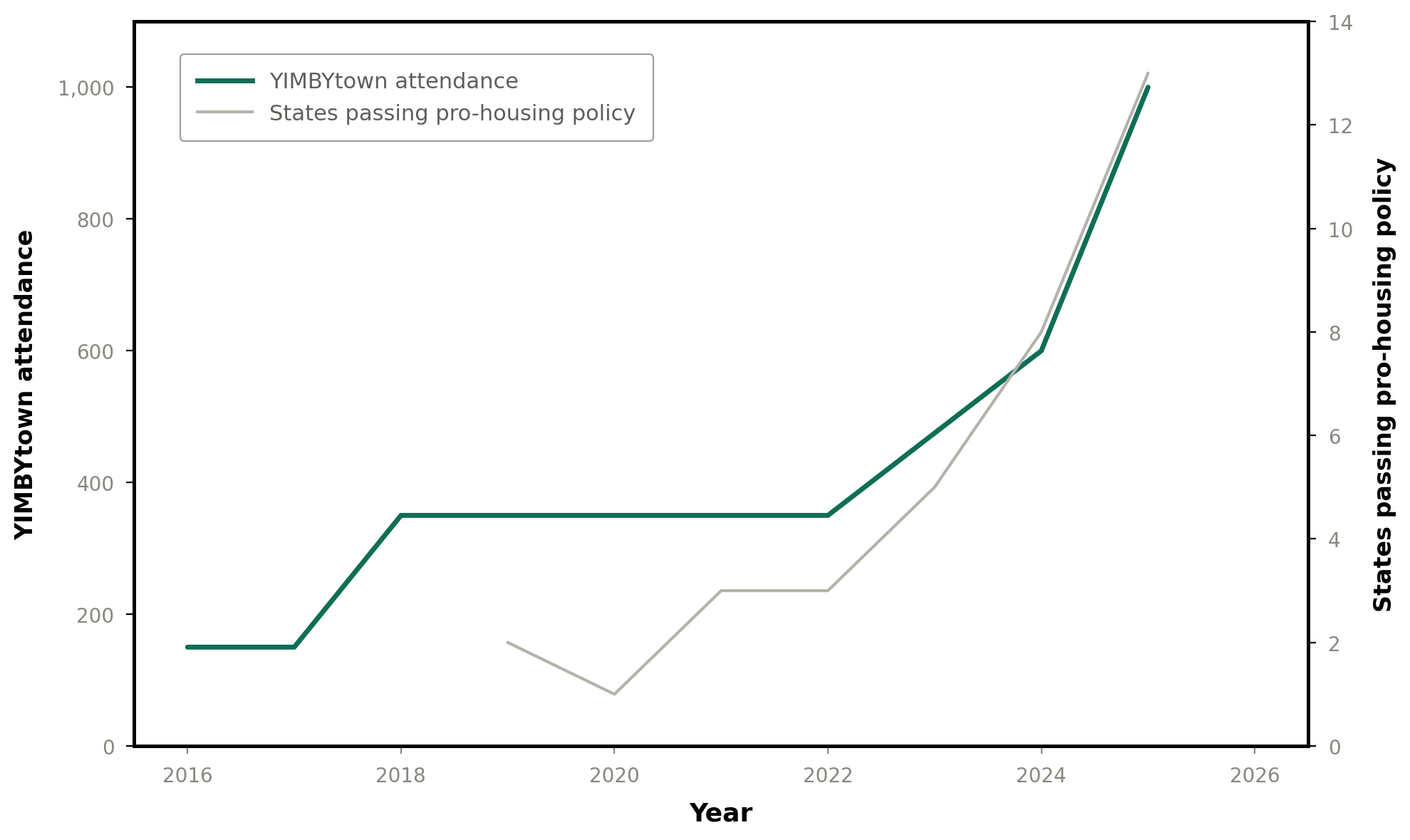
Moreover, many policies seem to “bubble up” from the states until they affect a huge swathe of the country, rather than being imposed top down by the federal government. Take housing, for instance. As our CEO Alexander Berger has noted, the YIMBY movement was trivially small at its onset around 2016, when we began supporting state-level YIMBY work in California. But the success of the movement there has led to growing movements in other states, and now a dozen-odd states have passed policies to encourage more housing production:
In political science, this is known as “policy diffusion,” and between-state diffusion of policy has been a major topic of study since a landmark article by Jack Walker in 1969. I’ve been starting to dig into this literature a bit in search of ideas for how to spark diffusion of good, growth-promoting policies. Penn State professor Daniel Mallinson’s excellent meta-analysis of the area has been a great help in getting my bearings, and the SPID (State Policy Innovation and Diffusion) database1, covering hundreds of specific state-level policies, has enabled a spree of really excellent work just in the past decade.
I can’t do the whole field justice in a short blog post, but I’ll highlight a few big takeaways I’ve gotten so far.
Partisanship is starting to beat proximity
Much of the diffusion literature explores to what extent policy decisions at the state level are driven by internal factors (how rich the state is, how liberal it is, etc.) versus influence from neighboring states. Obviously both factors matter, and at least since a 1990 paper from Frances Stokes Berry and William Berry, political scientists have been building models where both play a role. Those papers have tended to only focus on one particular policy area, though (in the Berrys’ case, state lotteries). SPID has changed that by allowing researchers to track diffusion patterns across many different policy domains over time.
Economists Stefano DellaVigna at Berkeley and Woojin Kim at Stanford recently published a very helpful paper tracking how the roles of partisan and geographic proximity have evolved from the 1950s to present. They conclude that from the ‘50s through the ‘90s, the most important factor was geographic proximity. If you want to know what will happen next in Iowa, check out what’s happening in Minnesota or Missouri. But by the 2000s and 2010s, the more important factor was state partisanship. Being nearby didn’t lose any of its importance; its coefficient in the main regression is basically unchanged. Partisanship just became much, much more important at the same time.
Other researchers have found the same thing. Also using SPID, Penn State’s Mallinson has found that partisanship became a more important factor from 1960 to 2014. Unlike DellaVigna and Kim, he finds that the role of geography has actually decreased, rather than staying constant over the decades. But the results are aligned in finding partisanship’s importance growing.
This pair of maps from DellaVigna and Kim illustrates the overall dynamic well:
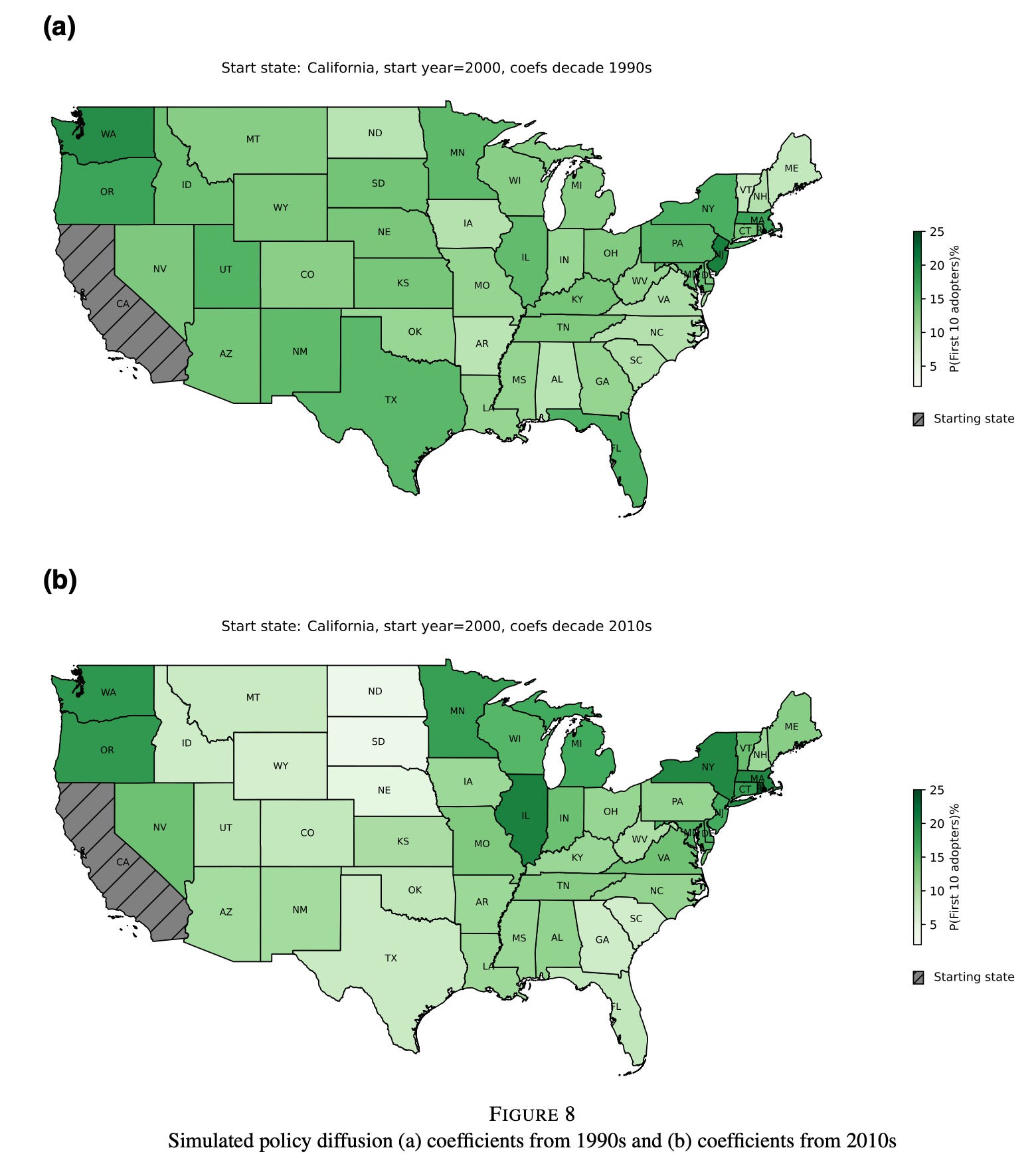
Here, DellaVigna and Kim are asking us to suppose that California introduces a new policy that no other state has (they find that California was the most “innovative” state in recent decades, in terms of introducing novel policies). The first map shows how likely different states would be to adopt the policy in turn according to the dynamics that prevailed in the 1990s: darker means more likely to copy California, and lighter means less likely. The second map does the same simulation but using dynamics from the 2010s.
The differences are subtle but noticeable. Blue states like Illinois and New York become substantially more likely to copy California by the 2010s. While Utah, Idaho, and even Texas are geographically close enough to California that in the 1990s you would’ve expected them to learn from it, by the 2010s the very different political stances of the states starts to dominate. One thing to note here is that in addition to the policy diffusion dynamics changing, California itself became much more left-leaning during this period; it had Republican governors from 1982 to 1998 and even voted for George H.W. Bush in 1988. So it makes sense that in the 1990s, Republican governors in places like Utah might have learned from California.
This paper’s point is descriptive, not causal; the authors are measuring the extent to which partisanship and proximity predict policy change, but their methodology doesn’t allow us to say something like “Iowa would not have passed this law if Missouri hadn’t passed it first.” Moreover, this research question is complicated by the fact that states might have the ideologies/partisan leanings they have because they’re close to states with those leanings. Being close to Massachusetts might make New Hampshire more Democratic-leaning, which makes separating out the influence of geography versus partisanship that much trickier. That said, being able to predict which policies spread from place to place is useful even if we don’t get good causal metrics.
Policies are more likely to diffuse these days
DellaVigna and Kim found that the importance of geographic proximity in spreading policies between states remained basically constant from the 1950s onward, but the importance of partisanship rose. Those two changes combined imply that there’s just more policy change happening, period, today than there used to be.
Sure enough, the baseline probability that a state adopts a given law in the dataset in a given year rose from 0.03 early in the sample to 0.05 later on, implying that passage odds nearly doubled. States are doing more learning from each other than they used to.
Some issues are still nonpartisan
The SPID dataset includes incredibly polarized issues like abortion, Medicaid expansion under the Affordable Care Act, and voting rights. But there are still areas of policies that are more technical and where divisions between the parties and ideological camps are not as sharp, and the dynamics in those areas seem more driven by geography than partisanship.
Case in point: Louisiana State’s Ryan Yang Wang and Penn State’s Krishna Jayakar have a nice paper from 2024 looking at state-level broadband internet policies. The policies included everything from laws governing right-of-way for fiber optic and other cabling; to financing and tax incentives for broadband rollout; to municipally run broadband services; to policies around mapping and planning future broadband rollout.
They find surprisingly little role for partisan control or affiliation in predicting if a state will adopt another state’s broadband policy. States with Democratic governors aren’t likelier to borrow from other states with Democratic governors; legislatures with unified Republican control aren’t likelier to borrow from other states with unified Republican control.
However, geography remains very important. They find that if two states are adjacent, they’re three times more likely (odds ratio of 3.028) to have one borrow a broadband policy from the other than if they weren’t bordering. Wang and Jayakar’s interpretation, which strikes me as correct, is that this is an area that’s both relatively unpolarized and where the specific geographies of states (eg how population-dense they are, how hard it is to dig underground wiring, etc.) are very important. That suggests a bigger role for geography than ideology.
Perhaps more surprisingly, Missouri’s Scott Lacombe, University of Iowa’s Caroline Tolbert, and the University of Tampa’s Samuel Harper find that diffusion of election laws is more strongly determined by a nonpartisan, objective indicator of how well states run elections (the Election Performance Index) than any partisan leaning. This surprised me, given that the list of election laws they considered included some that are highly politically contentious, like voter ID requirements, term limits, and moving to the popular vote for presidential elections. But it also includes unobjectionable good-government stuff like letting people register to vote at the DMV, The authors note that “the median policy was adopted by 31 states, and fewer than 20% of the policies were overwhelmingly adopted by states controlled by a single party.”
What does this mean for abundance and growth?
None of the studies here have focused specifically on the issues we at the Abundance and Growth Fund work on: housing supply, energy abundance, cheaper and faster clinical trials, more and better scientific funding, etc. Indeed, Mallinson’s meta-analysis calls out housing, transportation, and environmental policies as particularly lacking in policy diffusion studies.
But I still think there are some useful takeaways for our team:
Policy diffusion is real. Getting a policy passed in one state can meaningfully increase the odds that another state adopts it. That matters for our estimates of the impacts of state legislation. If funding an effort to have, say, Colorado simplify wind power permitting leads to neighboring states adopting similar reforms, that means our grant there is higher-impact than it looks like at first glance.
On certain technical issues, proximity is probably the best predictor of where that kind of diffusion will happen. But otherwise, we should expect diffusion mostly to happen between politically aligned states: between blue states, and between red states, but not crossing party lines.
It might be worthwhile to support parallel efforts in one blue and one red state to make progress on a certain topic. That way, you can set up parallel diffusion patterns, with Republican states learning from each other and Democratic states learning from each other, but the two groups arriving at a similar place in terms of actual policy.
We think this research suggests pro-abundance policies have a decent chance of diffusing at the state level, and we're going to keep investigating how to make that happen. If you have more papers on this or related topics, please link them below in the comments! We’re still very much in a learning process here, and welcome any and all suggestions.
SPID is a herculean effort with too many authors to list in main text so I’ll do it here: Frederick Boehmke at University of Iowa; Bruce Desmarais at Penn State; Jeffrey Harden at Notre Dame; Hanna Wallach at Microsoft Research; Mark Brockway at Syracuse; Scott LaCombe at the University of Missouri; and Fridolin Linder at Meta.
Policy diffusion is partly a language problem. The first jurisdiction to make a model operational gives others not just evidence, but permission to describe the same choice as administrative rather than ideological.
If you don't understand the impact of time delays on the supply-and-demand system, you cannot solve housing problems. Delays, such as permit delays, slow the supply response relative to the demand response, making the system mathematically unstable.
A good idea too late kills abundance and growth.