

Here’s what caught our attention over the last week:
Summer housing roundup and the end of parking minimums in NC — Alex Armlovich
Can you pay off the NIMBYs? — Nisha Austin
What’s a dollar of R&D worth? — Dylan Matthews
What's new in the economics of innovation — Jordan Dworkin
Advanced
marketclinical trial design commitments — Saloni DattaniSobering takes on Canadian wildfires — Willow Latham-Proenca
Stay tuned for a What we’re reading spotlight from Saloni tomorrow. And Matt is on holiday this week.
Summer housing roundup and the end of parking minimums in NC — Alex Armlovich
Halina Bennet has a summer housing roundup at Slow Boring: Beyond the already-covered ROAD Act, California's Governor Newsom signed AB 179, replacing the state's notoriously fragmented affordable-housing financing with a single application and penalizing localities that charge development impact fees on state-funded projects (saving $60,000–$70,000 per home). San Francisco slashed its unfunded inclusionary housing mandate from 15% to 5% after a court-ordered feasibility study found that even 5% could render projects infeasible under current costs and rates. Massachusetts folded a "YIGBY" (Yes in God’s Backyard) provision into its economic development bill, letting religious institutions build multifamily by right on land they've owned for three years. Finally, Zillow's latest census analysis, estimating a “national housing deficit” by comparing the number of doubled-up families to the available housing supply, held essentially flat in 2024 for the first time since the post-2008 underbuilding era began, driven by a 50-year high in multifamily completions. Even these crude accounting-based proxies for housing underproduction (which do not directly consider relative prices or inter-metropolitan mobility) nonetheless find the 4.7-million-unit deficit remains concentrated in the usual suspects: New York, LA, Boston, SF, DC.
Separately, North Carolina just became the first state to eliminate nearly all mandated parking minimums statewide. Governor Stein signed HB 162 (the Parking Lot Reform and Modernization Act) taking effect January 1, 2027. The coalition story is remarkable for most legislation but typical of the greatest YIMBY wins: the bill united environmentalists, farmers, developers, and business leaders. Reason notes the liberalization covers commercial uses too, not just housing, which again is unprecedented in statewide parking reform. The bill started as a stormwater management bill and the bipartisan framing (focused on stormwater regulatory relief first, and urbanism second) is what got it through a Republican-controlled legislature. Whatever the ideological context and framing, it remains fascinating to see parking relief laws begin to leap forward in car-heavy red states while trundling along incrementally in transit-rich blue states.
Can you pay off the NIMBYs? — Nisha Austin
A forthcoming paper by Michael Hankinson, Edward Glaeser, Joseph Gyourko, and Morris Davis surveyed roughly 1,700 residents of expensive areas and found that most people do have a price. Over 80 percent accepted at least one hypothetical housing proposal when offered cash compensation. The amount depended heavily on density: residents in dense urban areas needed only a few hundred dollars, moderate-density neighborhoods required low thousands, and low-density suburbs needed well above $5,000. Proximity and project type mattered too: proposals next door doubled the price, higher-density projects quadrupled it, and low-income-designated housing multiplied it fivefold. I was surprised to learn that when compensation was offered as a parks-and-streets fund rather than direct cash, residents demanded ten times more. As Rogé Karma writes in the Atlantic, this has prompted several think tanks to propose direct payments to residents in communities that hit housing production targets. What we'd love to see is similar research on infrastructure (in particular, transmission lines, wind farms, and industrial facilities). The evidence base there is almost nonexistent, even though siting opposition is just as central to those fights.
What’s a dollar of R&D worth? — Dylan Matthews
Here at AGF, we tend to think investment in research and development, whether by governments through agencies like the National Institutes of Health or in private businesses and universities, is worth an awful lot. When you get down to it, economic growth is about getting more benefit out of the same amount of physical stuff; you can only extract more benefit from the same stuff if you have better technology, and you get better technology through scientific research.
But just how beneficial is R&D? A big new report out of the Congressional Budget Office, coauthored by economists Sheila Campbell, Jaeger Nelson, Eli Schrag, Heidi Williams, and Caleb Wroblewski, has some of the most careful analysis of this question to date, using two radically different methodologies that come to quite different numbers. One approach results in an estimate that each federal dollar spent on R&D, financed by an increase in the budget deficit, grows GDP by $5.15. An alternative framework leads to an estimate of $1.98; the numbers in each case are higher if you pay for the funding through spending cuts, rather than borrowing it. Even the smaller number implies that R&D spending is an incredible deal, with each dollar invested doubling its value.
What’s new in the economics of innovation — Jordan Dworkin
This week I’m at the NBER Summer Institute, taking in lots of new work on the economics of science and innovation. Two of the papers being presented have already made appearances on this blog (one on idea diffusion, and one on the impact of AlphaFold). The rest of the agenda is also worth a look. Chen, Liu, & Ma take a new approach to estimating the economic value of science, building a text-based innovation network from 463 million papers and 81 million patents to trace how knowledge flows into technology; Songyuan Teng decomposes pharmaceutical innovation into novelty (new chemical building blocks) and recombination (new assemblies of existing blocks) and models their relative importance; and Mohnen & Gans have a new study on AlphaFold showing that it sped up experimental research but narrowed its scope (echoing other findings on contraction in AI-driven science).
Advanced market clinical trial design commitments — Saloni Dattani
I enjoyed reading a post by Witold Więcek on the Clinical Trials Abundance blog, titled ‘Market shaping and trial design belong together’. He explains why people interested in solving market shaping problems – such as economists designing advance market commitments and philanthropists funding multiple R&D projects for global health problems – should be interested in innovative clinical trials.
Most drugs today are tested in separate clinical trials: one drug vs one placebo, which is much more inefficient than running them together in a platform trial (with, for example, five drugs vs one placebo). That structure also makes it hard to make head-to-head comparisons between different drugs, since separate trials might enrol different kinds of patients, run at different times, and measure different outcomes.
That means the standard way to run clinical trials is less useful for decision-making. A market shaper, for example, might want to specify some criteria that different drugs have to achieve in order to receive a prize or payout from an advance market commitment. But differences in trial design and setting would leave open a lot of uncertainty about which ones qualify. So, he argues, why not have them play a role in designing the trial as well?
Sobering takes on Canadian wildfires — Willow Latham-Proenca
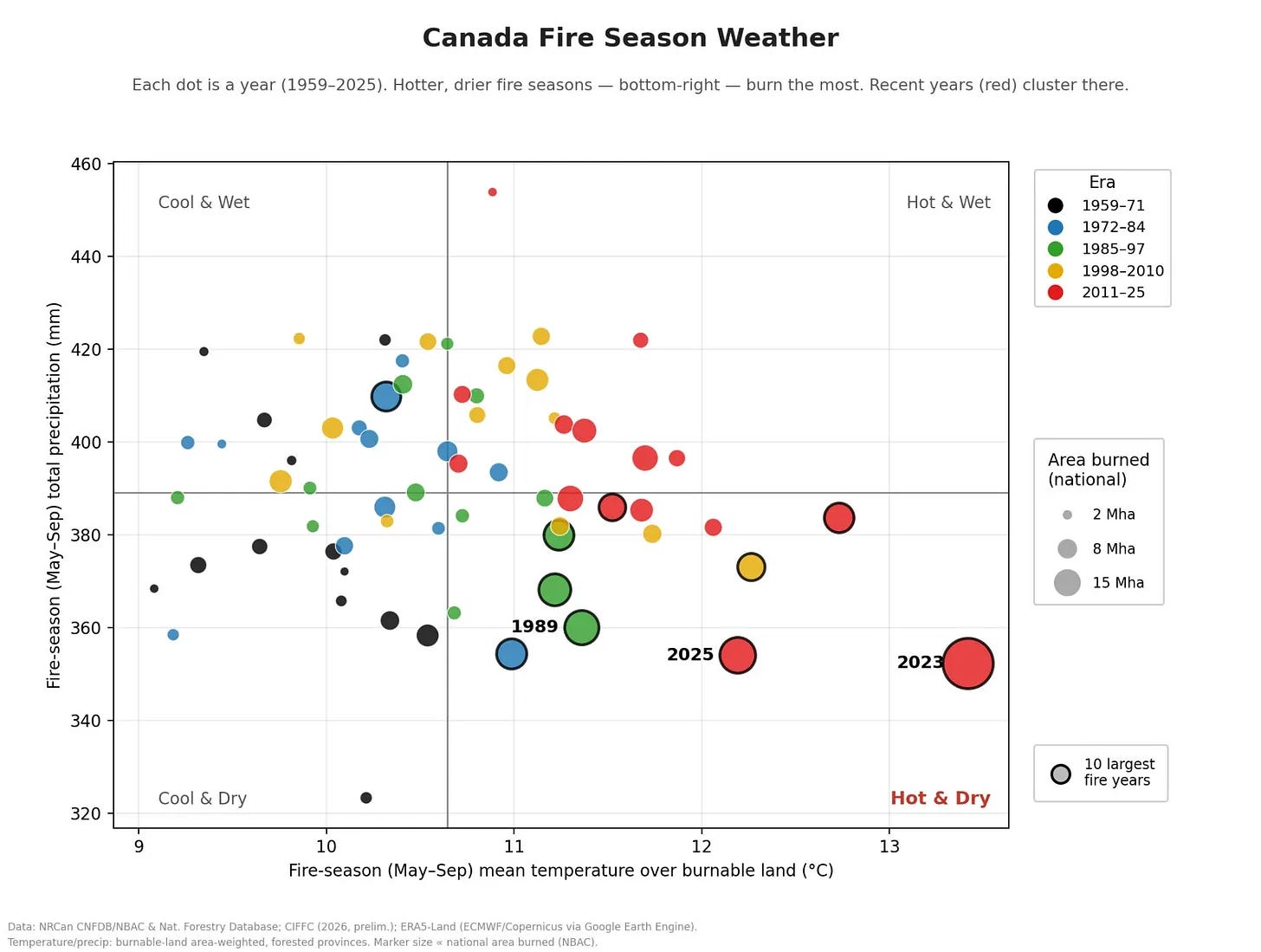
If you were in the Northeast US last week, you probably got at least a noseful of Canadian wildfire smoke. We’ve written before about the extraordinarily high health costs of wildfires, but Zeke Hausfather makes a convincing case that Canada’s fires – unlike many in the U.S. West – aren’t mainly driven by institutional mismanagement. Unlike in California, these Canadian fires are mostly occurring in boreal forests that have never been managed, so there’s no unnaturally accumulated detritus to burn. Devastating crown fires driven by weather (heat waves + lightning strikes) are the norm in these environments - so higher average temperatures directly drive more burning without additional human intervention.
Robinson Meyer makes a related case in Heatmap, arguing that the failure of climate research to integrate the potentially massive health effects of wildfire smoke is a potent illustration of how big the unknown-unknowns of climate change could be. While there was some pushback about the deep history of wildfire research, the fact that the resulting health effects weren’t integrated into flagship models of economic damages stands – as a result, policymakers had very little basis to understand and incorporate smoke risks before these types of fires became a regular occurrence. Part of this might be a map of science problem – wildfire risk, epidemiology (famously tricky for events like this), and mainstream climate modeling just didn’t overlap enough to stimulate research on their intersection until facts on the ground made the gap obvious. It’s worth wondering whether this is a problem that AI will help with, or one that the jagged frontier of scientific research will exacerbate.
Here are a couple highlights from our grantees:
Inclusive Abundance published “The Biggest Housing Bill in 30 Years Is Now Law,” a look at what the ROAD Act means for the abundance movement.
YIMBY Melbourne launched the Australian Zoning Atlas, mapping planning controls across all major Australian cities.
For the “yield of R&D spending” result, the delta between the two numbers is superficially not all that confidence inducing, right? Like it’s not as though the 2x is some kind of lower bound. I am a big believer in the ROI of R&D spending so I’m not personally especially concerned by this, but it does seem like a skeptical observer could conclude “well this is basically all over the place.”