

Here’s what caught our attention over the last week:
The Growth Effects of Energy Shortages - Willow Latham-Proenca
America Makes The Wrong Steel For Its Transformer Supply Chain — Dylan Matthews
Building New Homes - Alex Armlovich
GDP makes you better off, but it’s not the meaning of life - Matt Clancy
Nisha and Saloni are off this week. There will be more from Jordan later this week!
The Growth Effects of Energy Shortages - Willow Latham-Proenca
Energy-rich countries may not be all alike, but energy-constrained countries are also often each unhappy in their own way. Taiwo Hassan Odugbemi, Meron Tesfaye and the Energy for Growth Hub break down the monolith of unreliable power supply in Africa, showing how the grid can struggle in a variety of ways with distinct economic consequences.
Nigeria is the poster child for grid dysfunction, with chronic outages leaving the grid so unreliable that self-generation (usually with diesel generators) exceeds the total capacity of Nigeria’s grid. Transmission is a big part of the problem, likely a main culprit in keeping nearly 70% of the grid’s theoretical capacity offline. Beyond the direct cost of outages, the cost of buying and maintaining expensive backup generators increases firms’ production costs (potentially to 4x that of industrialized peers), and probably keeps firms that can’t afford the cost out of the market. As the authors flag, the “missing growth” cost here is hard to estimate (although apparently easy to invent?), but almost certainly in the billions.
In Ghana, in addition to outages and self-generation, long-dated power contracts rushed through in response to an energy crisis continue to undermine utilities’ financial stability. South Africa illustrates the continuing economic drag of past energy outages, even after (partial) recovery, with an estimated 1.5% GDP loss in 2023 yet to be recovered. Egypt’s case is perhaps the most interesting analog for the US right now – (barely) sufficient grid capacity and limited self-generation for the moment, but an uncertain grid expansion path when staring down the barrel of rapid demand growth.
America Makes The Wrong Steel For Its Transformer Supply Chain — Dylan Matthews
One of my favorite subgenres of business journalism / analysis are articles deeply exploring one particular, hyper-specialized product or resource that turns out to be strangely crucial to the whole economy. A great example is this piece in The Ecomodernist by Ryan Alimento on the production of “grain-oriented electrical steel” (GOES).
A specific alloy of iron and silicon, GOES is used to make cores for transformers. Transformers, an essential component in the grid that allow voltage to be adjusted for different types of transmission, are in extreme shortage, with order waiting times stretching to three years or more as the recent surge in electrical demand in the US forces more and more transmission buildout.
The US only has one steel plant making GOES, however, and its GOES is generally lower-quality and produces less efficient transformer cores than the GOES from Japanese and Korean mills. To make matters worse, the Trump administration briefly imposed steep tariffs on foreign GOES last year until outcry by the power sector forced it to reverse course.
Alimento gives a great breakdown of the problem, and an appealing suggestion for solving it: rather than rely on protectionism and import barriers, offer financing to enable US steel firms to develop new GOES-producing plants. He makes a compelling case that this is one specific area where industrial policy might be highly effective.
Building New Homes - Alex Armlovich
Brian Potter’s reading list has a good housing subsection this week:
First, there’s a striking divergence in existing home price data versus transaction prices at the largest homebuilders: Lennar has cut average selling prices 25% since 2022, overall median sale prices on FRED are down, but the Case-Shiller repeat-sale index for existing homes hasn’t followed. I see one unintended implication of this: Even the largest homebuilders can rapidly pivot to cheaper starter homes wherever they’re in demand, as soon as such homes are legalized in a jurisdiction.
Second, a new CalMatters piece documents that California cities have approved their Regional Housing Needs Allocation (RHNA) housing plans but are building almost nowhere near their targets. “Fair Share”-style housing frameworks like RHNA place a massive implementation burden on localities to proactively plan for growth from scratch, leaving the details wholly under local control. Decades of zero or weak results in these frameworks are beginning to draw more expert skepticism. State laws (like SB79) that prescriptively modify local zoning by default, subject to a local equivalent plan if a jurisdiction has staff capacity to make such a plan, increasingly look like a promising way to bypass the pain, paperwork, and massive staff time losses to RHNA-like processes.
GDP makes you better off, but it’s not the meaning of life - Matt Clancy
GDP per capita is positively correlated with a lot of desirable things, like health and subjective well-being (even though self-reported well-being in the United States has been falling for the last decade, it remains roughly at the level one would expect given our GDP per capita!). But GDP is not everything - it turns out reports of meaning in life actually decline with GDP per capita! Is this because “The meaning of life is a problem for people who are not desperate, people who can count on survival, comfort, security, and some measure of pleasure”, as social psychologist Roy Baumeister once wondered?1
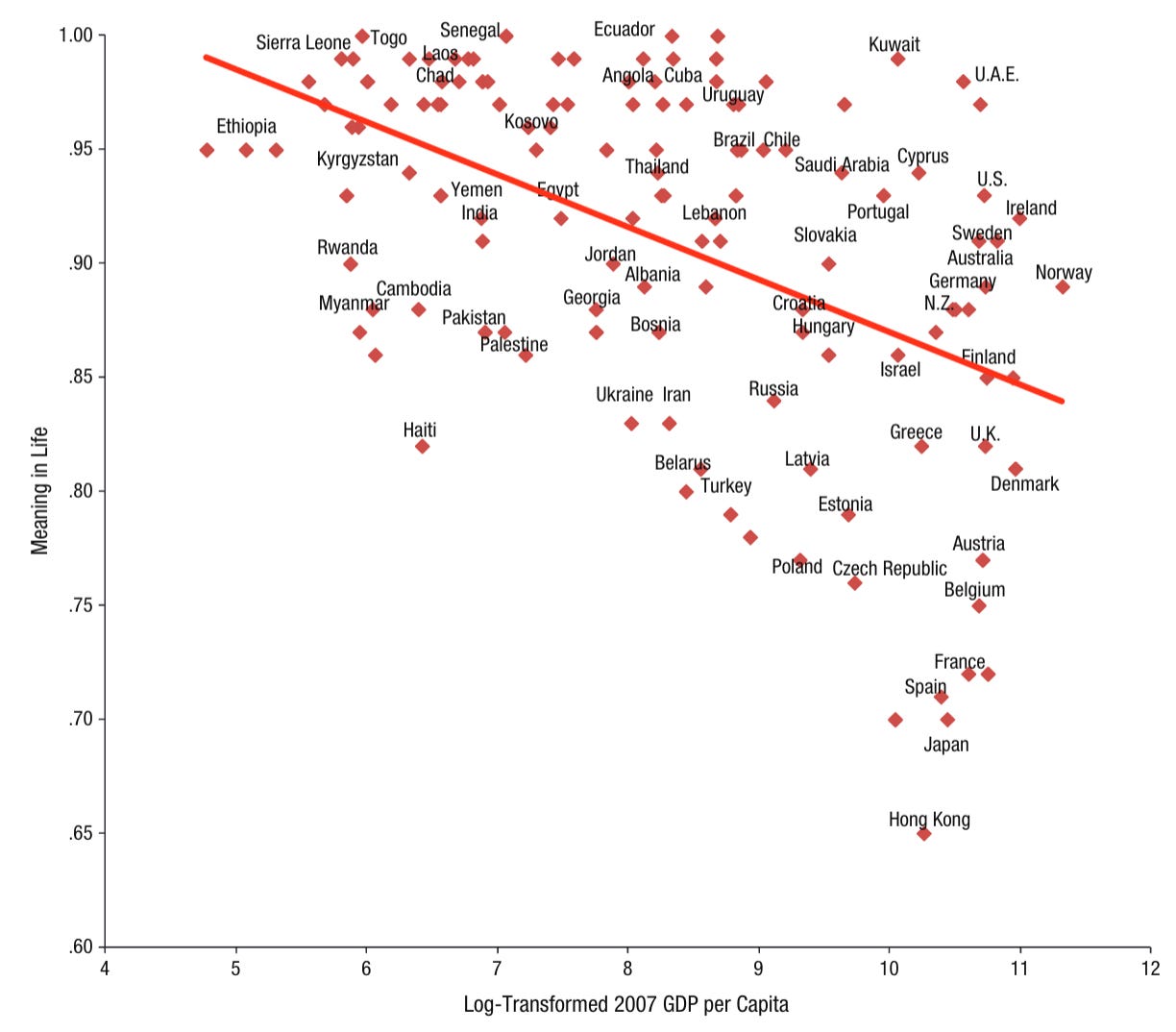
Maybe not. A 2014 paper by Oishi and Diener argues this effect is actually driven by religiosity. Religiosity is positively correlated with meaning; it’s just that religiosity is also negatively correlated with the GDP per capita. If you try to predict meaning with two variables - religiosity and GDP per capita, religiosity carries the day and GDP per capita no longer carries any additional predictive value. Indeed, when the data was collected, the US was actually an unusually religious high income country, and also a leader among high income countries in terms of how meaningful its residents find their lives. US religiosity has dropped substantially since 2007 though, and so I suspect a repeat of the study may not find the same results.
Here are a few other highlights and announcements from our team and grantees:
Last Friday, Alex wrote about the vast potential for transit-oriented development to end America’s housing problems.
You can now watch Saloni Dattani’s TED talk!
California YIMBY’s newsletter, The Homework, gave an update on the legislative session in all things California housing.
Renaissance Philanthropy has opened applications for the Biosecurity version of its Big if True Science Accelerator
Source: Oishi and Diener (2014), again.
What do you think the long-term solution to critical supply chain rate limitations of the kind we see in this transformer scenario might be? It seems impracticable to basically just inefficiently subsidize all thing-making capacity just because it might prove prohibitive for various future states wherein some component proves suddenly gatekeeping. But on the other hand, it does feel we require some amount of variously transferrable general thing-making capability (even if inefficient) to avoid being pilloried by don’t-choose-your-own-adventure vulnerabilities at inconvenient times. Is the the long-awaited ‘killer app’ for 3D printing? Is this just the kind of thing for which intentional solutions don’t cut the cake?