

Here’s what caught our attention over the last week:
Personalized cancer vaccines are now real — Saloni Dattani
Downweighing review scores at NIH — Jordan Dworkin
Housing supply laws across the country — Alex Armlovich
Housing and innovation: evidence from Germany — Matt Clancy
Dylan, Willow, and Nisha are all out this week!
Personalized cancer vaccines are now real — Saloni Dattani
Researchers have spent decades trying to develop personalized cancer vaccines, and last week, the first one succeeded. It’s called intismeran autogene (mouthful), was developed by Moderna and Merck, and involves sequencing melanoma patients’ cancer mutations, creating a custom mRNA to target them, and delivering the vaccine to stop the cancer recurring. The news came as the drug passed its interim goal in a phase three trial, where it was given to people with high-risk resected melanoma.
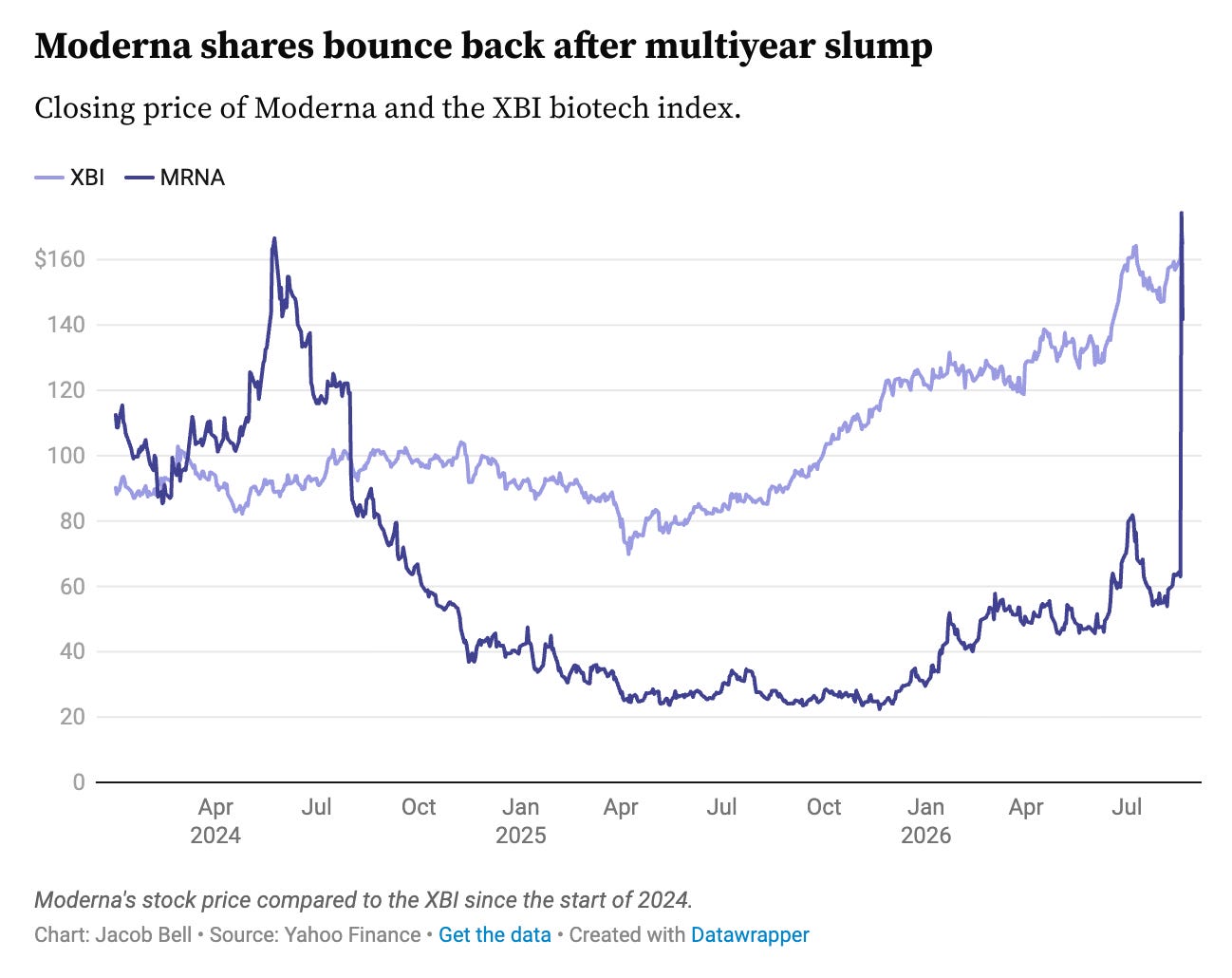
It led to Moderna’s stock jumping 177%, which was apparently the largest one-day gain by any S&P 500 stock this century. I found the size of the surge surprising because you could have already been fairly confident that the drug would succeed since at least June: as I wrote in an earlier post, the company presented data from their phase 2b trial at an oncology conference almost three months ago, which showed a 49% reduction in the risk of recurrence or death (p = 0.0075). But, according to financial analysts, the huge market reaction was probably down to a short squeeze and the belief that mRNA could be a more widely useful platform to develop other cancer vaccines too.
That makes sense, but it’s worth knowing that melanoma is a much easier disease to develop cancer vaccines for than others. It carries a very high number of mutations, so you have thousands of possible ‘neoantigens’ to select from and can choose those that look strong on many measures, but this isn’t the case for many cancers. Many cancers have far fewer mutations to select from, and it’s currently hard to predict whether their mutations will be displayed or measure which ones actually are displayed.
But very few people thought this attempt would work either, until recently. According to a very interesting new STAT article detailing how this cancer vaccine came about, Moderna’s own executives didn’t expect it would work until 2023; it first entered clinical trials in 2017. In case you’re interested in more about personalized cancer vaccines, I’ll once again recommend this great podcast episode, How to design a cancer vaccine, hosted by Owl Posting and featuring Alex Rubinsteyn and Benjamin Vincent, two scientists whose work focuses on cancer immunology and vaccines.
Downweighing review scores at NIH — Jordan Dworkin
Last week the NIH released an RFI proposing a change to how it uses and reports peer review scores. Instead of receiving a numerical impact score and percentile, applicants would learn only which of three bins their proposal landed in: “most competitive” for the top 25%, “competitive” for 26-50%, and “not discussed” for the rest. Overall impact scores and percentiles would also no longer be shared with program staff and advisory councils, who would instead see the relevant bin, the written critiques, and the specific criterion scores.
The stated rationale is that the numerical scores falsely suggest a high level of quantitative precision, and are middlingly predictive of downstream outcomes; thus, more qualitative buckets can give applicants and program staff a higher-level sense of relative quality while mitigating the likelihood of either actor overindexing on score-based rankings in their assessment of proposal quality. Indeed, I have heard from NIH institute directors that program officers’ decisions often hew too closely to percentile scores, rather than incorporating reviewer scores, reviewer comments, and PO discretion into a more holistic portfolio creation process. It is reasonable that removing the opportunity to simply rank and fund to the cutoff could encourage more consideration of written comments and disciplinary priorities (NSF already approaches their review and decision-making in something closer to this manner). But many scientists and science policy practitioners are reasonably wary, given the broader context of the OMB proposed rule, ongoing grant terminations, and politicization of review.
In my view, the most useful piece on this proposal is from DrugMonkey, a longtime pseudonymous blogger on biomedical science. They generally support a balanced approach, and point out that many institutes have historically deviated from the strict percentile order; as a result, this change mostly forces institutes that have historically funded more strictly on paylines to adopt the practices of the more balanced institutes. By DrugMonkey’s lights, the reason to be concerned is not that peer review scores are sacred and deviating from a strict order is itself harmful to science, but that the proposed change could give political appointees more authority to override scientific review while simultaneously obscuring that process. Comments are due October 13.
Housing supply laws across the country — Alex Armlovich
Mercatus Center’s fourth annual state YIMBY legislative tracker is out: 350 housing supply bills introduced across 40 states in the past year, 89 enacted in 28. The headline wins are familiar: California’s SB 79, New York’s SEQRA reform, North Carolina’s parking minimums, Virginia’s YIGBY package. But Mercatus also covers a long tail of state reforms: Idaho passed one of the strongest minimum-lot-size reforms in the country plus ADUs, single-stair, and third-party trade inspections in a single package. Kansas capped residential lot size mandates at 3,000 sq. ft with bipartisan support. One striking trend is geographic diffusion: the YIMBY legislative frontier has moved into moderate-cost states (Indiana, Kansas, Michigan, Pennsylvania) where postpandemic price increases turned housing from a coastal problem into a local one, and there’s some tractability argument for acting before prices get too far out of control. On the minus side, Connecticut repealed its single-stair law, the first outright repeal of a YIMBY-era reform. Hawaii, Minnesota, and Illinois all stalled despite high costs or strong gubernatorial pushes.
Housing and innovation: evidence from Germany — Matt Clancy
There’s an old idea that cities are engines of innovation in large part because they cluster together lots of innovators; these innovators make each other more productive via a variety of mechanisms. Across US cities, a 10% increase in the population of inventors is associated with a 2% increase in the per-person patent output on average (see Wiebe 2026, Table A12, column 7). We’ve always been interested in this idea, because it (partially) informs how valuable housing is: if zoning reform increases the housing stock of a city by 10%, do its inventors eventually become 2% more productive?
Unfortunately, correlation is not causation and pinning down just how real this relationship is has been tricky (see item #4 in this post for an example). So I was interested to find a 2024 working paper by Brian C. Fujiy at the US Census Bureau which looks at this question afresh. Fujiy looks at the unification of East and West Germany as an event that created a large amount of sudden and unanticipated cross-city movement from inventors. Using a variety of approaches to try and control for potential confounders, he eventually estimates that a 10% increase in the inventor population leads to a 4% increase in the productivity of the population’s inventors.
Here are a few other announcements from our team and things that caught our eye this week:
Patrick Collison, Mario Draghi, and Luis Garicano announced the Rhine Group, a forum to convene European leaders from government, academia, and business to discuss possible answers to get Europe to compete, build, and grow again.
Matt wrote a piece for Asterisk’s newsletter titled Why can’t technologists and economists agree on AI?
Jordan wrote a roundup on all things AI and Science last week (alas, already out of date!)
Works in Progress hosted the second iteration of its Invisible college.