




Here’s what caught our attention over the last week:
BAAJA blast— Alex Armlovich
Deficit abundance (?!) — Matt Clancy
Europe experiments with experimenting — Nisha Austin
Professor Oak’s next evolution — Saloni Dattani
When gas ≠ gas — Willow Latham-Proenca
BAAJA blast — Alex Armlovich
YIMBYs are realizing the big clean energy permitting reform bill actually has a lot to offer on housing. BAAJA’s cross-cutting red tape reforms weren’t explicitly drafted to streamline housing, but they pick up where ROAD to Housing left off on broad NEPA exemptions for federal housing loans & loan guarantees, and take a big leap beyond ROAD with new Section 106 historic preservation review exemptions for federal housing dollars. The YIMBY grassroots movement’s slow wakeup to this opportunity is excusable: Even for-profit homebuilders with large lobbying teams who monitor Congress closely were relatively late to realize the bill’s housing relevance, with National Association of Home Builders only just endorsing at the end of October and National Multifamily Housing Council yet to even put out a statement (!).
Deficit abundance (?!) — Matt Clancy
One reason I think abundance and growth ideas are gaining momentum is because the underlying idea of expanding shared growth by unblocking supply and improving government function is a smart way to achieve a lot of different goals. This year, voters care a lot about the cost of living, and growth is one of the few sustainable ways to address that concern, since prices fall when supply rises (and rising incomes make everything feel easier to afford). For those worried about ensuring a country is strong on the world stage, again, growth is a smart way to deliver. And a third area where growth helps is when you’re fighting a big government deficit.
In a new piece for The Argument, Zach Liscow takes a look at the case for abundance ideas as applied to the federal deficit. He points to the robust literature that expanding high skilled immigration tends to be deficit reducing, both because skilled immigrants earn a lot and pay high taxes, and because they raise the productivity (and hence wages and tax revenue) of domestic workers. Another engine of growth and wage growth are big cities, and policies that let more people live in them also raises tax revenues. Like us, Liscow laments the dearth of strong modeling on the growth effects of making it easier to build energy infrastructure, but it’s reasonable to believe it also increases growth and hence tax revenue too.
As Liscow notes, it is unrealistic to expect pro-growth policies on their own to erase the deficit. But they can take a meaningful bite out of the adjustment that’s needed.
Europe experiments with experimenting — Nisha Austin
The EU is negotiating its next big research program (FP10, the successor to Horizon Europe), and the European Parliament has agreed on its position. It’s a push for about €200 billion from 2028 to 2034 and includes a new article devoted entirely to experimentation.1 The program would have to “provide a structured framework for targeted experimentation in the award and implementation of Union support,” build the Commission’s capacity to run it, put some of its budget toward it, and report each year on how much is spent. It also lets the Commission waive parts of the program’s own rules, and of the EU’s financial regulation, to test new approaches for a limited time. In effect, it’s a regulatory sandbox for grantmaking, which very few governments have. There’s still a formal vote, then negotiations with member states and the Commission, and a big gap between embracing experimentation and doing the minimum to comply. But it’s a major step forward for progress in European metascience, and we’ll be watching to see where this leads!
Professor Oak’s next evolution — Saloni Dattani
I like to think of myself as a centrist on the question of how much AI will accelerate drug development, and to some degree I’m more interested in what the remaining bottlenecks will be despite progress in AI. But something that’s shifted me in a slightly more optimistic direction has been the approach of Mithril Medicine, a one-person biotech recently acquired by Anthropic, with a founder previously only known as Professor Oak on Twitter who revealed his real name, Cody Tranberger, as part of the announcement. Using Claude, he coordinated multiple drug programs for one project, supporting planning and analysis, maintaining project records, and helping to coordinate with external labs and part time consultants.
The biotech founder Egan Peltan argues this approach could help improve productivity across biotech, where previously drug development programs would have been constrained by managing complex projects and distributed information across experts; better program management using AI could then improve research efficiency, and make biotechs more lean by outsourcing practical tasks to external labs. But the reason I find it interesting is that the same kind of approach could be applied to operating clinical trials, which many people including me have often argued are a bottleneck to medical progress. As those aspects are made much more efficient by AI, I’d expect the rate limiting steps to gradually shift to the progression of diseases being tested and the validation of surrogate endpoints, as well as funding, manufacturing, and delivering the outputs themselves: AI won’t be able to ‘speed up’ the progression of cancers to test whether drugs work faster, but I think technological advancement could still go a long way, and circumvent problems that people don’t expect.
When gas ≠ gas — Willow Latham-Proenca
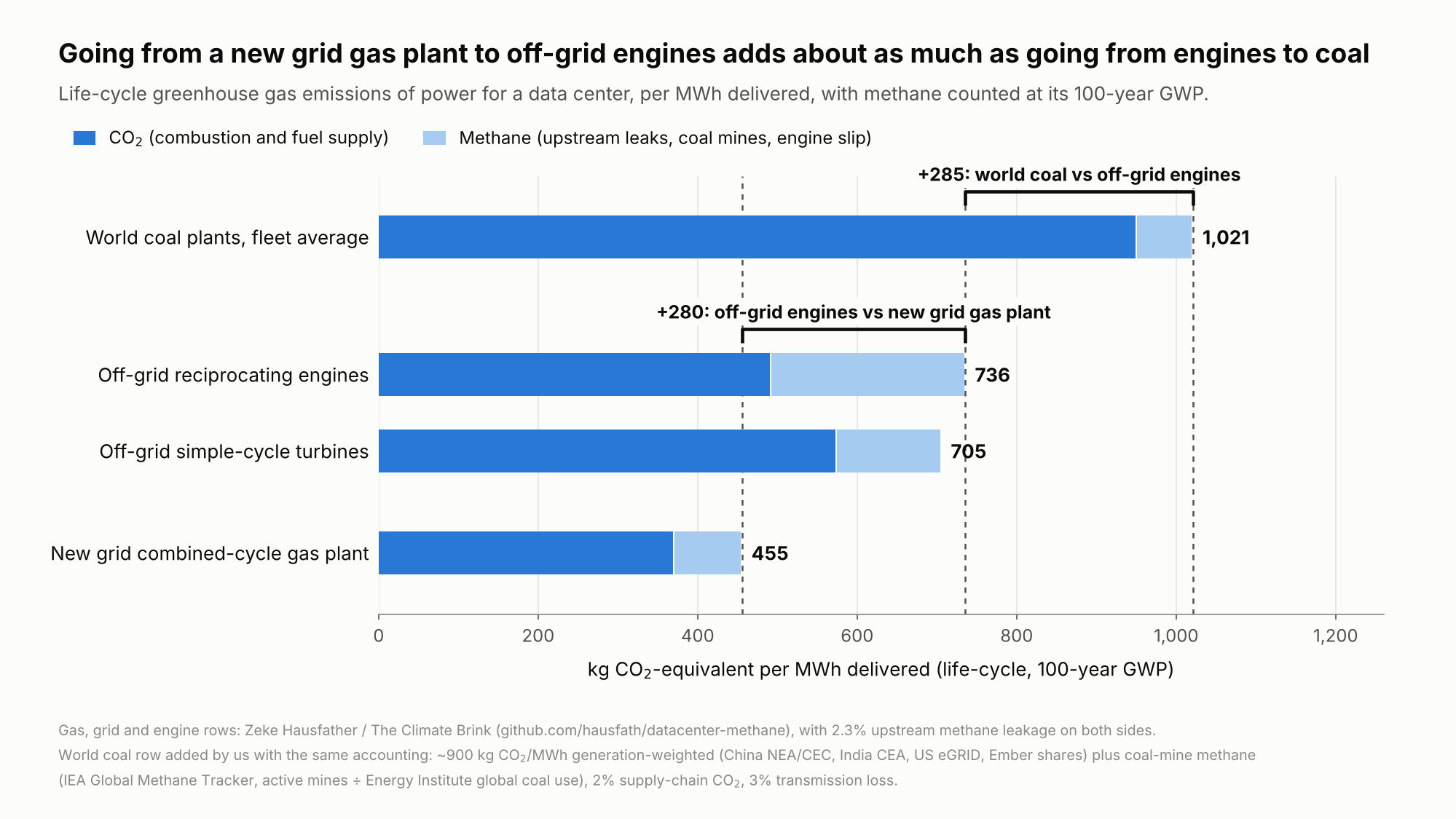
One of the most important climate arguments for BAAJA – which isn’t fully incorporated into most top-line modeling – is that it’s really important to get new load onto the grid because large off-grid loads are really bad. Even assuming all-gas generation, on-grid and off-grid gas are two completely different animals: going from a new grid gas plant to off-grid engines adds about as much as going from those engines to the average coal plant.
Zeke Hausfather’s piece last week runs the numbers on this, explaining how a combination of less-efficient gas generation technologies (reciprocating engines or simple-cycle turbines off the grid versus modern combined-cycle turbines on it) puts emissions from off-grid gas generation at about 30 - 55% above on-grid gas, even before accounting for higher accompanying methane leakage. This leakage widens the gap even further, to 55 - 80% over on-grid combined cycle generation.
This is pretty important: by some estimates, ~80% of planned off-grid capacity will use one of these low-efficiency gas technologies, and roughly a quarter of total planned data center capacity is off-grid. This is why one of the data center scenarios in Rhodium’s modelling this week shows that even if new demand were met mostly with on-grid gas – itself a pessimistic climate scenario – emissions would still be nearly a third lower than if that demand were pushed off the grid.
Here are a couple other highlights from our team and grantees:
Georgetown Abundance has been publishing a weekly link roundup on their Substack, covering abundance news across housing, energy, and infrastructure.
Saloni dressed up as Eroom’s law for Halloween. It’s a sneak peek of her forthcoming episode of Hard Drugs with Jacob Trefethen on the same topic.
More evidence that the consensus is growing that the future of science policy include metascience!