


Here’s what caught our attention over the last couple weeks:
10,000 pieces of type — Nisha Austin
Science’s institutional history at 250 — Jordan Dworkin
Anthropic develops drugs — Saloni Dattani
The Astera metascience essay contest — Matt Clancy
Trump v. Slaughter and the end of independent agencies — Willow Latham-Proenca
Modular housing and the HUD code — Alex Armlovich
And Dylan is on holiday this week!
10,000 pieces of type — Nisha Austin
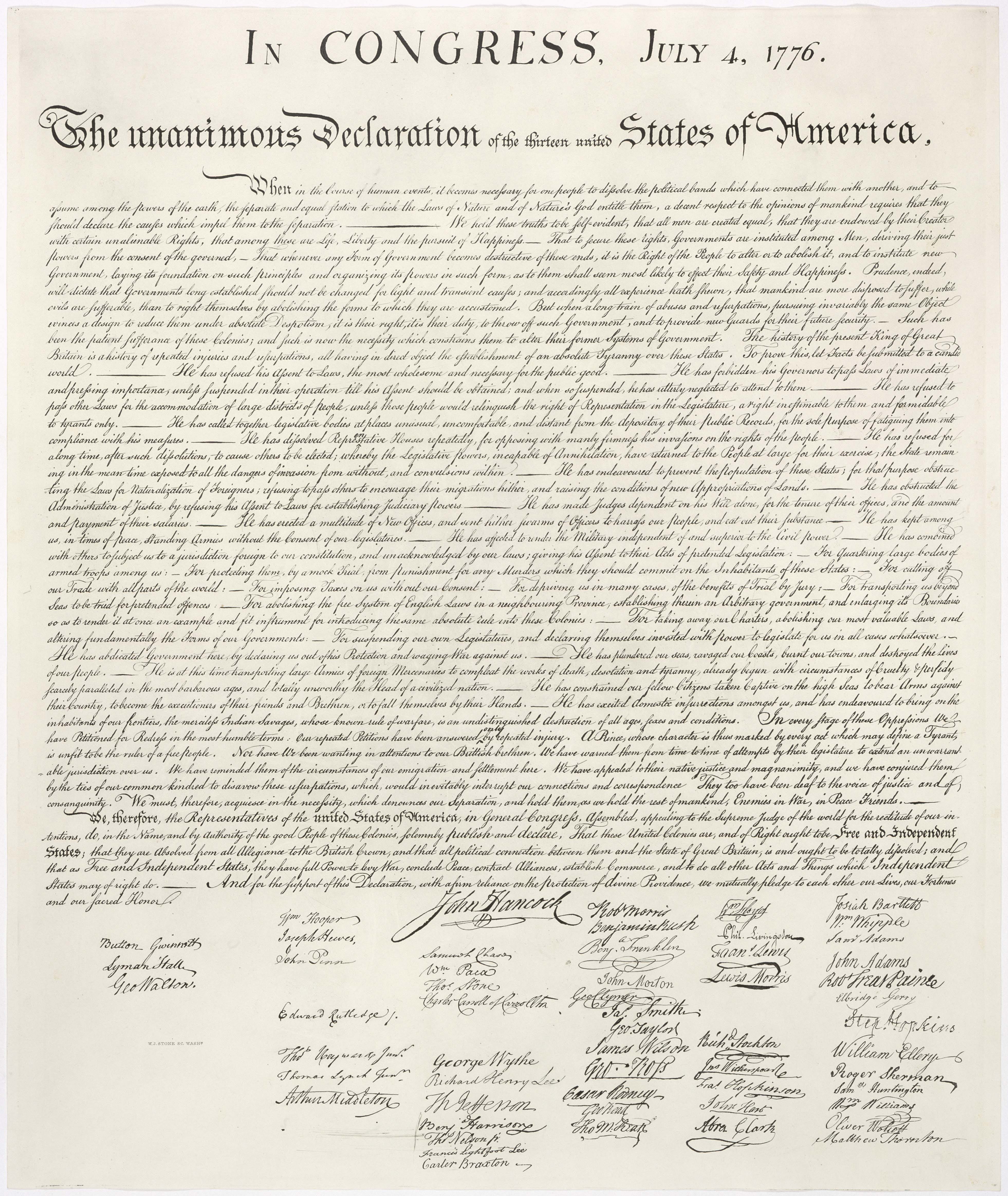
One of my favorite 4th of July traditions is to go to the historic fort in town for a reading of the Declaration and firing of the cannons by a historical reenactment group. This year, with the sweltering temperatures, we decided to go to a reading of the Declaration at the local town hall instead. It unexpectedly included a hand-printed copy of the Declaration that was made by setting roughly 10,000 pieces of type by hand and running each sheet one at a time on cotton linen paper, the same slow way it would have been done in 1776. There’s a fitting Massachusetts thread to this: in 1776, we were the only state to ask every town clerk to copy the text into town records and every minister to read it aloud from the pulpit. Two and a half centuries later, a version of this is still happening in our town halls.
There’s a line in the Declaration which defines our unalienable rights as life, liberty, and the pursuit of happiness, rather than the more familiar “property”. Jerusalem Demsas and Kelsey Piper dwell on that choice: the historian Arthur Schlesinger read “pursuit” as practice, as in a right not merely to chase happiness but to have it. Piper goes on to describe all the ways in which Americans live lives of staggering wealth: hot water on demand, a refrigerator, a cupboard holding more kinds of tea than most people who ever lived drank in a lifetime. In 1900, Americans spent 43 percent of their income on food; the White House had no indoor plumbing until the 1840s. Medieval kings would envy us.
Jason Crawford reads the anniversary in a similar way. American history is not a story of decline but one of long, messy accumulation of things built: the reaper, the light bulb, the airplane, the interstate system, the Internet, eradicating polio and smallpox. His piece lands where I did in our foundational texts post: on Lincoln, and what we owe the institutions we inherit. What we have is precious and rare, and it should make us generous. The work is never finished, and every generation has to show up for it.
Science’s institutional history at 250 — Jordan Dworkin
For America’s 250th anniversary, Brad Wible invited a trio of pieces for Science’s Policy Forum tracing the institutional shifts that built the modern US scientific enterprise.
Ronald Daniels writes about the founding of Johns Hopkins in 1876, made possible by a $7m gift (the largest philanthropic gift in US history at the time), which imported the German research university model and laid the foundation for the postwar funding system. Ashish Arora and Sharon Belenzon cover the rise and fall of the corporate research lab, positioning the pursuit of long-horizon research in commercial contexts as a break from the more distributed systems that dominated before (typically individual inventors licensing patents to firms) and after (typically universities producing novel science, startups translating it, and firms commercializing it). And Daniel Gross and Bhaven Sampat trace the federal funding system back to OSRD, which invented the federal R&D contract (described at the time as one of the “great inventions” of the war) and grappled with many questions that remain top-of-mind today, like indirect costs, patent rights, and geographic distribution.
Anthropic develops drugs — Saloni Dattani
Anthropic made two announcements in the last week about its plans in AI for science. First was the launch of Claude Science, a platform that integrates dozens of scientific databases and bioinformatics models and currently runs on Opus 4.81. Second, that it plans to develop drugs of its own.
I found it interesting for multiple reasons: Anthropic committed to working on pre-clinical research – drug development in the lab and potentially in animals – but didn’t rule out taking its drugs through clinical trials as well. It also plans to focus on “neglected diseases” with weak commercial incentives, which it describes as potentially including both rare genetic disorders and tropical diseases, although it hasn’t disclosed any examples of diseases or drug modalities that it might work on.
This follows Anthropic’s acquisition of Coefficient Bio,2 a stealth startup, earlier this year, with roughly ten people who came mostly from Genentech’s computational drug discovery unit; and Anthropic is also building its own wet lab.
But why work on drug development at all? According to Anthropic, it’s to get hands-on experience in the field it works with companies on and to build a feedback loop to learn how to make better tools and models. As their head of life sciences Eric Kauderer-Abrams described it, there’s no substitute for being “in the trenches trying to develop drugs.”
I’d be more optimistic about Anthropic’s chances for developing successful drugs for rare genetic diseases, which tend to be ‘simpler’ in biological terms – as they’re often caused by a single gene or mutation that can be targeted with drugs and gene therapies – than neglected tropical diseases, for which the biological data to understand them, and how to target them with drugs, is often lacking in the first place. And since the best validation of drugs is testing them in human clinical trials, rather than in the lab or animals, I’m left wondering if they’ve deliberately kept that possibility open. Even aside from that, it seems to me that clinical testing and manufacturing, rather than preclinical drug discovery, are more important bottlenecks to progress on both fronts, although most AI tools so far have been built for preclinical work.
News reporting also suggests that their stated focus, on neglected diseases, helps them avoid stepping on pharma companies’ toes. In a sense, thanks to the Orphan Drug Act, faster approval processes, and rare disease priority vouchers, rare diseases aren’t as neglected as they used to be and pharma companies do have some incentives to develop drugs for them (and they now make up roughly half of annual new drug approvals) – but there are so many different rare diseases that the rationale probably still works.
But building labs and hiring top wet lab biologists seems like a first step rather than an end goal in itself; and since clinical trials and manufacturing are the bigger bottlenecks, delivering on Anthropic’s public mission would probably mean going much farther than what they’ve announced so far.
The Astera metascience essay contest — Matt Clancy
The most interesting thing I read recently was the winning entrants in the Astera metascience essay contest, for which I was one of the judges. While not every winning essay was related to AI (see these two, for example), the opportunities and challenges of AI dominated the contest:
It’s a bit of a truism that AI and data are strongly complementary; but what data should you collect? What if we could use scaling laws as an input into this decision process? Collect data and train models on it, until we can see the trendlines emerge, which will let us estimate how much data we would need to collect to achieve a given performance (more from Peter Koo’s winning essay).
A major problem in science is the “file drawer problem”, wherein null results don’t get published, in part because writing up any result takes time and energy, and the rewards to doing so are very low for academics (more here). But if AI agents are integrated into the research process, they have all the material they need to do this for us at almost no cost. Could we finally open all (well, more) file drawers? (more on this theme from Niveditha Iyer’s winning essay)
One of the most important problems in science is knowing what question to study. With AI that can finally parse text as good as most people, we are in a position to map out the enormous network of cause and effect that the collective literature has studied. With a map in hand, could we identify promising gaps we would otherwise miss? Or could we at least make progress on automating the identification of important questions? (more from Prashant Garg’s winning essay)
The use of benchmarks to assess the quality of different AI models has been a notable hallmark of AI progress, and one that seems likely to spread across science more generally. But how do you design good benchmarks? Shaamil Karim and Jaeeon Lee both proposed ideas related to this.
One more interesting AI-related challenge: when we ran the winning essays through Pangram, some of them were flagged as using AI (though the share that used AI was even higher among the ones that had been triaged out, prior to the AI check).
I think all future essay contests are going to need to think hard about an AI policy. In our case, we cared about the arguments and ideas, not the authenticity of the prose (or even the provenance of the idea?), and so we decided not to factor AI use into our decisions. But questions remain: what’s the right size for a prize, when the cost of writing an essay has declined? To ensure the prize is incentivizing ideas that outcompete what you would get by simply asking an LLM for ideas, maybe contest organizers of the future should use AI to generate essays in response to the contest announcement and covertly submit them; a prize is only awarded if the judges pick essays that were not generated this way.
Trump v. Slaughter and the end of independent agencies — Willow Latham-Proenca
To add even more uncertainty to the fraught landscape of energy planning and regulation, the end of the Supreme Court opinion season last month brought a highly controversial ruling in Trump v. Slaughter, where the court held that the president can fire commissioners at independent agencies without cause. While some argue that this is an appropriate tightening of elected authority over independent bureaucracy, a less-hopeful view (articulated by Robinson Meyer in Heatmap last week) is that the ruling represents a continuing erosion of Congressional authority – in this case, powers intentionally delegated to independent technical experts – relative to the executive branch. While we’re unlikely to see major short-term policy changes on the energy front – the current FERC and NRC are already closely aligned with the goals of the current administration – over the long term, this could reshape policy at FERC and NRC in ways that are hard to predict. Robinson Meyer takes the strong view here, arguing that Slaughter essentially turns the commissions into agencies – implementers of the president’s agenda, rather than independent arbiters (Ben Schifman of IFP has an interesting take in the same thread arguing that ratemaking bodies like FERC will remain exempt - time will tell if SCOTUS will re-litigate that argument).
Modular housing and the HUD code — Alex Armlovich
Kimberly Burnett has a new piece at Niskanen on HUD's new best-practices guidance for states and localities, focusing on one key recommendation: regulate modular housing by harmonized and objective performance standards rather than prescribed construction methods. Modular is still only ~3% of US single-family homes against 28% in Japan, and we’ve lived through many modular “hype cycles” in the US. But factory-built manufactured housing using the national HUD code is still between 5% to 10% of single family housing completions in the US, suggesting a key binding constraint to modular methods is regulatory fragmentation: duplicative factory-and-site inspections, codes written for on-site assembly, and thousands of local building departments with no capacity to evaluate factory-built homes. National model code standards for modular homes, like ICC/MBI 1200 and 1205, are spreading but have not yet succeeded on the scale of Congress’ choice to directly preempt local building codes nationwide with the HUD Code in the 1970s.
And finally, a couple additional highlights worth sharing:
Institute for Progress published a detailed report on reforming Section 106 of the National Historic Preservation Act, which has expanded well beyond its original “stop, look, and listen” function into a significant source of delay for energy and transmission projects. The report proposes right-sizing the review process by limiting scope, capping visual-impact studies, and setting statutory deadlines, in line with recent NEPA reforms.
California’s SB 79, the Abundant and Affordable Homes Near Transit Act, took effect July 1, establishing statewide zoning standards that allow increased residential density near major transit stops across California’s urban counties. Cities are taking markedly different approaches to implementation, with some complying, some using the law’s exemption provisions to delay.
Not Fable, which shuts down if you ask it any question about biology, including 'What's the powerhouse of the cell?' and even 'Biologically speaking, why did the chicken cross the road?’
No relation.