

Hope you are staying warm this week! Here are some interesting things we’ve been reading:
Critical comment on ‘Does Rent Control Turn Tenants Into NIMBYs?’ - How does rent regulation affect incumbent resident outlooks on housing growth? Two common intuitions have opposite signs: Maybe rent regulation makes renters more like change-averse homeowners who are partially insulated from the negative consequences of housing underproduction. Alternatively, rent regulation’s partial insulation from housing market forces could make some tenants more risk-tolerant by alleviating fears of amenity-driven hyperlocal displacement attributed to new housing, retail, and job growth. A recent paper on rent regulation in Berlin made headlines in finding some evidence in favor of the pro-housing hypothesis; this blog critiques that finding. The critique may be a bit harsh–one author of the Berlin paper himself already cautioned in The Atlantic “the confidence intervals are really large”--but this informal peer review digs in on precisely why the literature still can’t yet be sure what the net effect of rent regulation is on attitudes toward inclusive growth. — Alex Armlovich
Assessing the Cost of Impact Fees on Affordable Housing: An Analysis of Low-Income Housing Tax Credit Projects in California - Housing policy watchers may be familiar with the RAND report on how Californian multifamily development costs are more than twice as high as Texas, including the finding that Californian development fees can be between 10x and 40x higher than Texas. This new Terner report zooms in on how California’s uniquely toxic local housing fee regimes affect federally subsidized low income housing, with $300M/year in local impact fees consuming a troublingly high share of the value of California’s $550M/year allocation of new federal LIHTC subsidy awards. — Alex Armlovich
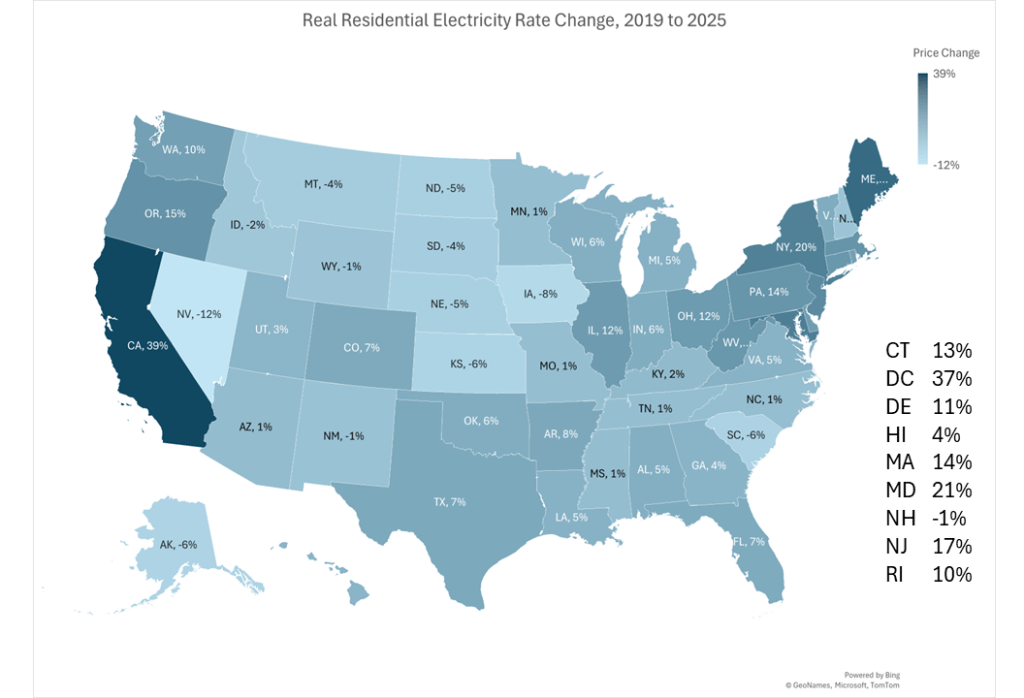
A geographical analysis of electricity prices published this week points out the fragmented nature of the affordability crisis. 2019-2025 price increases varied widely by state, with increases in California and the broader Northeast driving much of the national pattern. While prices tend to lag and there’s some indication that increases in other regions are catching up, it’s interesting to note the variance in explanations – at least to date – for what’s usually framed as a national trend. — Willow Latham-Proenca
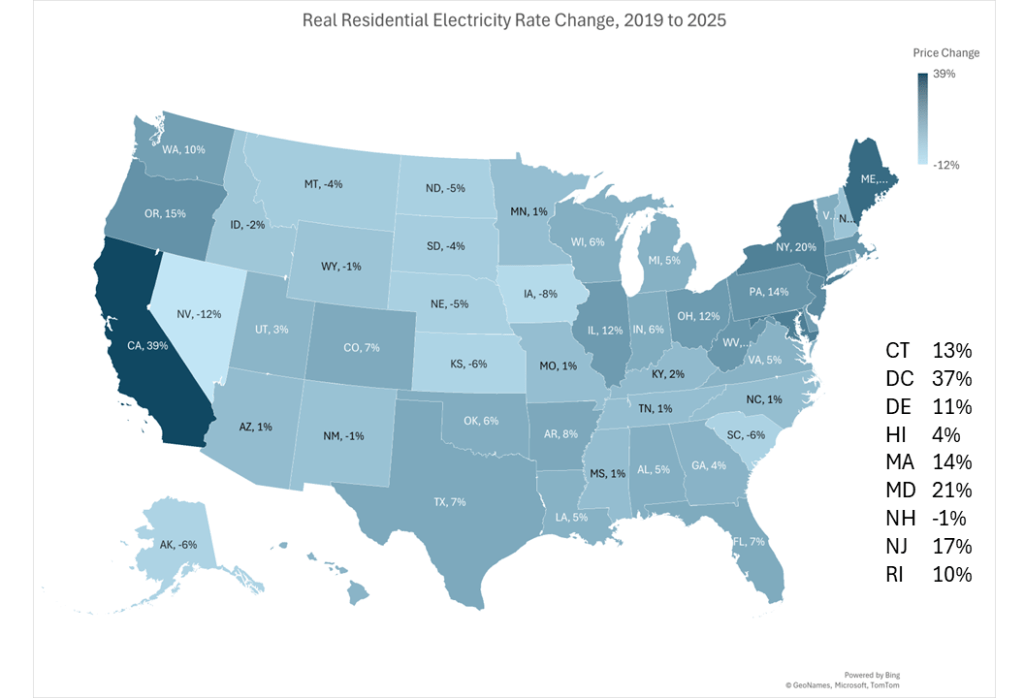
Figure from “Locating the Electricity Affordability Crisis” Much of NEPA’s power to slow down project timelines comes from the lawsuits it enables. Litigation doesn’t just slow down projects directly - it also incentivizes agencies to spend time “bulletproofing” their environmental documents before projects can even start, and the threat of lawsuits makes all projects riskier, keeping some potential developers out of the market altogether. In a recent piece, Samuel Roland offers a fascinating historical deep-dive into how NEPA – which never explicitly provides for private lawsuits – turned into a litigation machine. — Willow Latham-Proenca
Institutional Review Boards (IRBs) are meant to protect research participants, but today their fragmented standards often create needless delays. In a new piece for the Institute for Progress, Ruxandra Teslo argues that this bureaucratic inertia isn’t inevitable. She makes the case for IRB reform by guaranteeing federally funded researchers the right to choose any compliant external IRB, creating a public registry of accredited boards, and establishing anonymous reporting to strengthen oversight. The result, she argues, would be faster, more consistent ethical review, that would protect participants while reducing administrative drag. — Saloni Dattani
Most discussions of health care in the US focus on the consumer or demand side: how do we lower drug prices for patients? How do we help the 8 percent of Americans lacking health insurance? How do we make it easier for people with insurance to get care? Those are all important questions, but Ashish Jha, dean of Brown’s School of Public Health and former Covid-19 czar under Biden, makes a compelling case that they’ve overshadowed equally important questions about supply: are too many hospitals and practices merging? Are we letting enough hospitals be built, and physicians be licensed? Are insurance payments incentivizing waste? Jha is starting a series of essays on these questions, and while the intro is light on details, I’ll be checking back in regularly. — Dylan Matthews
When drugs lose patent protection, the incentive for large-scale clinical trials of new indications dries up. A recent working paper estimates that hundreds of new uses for existing drugs have gone undeveloped as a result. Writing for the Good Science Project, Nicholas Reville proposes an NIH High-Leverage Trials program to fill this gap. The idea is to create infrastructure for running publicly funded Phase III trials of off-patent drugs and supplements. He points to some interesting precedent, including the 2002 Best Pharmaceuticals for Children Act, which empowered NIH to identify and study high-potential off-patent drugs; and he identifies a few dozen candidate trials and some strategies the program could use to run them more efficiently. — Jordan Dworkin
Last week’s science appropriations news was encouraging, but a Nature feature this week documents the damage done over the last year: almost 8,000 grants were terminated or frozen (2,600 of which have not been reinstated); science agencies lost roughly 20% of their staff; and although spending caught up to expectations, the number of new grants issued by NIH and NSF fell by almost a quarter. And even with strong appropriations, some threats remain. A separate Nature piece reports that 13 NIH advisory councils are on track to have no voting members by the end of the year. If that happens, new awards at those institutes could halt. — Jordan Dworkin
Finally, let’s zoom out to a big question: is progress slower than it could be, because too many people don’t believe progress is possible? I’ve wondered about this for awhile; in 2024 I wrote about the decline in positive, future-oriented writing around the world, which seems at least somewhat correlated with a slowing pace of economic growth. But which way does causality flow? A new paper about an experiment in raising ambitions about the future is interesting, when seen in this light. In a remote part of Ethiopia, economists showed a random subset of the population some documentaries about people like them working hard to achieve more material prosperity (control groups saw entertainment programs or just got a survey). Five years later, the authors find surprisingly large positive impacts on work levels, schooling for kids, and more, for the group that saw the aspiration-raising documentaries. I wouldn’t extrapolate too much from any single study, but it joins a host of other papers that show how ideas around what it is possible to do with your life matter. – Matt Clancy
To close, over at The Good Science Project, our own Jordan Dworkin and Stuart Buck debated Jordan’s recent white paper on how to realize a high return on investment when funding replications.