


We've been diving into everything from wage premiums to immortal jellyfish this week. Here's what caught our attention:
David Card, Jesse Rothstein, and Moises Yi had a cool study published last year to try and get a reliable estimate of the wage benefits you get from living in a superstar city. You might think you can tease this out by just looking at wages in one city and comparing them to wages for the same kind of work in another. But this doesn’t work so well if the workers differ across cities - if more productive workers migrate to superstar cities, then that means the wage comparison is conflating the wage premium associated with the worker and the wage premium associated with the place. So Card and company instead look at how a worker’s wage changes when they move from city to city (even that makes it sound simpler than it really is!). They find coastal cities like New York, the Bay Area, and Washington, DC, pay a wage premium of 10-18% relative to the average city, though those gains are mostly offset by increases in the cost of living (especially housing). — Matt Clancy
This year’s remarkably bipartisan burst of federal housing policy legislation is back in action after the earlier breakdown of House-Senate talks: The House has put their package on the calendar this week, and the Senate is exploring floor time this month. This fresh NYT coverage provides a useful, highly simplified introduction to the two packages if you’re tuning in for the first time. — Alex Armlovich
Why is it so hard to build enough electricity supply to meet surging demand? A new draft paper from Joshua Macey and Lynne Kiesling argues that the current regulatory system creates perverse incentives for incumbents to keep supply constrained. Utilities that own both transmission and generation have reason to slow-walk competitors in interconnection queues or hold up new transmission. Incumbents control planning processes and cost allocation, deciding where new lines get built and who pays. And rate-of-return regulation rewards capital spending rather than system performance. The fix, they argue, is to separate out the parts of the system that are still true natural monopolies and reintroduce competition in the parts that aren’t - reducing opportunities to “ration by process rather than price.” — Willow Latham-Proenca
Here at AGF we care a lot about ensuring basic scientific research gets funded and conducted well, and this piece in Works in Progress by Aria Schrecker is a nice illustration of why that kind of work can matter in achieving a prosperous, healthy future for humans. Schrecker examines the characteristics of species that can outlive humans: lobsters, quahog clams, “the immortal jellyfish,” Greenland sharks, Aldabra tortoises, bowhead whales, and naked mole rats. That’s an astonishingly diverse list, including vertebrates and invertebrates; aquatic and land animals; mammals, fish, and reptiles. But Schrecker argues that some of the things they have in common, like slow metabolisms, could hold useful lessons for human longevity. — Dylan Matthews
It’s admin burden week in the AGF Innovation Policy vertical. Let’s start with the good: last week the NIH announced that they will no longer consider “Basic Experimental Studies Involving Humans (BESH)” to be clinical trials. Since 2014, these studies – broadly, interventional experiments designed to produce fundamental knowledge about biology or behavior, rather than directly inform health or treatment – had been subject to the same policies and requirements as full clinical trials. From a neuroscientist: “The fact that collecting EEG data from healthy young adults while they did a simple visual memory task was considered a ‘clinical trial’ made a lot of our research a lot more difficult. I’m very happy to see this is no longer the case.” — Jordan Dworkin
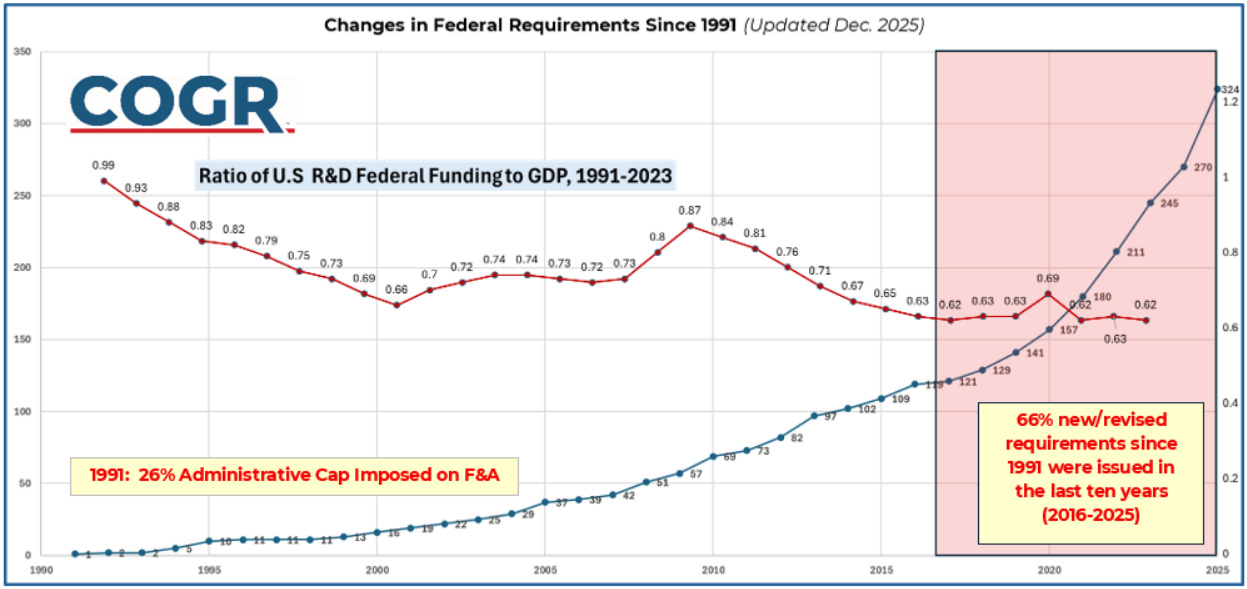
Now for the ugly: a few days ago the Council on Government Relations released a new report on research regulations; they find that 66% of new or revised requirements since 1991 have been issued in the last 10 years, with 2025 showing the biggest year-on-year increase since their measurement began. Over on Twitter there’s some interesting discussion about how these numbers should be interpreted (some of the new regulations replace existing ones, some might be intended to reduce burden rather than enhance it), but the top-line interpretation seems to hold: the administrative and compliance burden on researchers is increasing rapidly. — Jordan Dworkin
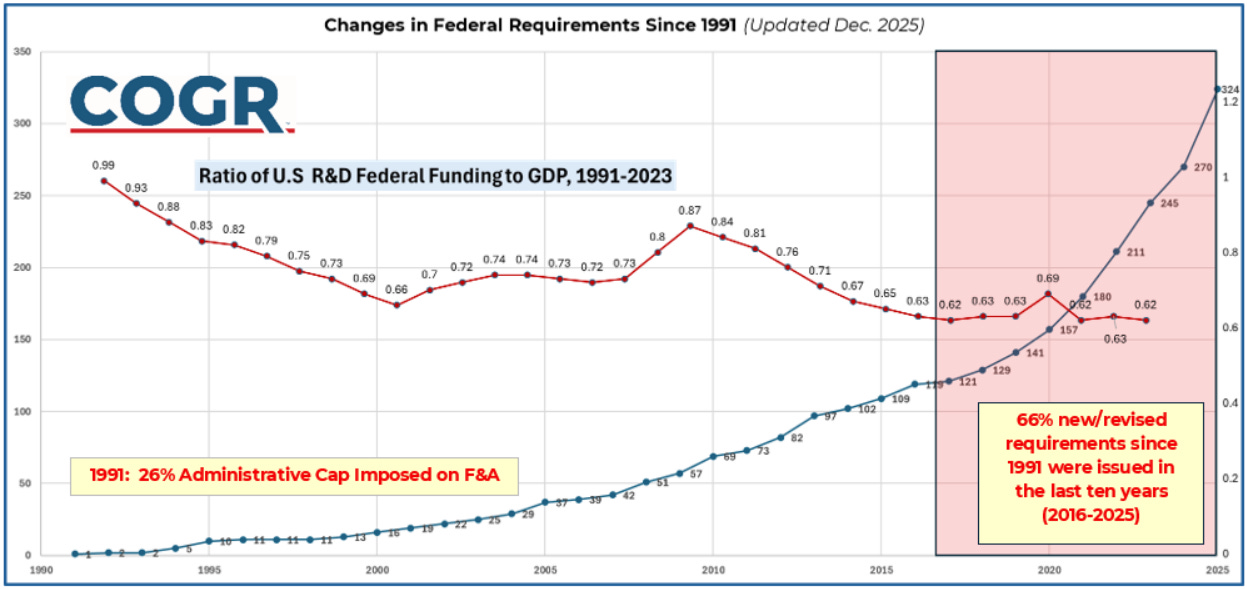
Figure from COGR’s “Changes in Federal Research Requirements Since 1991” AI makes it easier to do good science, but it also makes it easy to churn out junk papers. Late last month, arXiv, under strain from a rapid increase in submissions, changed its policy to block new university-affiliated authors from submitting their work to the site, unless they were personally endorsed by existing arXiv authors. For some thinking about how this all shakes out, Oliver Hanney (managing editor at VoxDev) has an interesting post on the future of scientific communication. Rising in importance for Hanney are curation, academic influencers, direct contact, living documents and more. This resonated with me and a lot of the thinking behind our program to support living literature reviews (not too late to submit an application; we’re reviewing for the next batch in the next few weeks!). — Matt Clancy
We also wanted to celebrate some exciting announcements from a couple of our grantees this week. Adam Kroetsch launched a new research project, the Clinical Trials Efficiency Project, where he’ll be thinking about systemic reform and collective action around clinical trials. Another grantee, Ruxandra Teslo, will be focusing on Clinical Trial Abundance work as a Fellow at Renaissance Philanthropy. We’re excited to support multiple grantees who are fully focused on this important work!