


Hope you’ve had a good February! Here’s what we’ve been reading:
“It is simply remarkable how robust public support for skilled immigration is.” Alexander Kustov takes a look at research on the US and abroad, and points out that despite all the rhetoric, support for skilled immigration remains very high (including on the right). Kustov argues this is because people intuitively grasp the argument that bringing in skilled workers benefits the receiving country. If it’s so obvious though, why do we have so many restrictions on skilled immigration? There are a lot of reasons, but a factor in our current climate is that the vocal minority opposed to skilled immigration (as well as immigration in general) is concentrated on the right, which gives that consituency disproportionate influence when the right is in power. Meanwhile, the left has tended to focus more on the humanitarian case for immigration, leaving the pragmatic argument for skilled immigration more neglected. — Matt Clancy
One exception to the generalized support for skilled immigration, however, is support for a specific visa, the H-1B, among US tech workers (see the previous link for some discussion). A recent analysis by George Borjas argued that H-1B workers were paid, on average, 16% less than comparable natives, which provided one argument for the new $100,000 fee for H-1B visas. However, a new analysis from the Economic Innovation Group argues this analysis did not actually compare like-for-like jobs: most importantly, Borjas’ sample of H-1B workers spans 2020-2023, while his sample of native workers wages comes from 2023. Even if H-1B and native-born workers were paid the same in each year, wage growth (via economic growth and inflation) would mean a sample of wages from 2023 would be higher than a sample from 2020-2023. When EIG compares only 2023 wages of H-1B workers to native born workers in that year, there is still a wage gap, but it falls to 7.5%; this falls even further when EIG makes some additional reasonable tweaks. Finally, they show that the wage gap varies considerably across workers: young workers with newly minted PhDs (for example) tend to be paid more than native born counterparts. — Matt Clancy
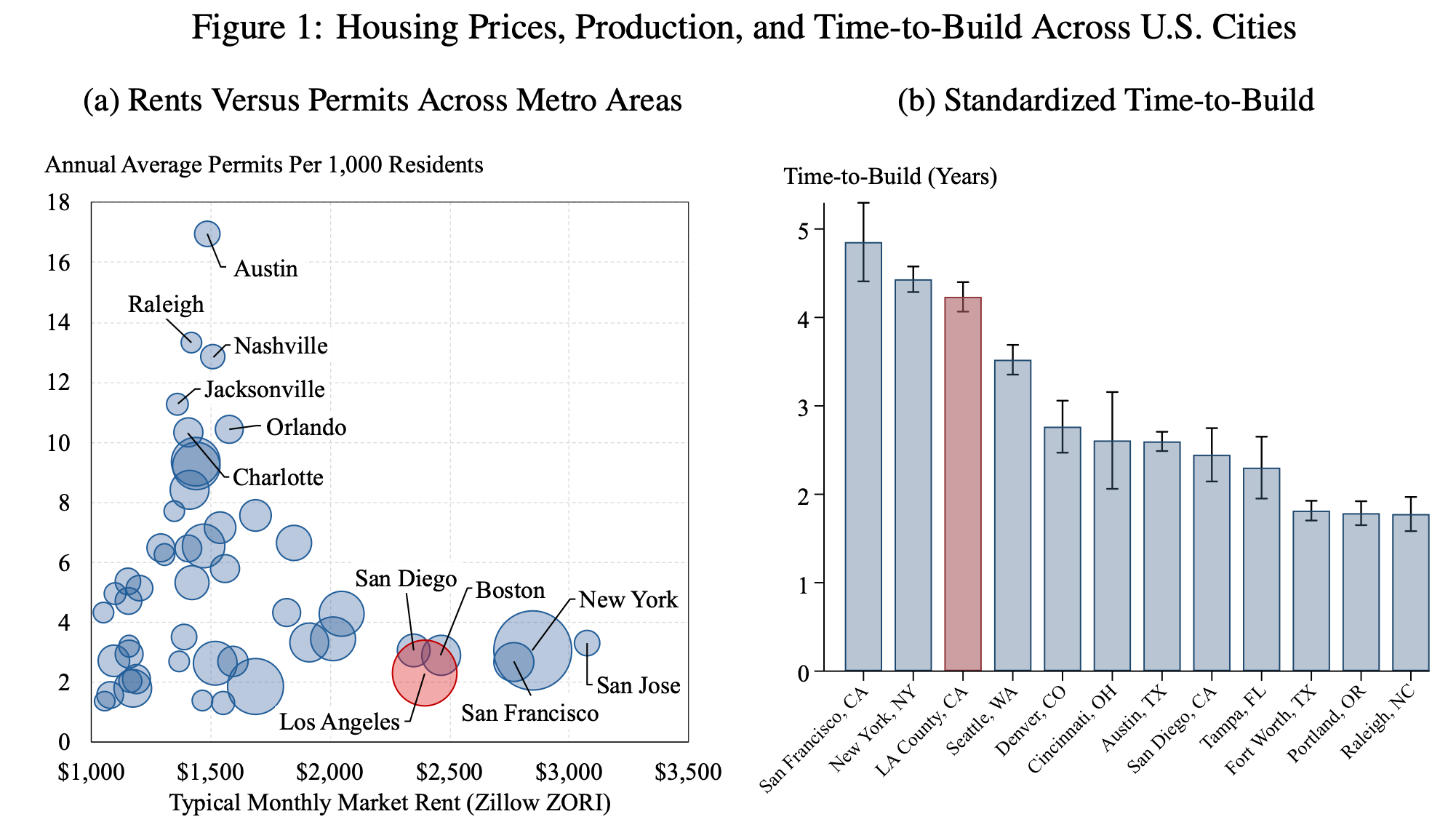
How much do permitting burdens raise the price of housing? This is a big question in our housing work, and it can be hard to measure the exact contribution of zoning applications, historical preservation review, and other permitting processes to our housing shortage. Princeton’s Evan Soltas and MIT’s Jonathan Gruber found a clever way to get at the number: compare land in Los Angeles that’s pre-approved for development to land that isn’t pre-approved, and see how much permit approval raises the price of land. The answer: it raises the price by 50 percent! — Dylan Matthews
Tokyo is the world’s largest city, with 38 million people sharing one agglomerated labor market. Despite high land prices, Tokyo’s structure rents are remarkably affordable by global megacity standards; they allow high densities and build far more new homes on a per-capita basis than peer megacities in the English-speaking world, inspiring NYC Mayor Mamdani and many other YIMBYs on the left and right. How do policy elements like land use regulation, moderate rent regulation with vacancy decontrol, and publicly subsidized construction work in Japan? The US-Japan Foundation offers Lessons from Japan: Improving US Housing Outcomes. — Alex Armlovich
Sometimes a pro-housing reform’s most articulate communicator is that reform’s biggest opponent. In a remarkable video, NYC Councilmember Vicky Paladino describes how New York’s pro-housing ballot measures have ended the “member deference” housing vetoes that are typically inevitable in city councils with single member districts. (Though member deference is impossible in at-large city council charters, and at-large charters can be combined with Ranked Choice Voting to satisfy the Voting Rights Act free of district-based residential segregation, NYC voters just achieved similar results through an override board with citywide officials.) — Alex Armlovich
On the trend of surprising public opinions, solar is remarkably popular among Trump voters, according to two MAGA-aligned polls released this month. The first, a survey run by Trump’s head campaign pollster, found 51% of GOP+ voters support utility-scale solar, jumping to 70% when panels are American-made. A second, this one from Kellyanne Conway’s firm, found 75% of Trump voters across five red / swing states agree that solar should be used to strengthen US energy supply. Both are helpful illustrations not just of solar’s bipartisan appeal, but also how central affordability and reliability are to the story. In a depressing counterpoint, Ysabelle Kempe shows that the broader trend of GOP solar support may actually be heading down – underscoring the importance of getting common-sense reforms over the line before solar becomes another culture war casualty. — Willow Latham-Proenca
There was a good back-and-forth on NIH funding in the Good Science Project last week. Aishwarya Khanduja and Stuart Buck first made the case that science funders would benefit from adopting some VC-style practices, then former NIGMS director Jeremy Berg responded. The most interesting disagreement — whether grantees are functionally locked into their original grant scope, or have flexibility to adjust relatively nimbly — highlighted how useful these exchanges can be. Berg clarified that, in practice, researchers can and do follow the science where it leads without bureaucratic pre-approval. Pair that with the common observation that researchers often apply for projects they’ve effectively already completed so they can use the funds for the next thing, and R01s start to look more like “person-based funding” than the metascience community gives them credit for. Of course, that’s not to say expansion of actual person-based funding is not worthwhile! But we have limited bandwidth to push for large-scale reforms; exchanges like this help us figure out where the system is actually stuck vs where it’s perhaps working better than some think. — Jordan Dworkin
STAT reports on a growing number of state-level science funding proposals. Massachusetts’ governor has proposed a $400 million DRIVE initiative, a coalition of medical schools and researchers is pushing New York to create a $6 billion Empire Biomedical Research Institute, and Texas voters already approved $3 billion for dementia research modeled on CPRIT (which has disbursed roughly $4 billion in cancer research grants since 2009). Jeff Alexander and Ivy Estabrooke frame the efforts in a recent Science editorial: state involvement in science funding can make institutions more resilient and provide an outlet for experimentation with funding design, but they are no replacement for federal support. — Jordan Dworkin
The rise and fall of DOGE was an interesting state capacity story to me on a number of dimensions: DOGE cuts threatened to undermine state capacity in a number of ways; it was pitched as a way to bring in outside tech expertise to boost state capacity; it was an attempt to show that at least a small arm of the state could build the capacity to bring the whole budget to heel. If it was the latter, though, it totally failed, and that meant that prominent tax economist Alan Cole made himself $128,000 by betting his entire life savings that DOGE would fail to reduce federal spending. Congratulations, Alan! — Dylan Matthews
Meanwhile, some updates from our team and grantees:
For the last few months, our team has been collaborating with the Alfred P. Sloan Foundation to stand up the Pop-Up Journal Initiative, a new publication model chronicling and spurring progress on a single important policy question over five years. The first journal will be on the “Griliches Question”, which asks what societal return-on-investment we can expect from R&D. We’re pleased to announce that the National Bureau of Economic Research will serve as the host organization for this first pop-up journal. The project will be co-led by Tim Simcoe and Craig Garthwaite, and over the course of five years will include an annual research conference, the commissioning of original papers, an up-to-date synthesis of the state of knowledge, and annual tracking of how expert views on this question are evolving in response to new evidence. As part of this effort, we are also collaborating with the Sloan Foundation to support research that will advance our understanding of the returns to R&D investment. If you are interested, you can find more details in the Request for Letters of Inquiry.
Our grantee Sightline Institute has been advancing a “funded inclusionary zoning1” model that captures the social benefits of income-mixing without suppressing new housing production. A bill inspired by their approach just passed the Oregon Senate.
Finally, Dylan Matthews published What Gilded Age America and 1960s police can teach us about state capacity exploring how governments can build the capability to deliver on ambitious goals.
“Inclusionary Zoning”, the requirement for new housing builders to provide non-market housing, usually without any public subsidy, is a controversial and partisan topic in US housing policy. Although income-mixing at the zip code level has quantifiable & causal external social value–call it the “Chetty Externality”--the tendency of IZ programs to require below-market housing without funding acts as a tax on new housing that tends to suppress housing production (sometimes by well-meaning accident, sometimes intentionally by NIMBYs). The only exceptions are when the targeted IZ rent happens to coincide with the already-feasible market rent on a project, or when the gap between feasible rents and IZ rent target is publicly funded.
That's very encouraging polling on solar. Hopefully when Trump 2.0 is over, we can get an administration that doesn't try to prop up coal at least.
On an off-topic note, I was very surprised to see folks like Richard Evans and Tyler Cowen involved in this interactive tool on the economic implications of medical research targeting the biology of aging: https://silverlinings.bio/?chapter=about
Abundance and medical research on aging biology fit well together in my opinion, as increased healthy lifespan and decreased age-related illness/disability is a very special form of abundance. Clean energy, safe housing, health, and more scientific breakthroughs can all be related somehow.
Never bet against an increase in federal spending. Love the prediction market story. Sound the nerd victory klaxon!