


Here’s what caught our attention over the last week:
Legalizing manufactured housing requires legalizing starter homes — Alex Armlovich
The cascade of rigidity — Nisha Austin
Willingness to pay for faster clinical trial approval — Matt Clancy
Should more of us be theoretical biologists? — Saloni Dattani
Willow is on holiday this week.
Legalizing manufactured housing requires legalizing starter homes — Alex Armlovich
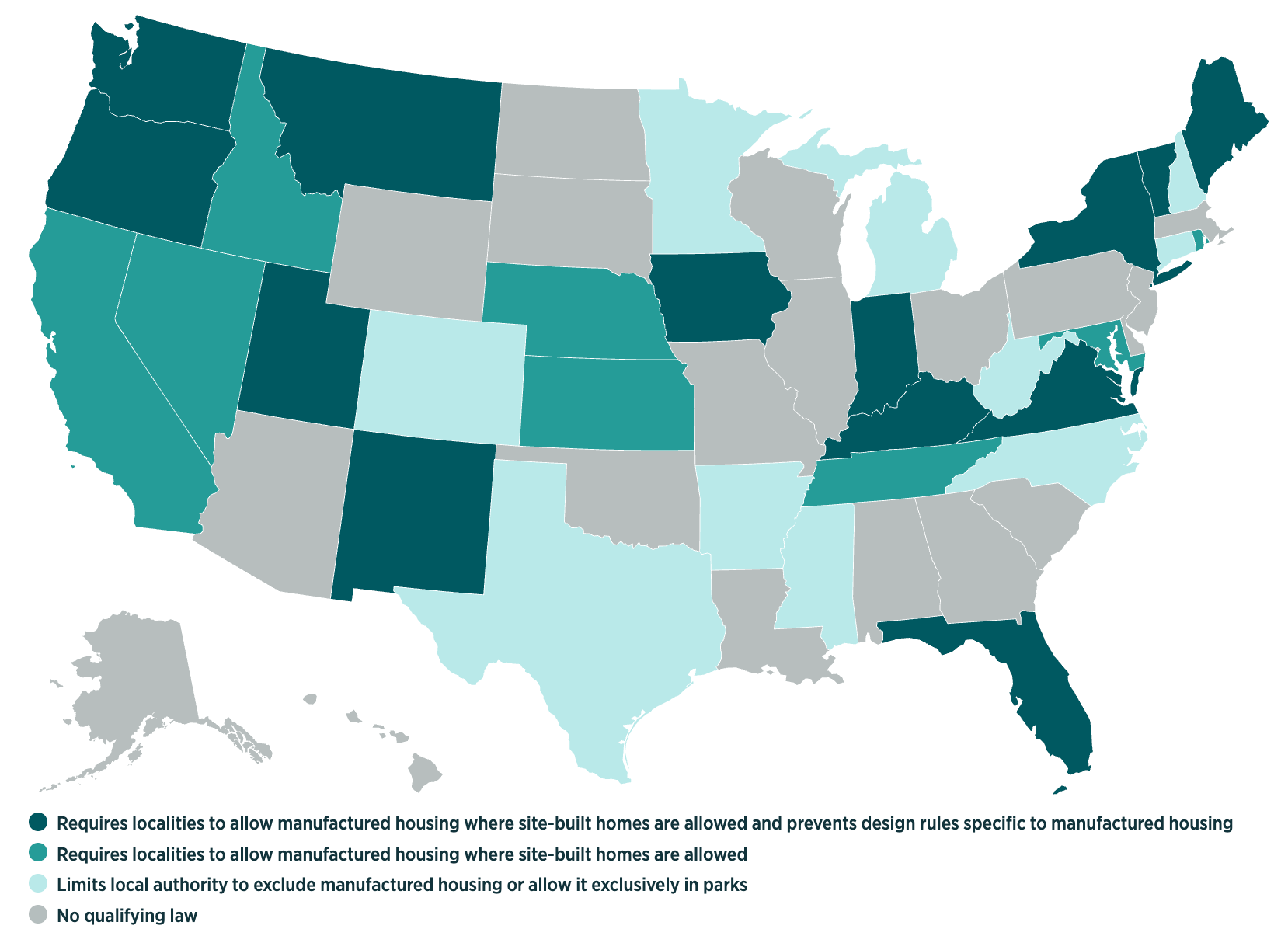
Emily Hamilton at Mercatus has a new policy brief on the key zoning reforms needed to make HUD Code building code reform work: if a town has zoned out starter homes, it has zoned out manufactured housing. Twelve states have passed laws since 2020 to make HUD Code homes easier to site, and the cost advantage is real: a single-section home runs 65% cheaper than comparable site-built housing, a double-section 40%, and a CrossMod 27%. But in the three states with the strongest equal-treatment laws, manufactured housing's share of new construction showed no visible jump afterward, in substantial part because nondiscrimination against HUD Code starter homes is perfectly compatible with bans on all starter homes. Pairing National Zoning Atlas data with FHFA land values, Hamilton finds that land cheap enough to support a single-section home ($47,000 for the lot under a $94,000 house) covers 0.77% of zoned land in Middle Tennessee, 0.89% in Hampton Roads, and 0.02% in Northern Virginia under current minimum lot sizes. Cut minimums to 1/16 of an acre and those shares rise to 12.8%, 5.3%, and 1.8%. The ROAD Act's chassis fix widens the HUD Code cost advantage…but only if those homes aren't also bundled by zoning law with an unaffordably large parcel of land.
The cascade of rigidity — Nisha Austin
I was excited to see America.gov launch yesterday, and happened to be reading How to peel a banana by Marina Nitze this week. There’s a nice parallel between being able to access the right information and the information itself being right.
Nitze writes about the “cascade of rigidity” which she defines as what happens when “each layer of government interprets the layer above it a little more stringently than the one before… rules only ever get added and calcified, never taken out or relaxed”. She uses the foster care licensing standards as her primary case study and talks about how HHS published model foster care licensing standards in 2018 with the explanatory context stripped out, states copy-pasted them, and created situations where care providers were disqualified under rules that didn’t make sense (e.g. a grandmother on tribal land being disqualified because she didn’t meet a recycling requirement but the land she lived on did not have recycling service). Nitze and her team figured out how to work with the system: they worked with HHS to make separate standards for kin legally permissible, and then published better model standards themselves, letting the same copy-paste machinery carry them; 39 states and 6 tribes had adopted them so far.
Willingness to pay for faster clinical trial approval — Matt Clancy
One important reason why accelerating clinical trials is a good idea is that we want people to get access to new medicines sooner. But another reason is that there is a robust literature that shows pharma companies do more R&D when it is more profitable to do so. Shorter clinical trials mean firms can make money off their drugs for a longer time before their patents expire, and all else equal, this should induce more research that leads to new drugs.
Just how much does faster approval increase profits? Priority Review vouchers provide one line of evidence on this question. Priority review vouchers allow the holder to get an expedited review of a drug, shortening approval time by about four months; they’re issued to induce organizations to develop certain qualifying drugs. Drug sponsors can sell these vouchers to each other, and the price a pharma company is willing to pay for a voucher gives a window into how valuable a four-month speedup in drug approval is. Writing for Nature Reviews: Drug Discovery, a recent short article by Ridley and Xu find the typical price firms are willing to pay for a review voucher was about $100mn between 2019 and 2024, but has climbed to about $200mn in recent years. For the drugs that obtained vouchers, they also look at sales data and attempt to model the value this speed up provided to the holder. The average value, in terms of increased sales from faster market entry, is a little over $500mn. But the returns are highly skewed: three drugs probably made more than $1bn in additional sales from accelerated approval, but several others earned less than $100mn. Even so, they estimate more than half of drugs with a voucher earned an additional $200mn from the voucher, double what the going price for a voucher over the last few years.
Should more of us be theoretical biologists? — Saloni Dattani
‘Biology is more theoretical than physics’ was the provocative title of an article several years ago that laid out some examples of biological theories that preceded or predicted the discovery of important entities in advance, including genes, receptors, enzymes, tumor suppressors. Entire processes in biology were also theorized before their discovery, including how neurons function and carry out computations; how the inheritance of genes is sometimes linked to that of others; and ‘clonal selection’, the process by which immune cells multiply after matching with antigens to respond to an infection.
In a new piece for Asimov Press, Ulkar Aghayeva writes about why theoretical biology hasn’t had as much recognition, whether it’s harder for theories to be developed and tested due to the complexity of biology, and about some of the impacts that this theoretical work has had, including inspiring entirely new fields of experimental work. It seems to me that a huge amount of biology traces back to ideas that had previously only been theoretical, extrapolated from a couple of observations here and there, before being tested, refined or overthrown. And sometimes, even theories that were once cast aside have made a comeback decades later, like innate immunity, which was basically forgotten for about eighty years. Perhaps more of us should be theoretical biologists.
Here are a couple other highlights from our team:
Matt appeared on Macroscience to discuss science policy and the returns to R&D investment.
Saloni published an interactive clinical trial bottlenecks game, letting readers walk through the tradeoffs and constraints that slow down drug development.