

If happiness equals reality minus expectations, there are two ways one might go about increasing happiness: improving reality, or lowering expectations.
In our work, we focus on the former, trying to improve the lives of people around the world by making housing more available, energy more abundant, and health more secure. To date, we have not funded the Institute for Lower Expectations (though they keep asking). That focus will continue. But to fully capture the value of improving reality, it is important to step off the hedonic treadmill every now and again, take a breath, and reflect on how far we’ve come.
There’s a bit of this thinking in the air these days. My colleague Matt Clancy wrote a piece last year exploring how new technology improves his own life; Charles Mann published a six-part series in The New Atlantis showcasing the complex, awe-inspiring societal infrastructure that many of us take for granted; he and Virginia Postrel also recently started a podcast, called Everyday Abundance, with a similar goal; and Jerusalem Demsas and Kelsey Piper wrote about all of the seemingly small joys of modern life that past generations couldn’t dream of.
In that piece, Kelsey writes, “I try — once a year or so, perhaps around Thanksgiving — to surround myself with the thoughts of all the people who have ever lived. Almost every single human who has ever lived was very poor. With them accompanying me, I walk through my house and try to see it through their eyes.” While she was drafting those words, I was working on a project to help people do exactly that.
The limit of human felicity
In their Everyday Abundance episode on music, Charles and Virginia highlight this quote from an 1888 novel by Edward Bellamy:
[I]f we could have devised an arrangement for providing everybody with music in their homes, perfect in quality, unlimited in quantity, suited to every mood, and beginning and ceasing at will, we should have considered the limit of human felicity already attained.
I find this sentiment breathtaking. Less than 150 years ago, “accessible music in the home” was a dream that some felt would represent the absolute pinnacle of human happiness; for most of my adult life, I have been able to listen to much of humanity’s discography whenever I like, and, without necessarily realizing it, I’ve used that privilege to make cherished memories, deepen relationships, and better understand myself.
Day to day, I find it difficult to conjure that sense of awe and appreciation. But Bellamy’s quote got to me, and I wondered whether similar historical expressions of hope, relief, and joy for the things we now find commonplace might help more people access those feelings themselves.
My attempt to capture those sentiments is ordinaryabundance.com.
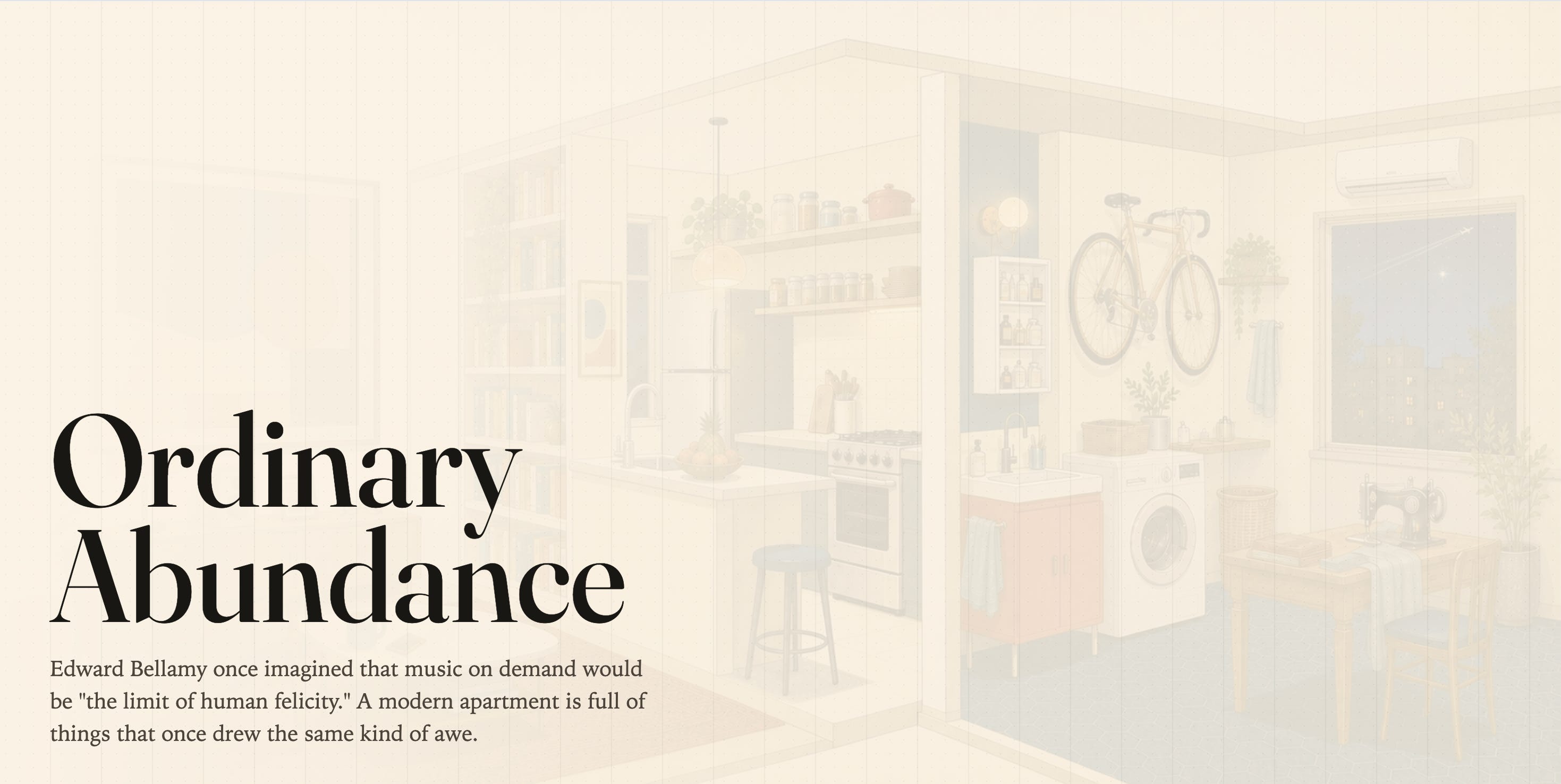
The core of the site is a tour through past perspectives on our modern amenities. I loved hunting down these quotes, so if you know of any others that deserve to be highlighted, please do reach out (or comment here). I hope you take a look, and if you crack a smile next time you do a load of laundry I’ll call it a win.
For now, I’ll leave you with the closing paragraphs of the site, and what I personally took away from this exercise:
It is to humanity’s credit that we remain restless in the midst of all of this progress. We continue to look forward, pushing the frontier further with new treatments, new tools, and new institutions that will help future generations in ways we can’t even picture yet.
But our lives today are a gallery of past generations’ heroic efforts to do the same. It serves us, and honors them, to recapture whenever possible the old sense of awe at these wonders that have long since become commonplace.
This is awesome and I love the concreteness of it. It’s almost the inverse of a memento mori - a reminder of the sheer infinitude of life, its almost banal fecundity of possibility.
Thanks for writing this, and the website is gorgeous. I loved Charles Lamb's quote about the pineapple!
"Like lovers' kisses, she biteth — she is a pleasure bordering on pain from the fierceness and insanity of her relish."
Made me dash out and grab one!