


Here’s what caught our attention over the last week:
What federal siting did for gas pipelines — Willow Latham-Proenca
The visa gauntlet — Matt Clancy
Fast track to nowhere — Saloni Dattani
Candidates won, measures lost — Nisha Austin
The tools behind the discoveries — Jordan Dworkin
What federal siting did for gas pipelines — Willow Latham-Proenca
A classic talking point for energy wonks and dilettantes alike is the difference between how natural gas pipelines and transmission lines are sited – while gas pipelines enjoy federal siting authority, transmission lines must muddle through state-by-state approval processes. While it’s pretty clear that a one-time federal approval would be the faster option, there’s surprisingly little evidence on how much improved federal siting would actually move the needle on transmission.
A new paper from Zachary Liscow, Joseph Shapiro, and Heidi Williams digs through newly digitized federal and trade data on the best historical analog we have – the 1947 Natural Gas Act amendment that established federal siting authority for interstate gas pipelines (technically, eminent domain authority for federally-approved lines). The results are striking, even visually – annual additions to gas pipeline mileage grew nearly 6x after the reform, while oil pipelines, which were not directly affected by the amendment, maintained their pre-reform trend (a 1954 amendment changed the way pipeline data was collected, so the sample cuts off in 1953).
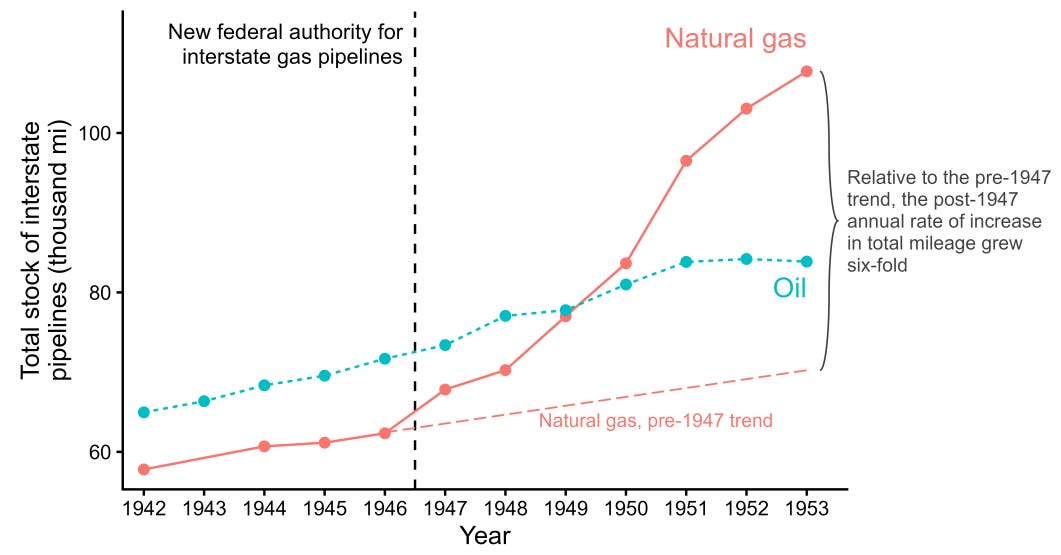
While some of that movement might be attributable to changes in demand for natural gas, the authors investigate this in part by comparing growth in interstate vs. within-state pipelines. The results are again visually indicative, with new interstate pipelines appearing to drive the lion’s share of post-reform growth.
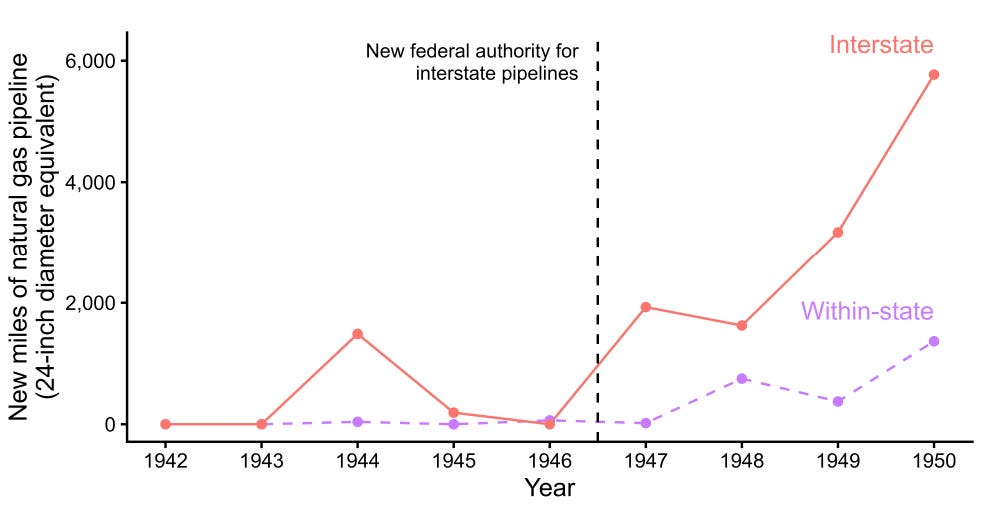
While of course it’s hard to disentangle the many threads of permitting and siting reform, this certainly looks like suggestive evidence on not just the direction but the scale of federal siting reform’s effects.
The visa gauntlet — Matt Clancy
Foreign born inventors account for about 16% of patent-holders, but 23% of patents, and around a third of the citations received by patents (a common proxy for the value of patents). A large share of them come to the US via higher education, where there is a multi-step process to work in the USA. IFP’s Macroscience substack has a good post summarizing all the hurdles the Trump administration has tried to place at each step foreign students typically must complete before they can do science and invention in America.
A common first step is to secure an F-1 student visa to attend a US university. A new “duration of status” policy means these visas, by default, would not last long enough to cover many educational courses (especially PhDs). Students need to apply for an extension when the visa expires before their studies are complete. This rule is on hold while the administration appeals a court decision that found the rule “arbitrary and capricious.”
A common second step would be for a student to do an internship or co-op during their education; international students have been doing this for decades. But in August, ICE announced that foreign students could only participate in internships or co-op programs if their degree program required all students (domestic and foreign) to complete one as a condition of graduation.
After graduation, many foreign students’ next step is to work for 1-3 years in their field of study via the Optional Practical Training (OPT) program. The Department of Homeland Security has proposed a rule requiring universities to pay $70,000 per student for students who want to use the OPT program for one year, with another $30,000 per student for those who extend OPT beyond one year.
After a bout on OPT, many students apply for an H-1B visa (indeed, the majority of H-1B applications come from people on OPT). The Department of Homeland Security has proposed a fee of $103,265 for applicants to H-1B visas that are subject to the national cap (some orgs, like universities and non-profits, are exempt from the H-1B cap and hence the fee). This follows a different attempt last year to impose a $100,000 fee on H-1B visas, which was blocked by courts.
It’s important to note also that whether or not these policies survive contact with the courts, or are overturned by a future administration, or are augmented by additional hurdles, they already work to increase the uncertainty associated with immigration to the United States via higher education. It’s a long journey to immigrate to the United States, and the more uncertain it becomes that you’ll reach your destination, the less appealing it is for people to start the journey in the first place. Notably, a recent survey of 809 universities by IIE found the number of international students declined by 9% from last year.
Fast track to nowhere — Saloni Dattani
Last week, Reuters reported that the FDA has effectively shelved its ‘Commissioner’s National Priority Voucher’ program, which it launched in June last year. Companies can still apply for vouchers but it seems that no new vouchers have been awarded since Marty Makary left his role as the FDA commissioner and applications are no longer advancing.
For context, this program was a spin on previous long-standing priority review voucher programs, which aimed to incentivize drug development for rare pediatric and tropical diseases by providing companies with a ‘voucher’ they can use (or sell) to speed up the review of another drug. In this case, however, the vouchers were meant for drugs that addressed national priorities, were non-transferable, and the drugs were selected directly by the FDA commissioner, then Marty Makary, and his senior leadership.
After Makary announced it last year, STAT News reported that the FDA was ‘flooded’ with applications, probably in part because the eligibility criteria were broad and vaguely defined. Some of the drugs that received it were fairly high profile and important, however, including daraxonrasib (this year’s pancreatic cancer breakthrough drug), orforglipron (the first small-molecule version of a GLP-1 drug), and enlicitide (the first pill version of a PCSK9 drug for cholesterol).
But the program was widely reported to have been politicized, and also probably strained the FDA’s capacity further. And because the vouchers move some drug applications up the queue at the expense of others, the more vouchers there are, the less valuable they become and the less time they save.
Candidates won, measures lost — Nisha Austin
Halina Bennet wrote in Slow Boring about how abundance fared on last week’s housing ballot measures. Every measure that offered financial help passed with roughly 60 percent of the vote or more: bonds in California, Rhode Island and Hawaii, and a property tax exemption in Florida. The measures that changed the rules didn’t do as well. California’s Prop 45, which would have shortened environmental review for some projects, lost by more than 10 points.
Massachusetts Question 7, which would have stopped towns from requiring lots bigger than 5,000 square feet for a single-family home, lost by about a point, despite backing from the governor. Boston, which was exempt, voted for it more than two to one, and so did places like Cambridge, Somerville and Brookline. Most other towns voted no.
At the same time, America practices a form of representative democracy, and candidates who ran on abundance ideas - Nithya Raman, Scott Wiener, James Talarico, or Abdul El-Sayed, for example - did very well. That reminded me of a paper on my reading list by David Broockman and Daniel Butler on what happens when state legislators simply tell constituents where they stand on an issue. As it turns out, constituents tended to move toward the legislator’s position, and it didn’t matter much whether the legislator explained why.
If you know of other good work on whether movements win over the public or elites first, send it my way!
The tools behind the discoveries — Jordan Dworkin
A few weeks ago, Conor Griffin wrote a thoughtful and compelling review of The Engine of Scientific Discovery by Alexander Krauss, which argues that the history of science is primarily a story of tools and methods, rather than experimenters and theorists. For the book, Krauss built a dataset of 761 major discoveries, read the original publications, and found that almost all were enabled by a recently developed tool or method, with a shrinking lag between the development of the tool and the breakthroughs it enabled. Krauss argues that this type of scientific contribution is chronically undervalued, both by the institutions of science and by modern metascience, whose metrics and incentives prize discoveries rather than their underpinnings. He proposes funding for toolmakers, more scientific credit for tooling, and “Methods Labs” where scientists and engineers could do dedicated development of instrumentation and techniques.
In addition to going deep on the ideas in the book, Conor raises some potential counterarguments, and lays out several interesting ideas for what Krauss’s thesis might mean in an era of AIxScience. He suggests that AI might be useful for (1) upgrading existing tools and methods (e.g. improving software, developing efficient surrogate models for slow processes, or improving design of hardware), (2) curating tools and methods (e.g. identifying ideas/methods/combinations latent in the literature but underused), and (3) creating entirely new tools and methods.
But ask not (only) what AI can do for tools; ask what tools can do for AI. What kinds of new methods and instrumentation do we need to maximally leverage AI’s strengths in science? There’s a lot of focus on the collection of large-scale data to enable AI-driven science, but the upstream corollary is that the design and engineering of new forms of data-acquisition instrumentation will become more important. If AI increasingly handles cognitive and analytical work, and data collection continues to receive substantial attention and investment, then building tools/methods to collect new modalities of data will be a natural place for (human) scientific effort and incentives to migrate. If prestige follows that bottleneck, perhaps tool-making will surpass paper-writing as the prized scientific career path sooner and more easily than we expect.
Here are a few other highlights from our team and grantees:
Matthew Meyers joins the AGF team this week!
Alex is at YIMBYtown this week, presenting on the housing reforms we want to help fund, which he wrote up on the blog yesterday.
Coefficient Giving’s Effective Giving and Careers fund has opened a request for proposals for incubating new organizations.
Astera is accepting applications for its spring residency, which supports people working on metascience ideas.
Nick DeVito is hiring a postdoc to work on TrialsTracker 2.0.
Heidi Williams is inviting dissertation-stage PhD students in economics and related fields to a PhD workshop in March in Washington DC on how policies on housing, energy and transportation infrastructure, high-skilled immigration, or R&D affect economic growth.
Companies that built launch plans around a voucher now have a timing gap to manage. Manufacturing scale up, payer dossiers and field hiring were likely sequenced to a faster review. Teams still waiting could stagger those commitments against the standard review clock and keep the voucher timeline as upside.