

The debate over an arcane recent quirk in the urban economics literature has a new installment.
This all started in March 2025, when a SF Fed paper by Schuyler Louie, John Mondragon, and Johannes Wieland made a striking claim: zoning and other constraints to building new housing are not associated with significant demand-conditional differences in housing quantities supplied at the regional level.
The paper finds similar relationships between total regional income growth–which intuitively should be one acceptable proxy for housing demand–and housing supply growth across metros classified as more and less constrained. Consider the figure below, which plots the annual increase in total income in a particular region on the horizontal axis against the annual increase in housing quantity supplied there, on the vertical axis. The blue regions have more constraints on their ability to build new homes, and the red ones less constraints. The authors argue we should observe large differences in supply quantity responses on the y axis, conditional on any given increase in the regional housing demand proxy on the x axis, between these two groups.1
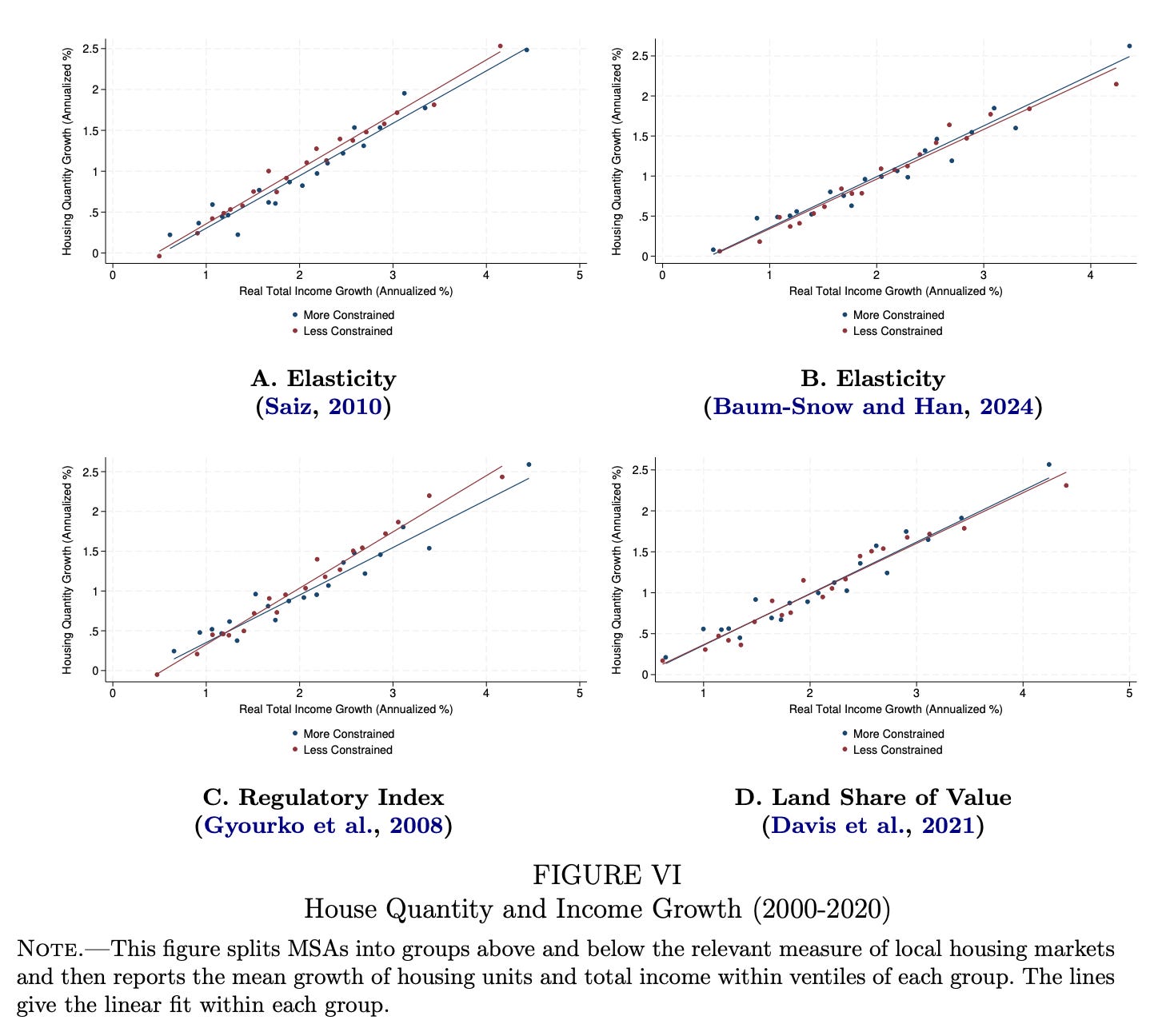
Regional real total income growth means the sum of growth in incomes per resident and growth in total residents. And for this reason, YIMBY practitioners weren’t surprised by the result: most of regional income growth boils down to growth in residents, and it’s not shocking if both SF and Houston add something like 1 more home per 1 new worker: SF just permits very few homes and very few residents, and Houston allows more homes and many residents, but conditional on adding one home, both add similar numbers of residents.
But the counterintuitive Mondragon finding on total income growth and housing supply growth is apparently “only” substantially weakened, not completely eliminated, by looking at income per person in isolation (i.e. after excluding the circular relationship between the number of people who move in and the number of homes allowed, which powers much of the headline result.) If it holds up, this is of nonzero academic interest even if it doesn’t have any real world policy implications for whether or not San Francisco should continue to all-but-ban large multifamily housing construction. There has subsequently been some back-and-forth about the paper’s findings.
Now, in a new October Dallas Fed working paper, Anthony Murphy and Maddie Shaheen push back against the paper. Giving larger metros weights proportional to their size, and examining annual building permits alongside long-run housing-stock changes, the Dallas researchers recover the standard result that construction generally responds more strongly to demand where building is less constrained.
The original SF Fed’s paper’s figure above nevertheless recovers the classical YIMBY finding in another counterintuitive way: it places more-constrained metros on a higher price-growth trajectory at any given rate of housing growth. The counterintuitive part is that the fitted slopes look similar but the intercepts differ. This is more intuitive when phrased in reverse, however: At any given level of annualized real price growth, the bin of more-elastic metros build far more per year than the bin of less-elastic metros.
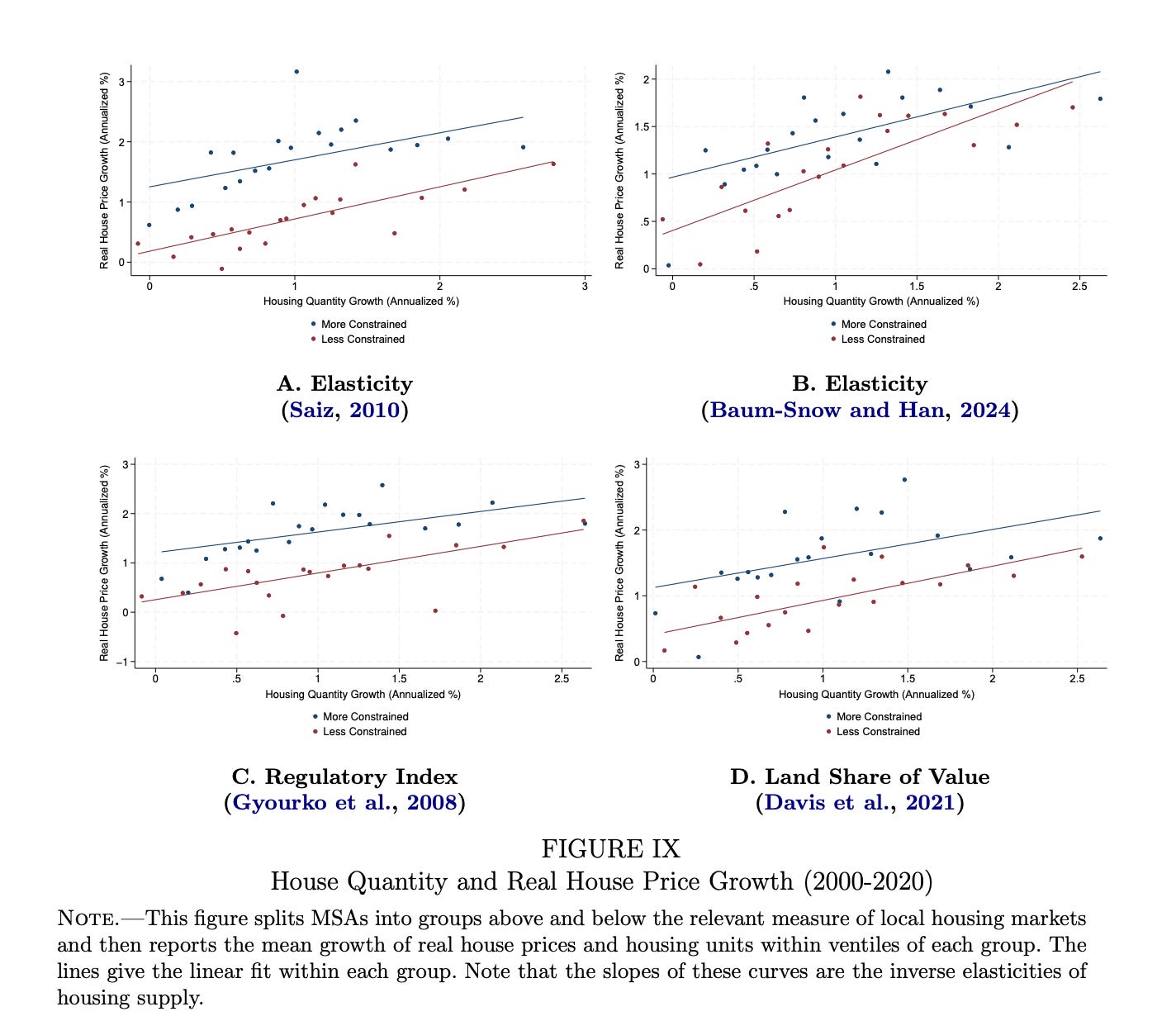
The authors propose an exotic theory of differences in demand for housing quality and amenities, rather than different supply elasticities. I see this as an Occam’s Razor violation: Whenever one observes a product market with regulatory quotas and durable deviations of prices above marginal costs, it’s unreasonable to attempt to develop some novel theory of it that violates conventional microeconomics, rather than keeping ordinary microeconomic reasoning about regulatory quotas as your baseline hypothesis for the explanation.
In sum, the Dallas response gives academic housing researchers substantive new results to assess. Practitioners can follow that debate without yet worrying about the real-world policy stakes: Even the original authors accept the standard idea that an exogenous expansion of supply lowers prices. The contested question in this particular literature thread apparently remains how much particular reforms expand supply, and on a deeper level, how close new multifamily prices really are to marginal supply cost in SF under current fee/exaction/permitting law & building codes.
In the extreme, imagine a city with no constraints on building at all: in such a city, we might think home prices are set at the cost of construction, so don’t change with real income growth at all - when there is more demand for housing, this city just builds more houses at the same cost of construction.