

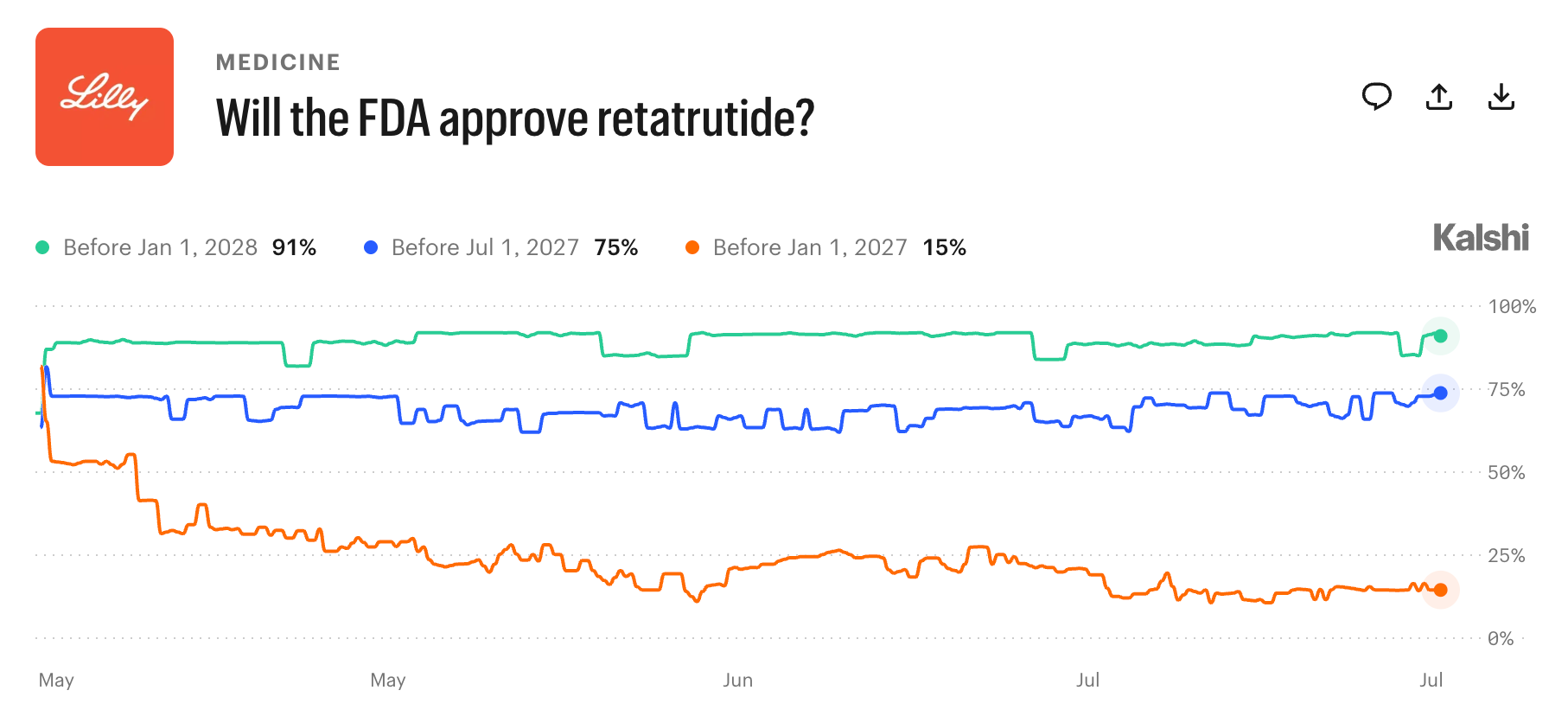
Kalshi, one of the biggest prediction market platforms, announced last week that it has started letting people bet on the outcomes of clinical trials and FDA regulatory decisions. This would make it possible for investors to bet on more specific outcomes – drug approvals and trial results – than on stock markets.
Prediction markets are already ethically controversial because of concerns about insider trading and market manipulation. So Kalshi says that, for now, it will limit the markets to Phase 3 trials after they’ve been fully recruited, and will include some guardrails requiring employment verification to bar insiders like lead investigators, biostatisticians, safety-monitoring committee members, the drugmaker’s own staff, and trial participants from taking part.
But I wonder whether, or how, these markets would be useful. Anne Wojcicki, who runs the 23andMe Research Institute, says the idea is ‘very patient-empowering’ and that they could help people follow trials relevant to their disease, but I think the case is pretty weak: Kalshi says their markets would open only once a trial has finished enrolling, so they couldn’t influence a patient’s decision about whether to enrol, at least in that study; rather, the main change a patient could make based on the market would be dropping out. If that happened, it would make it even harder for trials to retain enough statistical power to reach their endpoints.
That kind of self-fulfilling outcome seems like it would have even more downside in an industry that’s already very conservative and finds recruitment challenging enough. (Maybe some doctors would ask for access to promising experimental drugs for their patients through ‘compassionate use’ based on prediction market signals, but in practice that depends on the drugmaker’s willingness to supply the drug before it’s approved, which is usually pretty limited.)
Still, prediction markets might be more useful to external researchers, investors, and policymakers, in shaping follow-on research or funding around them. They might also help surface suspected fraud earlier, the way some short sellers have done. But, because they would make the stakes more directly linked to each trial, I’d guess they’ll also raise the risk of it happening in the first place. (See, for example, a recent case of statistical manipulation in a high-stakes phase 3 trial that was only uncovered after the drug was approved!)
It’s probably going to become more important to maintain the integrity of clinical trials, with stronger guardrails in blinding researchers and patients in the trial, strengthening regulatory independence, and maybe also requiring researchers to pre-register the full statistical analysis before the trial begins.
I'm not sure betting (with Kalshi) on a Phase 3 trail would benefit patients. Trials are already tracked in clinicaltrials.gov, although, not many outside of pharma/academia know of this. I'm also uncertain how this specific prediction market on Phase 3 trials is different than investing in the stock of the company - the value of which increases or decreases substantially with trial successes and failures. Perhaps I just don't understand these prediction markets, but I don't see how these can uncover fraud in the trial - trials are typically decentralized (performed across multiple sites with independent investigators) with numerous data collection regulations to minimize fraud. That being said, its still possible that fraud may enter the trial, but I just don't see how a prediction market would help in this regard.